Illustrator Interview: Duncan Beedie

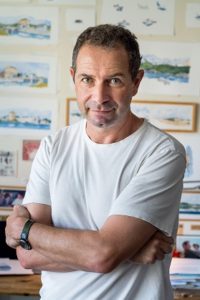
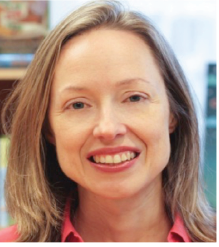
This month’s interview is with author/​illustrator Duncan Beedie, the first UK-​based interview subject we’ve ever had at OPB! Don’t worry, though—I’ve installed a UK-​to-​American-​English translator plugin, so we don’t run into any linguistic snafus!

Let’s borrow some bio stuff from Duncan himself: “I have been doodling and drawing since way back in the early 1980s, lying on my parents’ living room floor, grasping a felt tip in my clammy little fist, through to my current profession, grasping a Wacom stylus in my clammy little fist. So, not much has changed, although I no longer lie on the floor to draw.”

I first learned about Duncan via his picture book, The Lumberjack’s Beard, which I read to my kids and they said, “That beard is bonkers good.” With an endorsement like that, I knew I had to bring Duncan into the OPB fold one way or another.

So, let’s get this interview underway and learn about all things Duncan! With a little luck, we might learn something about that wondrous across-​the-​pond place called the UK, as well.


RVC: Let’s start right where my kids did—that lumberjack’s beard. With a picture book where you’re both author and illustrator, where does the story begin? With a title, an image, a phrase? (It’s the beard, right? You can tell us.) 

DB: I always start with a character design. I consider myself more of an illustrator than a writer, so doodling in a sketchbook always comes first. Then, if there’s a character I particularly like, I start to develop a world for him/​her. I think about that character’s routine, what they might wear or eat, and hopefully a story idea emerges. That was certainly the case with “Big” Jim Hickory in The Lumberjack’s Beard.

RVC: One of the things I’ve noticed in looking at picture books by UK publishers (like Templar Books, which published many of your titles) is that there’s a stylistic difference from picture books from US publishers. What do you think? Do you see it, too? What’s this about?

DB: I’m afraid to say I haven’t looked closely enough at enough US picture books to be able to comment on the stylistic differences (my apologies!) I do, however, notice differences between UK books and their European counterparts. Particularly in terms of the illustration. I also think artists and writers vary incredibly within the UK. I haven’t a clue what accounts for this stylistic difference, but it’s great to see so much variety on bookshop shelves.

RVC: I completely agree. Variety is the life of spice, right? Something like that?

Moving ahead! I always like to know the origin story of a creative. You gave us a wonderful bio nugget in the intro, so let’s jump to another key point in your creative past—your first book. What’s the story behind it? How did it come about?

DB: The Bear Who Stared came about from an illustration as well. One day I drew a gormless-​looking bear [UK translator in action here! Gormless: an informal British word, meaning “lacking in vitality or intelligence; stupid; clumsy”] as if he were posing for a passport photo. I had a printout of it in my studio and would occasionally stare at it–the gormless bear stared back.

Eventually a story about a socially awkward bear formed in my mind. I sketched out a storyboard and sent it to a couple of publishers, and Templar Books replied stating they were interested in developing it. The rest is history, as they say.

RVC: I love the answer, but I confess–that bear’s staring is getting to me now, too! ARGH! Let’s move on as if that bear isn’t still giving me The Look…

Prior to getting into illustrating picture books, you worked in animation for 14 years. How did the skills you learned in that environment inform your work as a picture book illustrator?

DB: Quite simply, animation is a great form of storytelling. In terms of my artwork, it taught me a great deal about the storytelling process. Storyboarding in particularly made me think about pacing a narrative and how to construct a visual composition in terms of using the space available. I still use animation software (Adobe Animate CC) to draw the colour artwork for my picture books. I know there are plenty of other programs out there, but I find it so intuitive and easy to use. 

RVC: In all your experience with picture books, what has surprised you the most?

DB: This might sound weird, but I’m constantly amazed by how bloody nice everyone is in the world of children’s books. Maybe I’ve just been lucky, but there’s a real community spirit among authors, illustrators, and even competing publishers. I say “competing,” but there seems to be a genuine camaraderie across the board. I came into the industry from having worked in TV and commercials, so it was a bit like moving from LexCorp to a puppy sanctuary.

RVC: I understand that you “have a desk” at Paintworks, which seems like an artsy, hipster place with studio/​offices, residential spaces, and an exhibition venue. How much work do you do there? And how does it affect your creative process, having a clear view of the city, as you do?

DB: Well, I see you have done your research!

I rent a desk in an animation studio called Sun & Moon Studios. I’ve known the directors for a long time and they are good friends of mine. We have recently moved to a much bigger studio that is even “hipper,” with a foosball table and “industrial-​chic vibe.” However, I have lost my window view of the city, so have to make do with a photo of it as my desktop wallpaper.

I tried working from home, but it was such a solitary experience that it genuinely impacted my mental health. It’s nice to be able to socialize with fellow creative types.

RVC: What do you think is the most common misconception about freelance illustrating?

DB: That we sit around in cafés with MacBooks, eating artisan poppy seed bagels, whilst wearing gaudy knitwear and big hooped earrings, and stroking cats. Although, like most clichés, there must be enough truth in this scenario to warrant the cliché status.

RVC: Though your description there is a 100% match with every single artist I know, I take your point. It could just be me and my select group here. Who can say?

Let’s talk agents. You’re repped by Jodie Hodges at United Agents. At what point in your career did you secure representation, and how vital is it for young artists to do the same?

DB: I was initially repped by Illustration Ltd (from 2011) and it was great to have a team with their expertise fighting in my corner, as it were. If I do conform to an artist stereotype, it is that I have about the same level of business acumen as a goldfish. A lot of clients (outside of publishing) seem to think of illustration as a hobby and therefore don’t value it for what it’s worth. An agent will fight to get you a fair price and have the gumption to stand up to the cheapskates.

RVC: If I asked Jodie to describe your work, what would she say?

DB: What I love about Jodie is that she has this brilliant ability to communicate what she looks for in authors and illustrators in such a clear yet personable manner–that’s a hugely important asset for an agent to have. As such, I couldn’t begin to put words into her mouth–I’d just ruin it.

RVC: Sometimes I hear people say that you can’t teach people to write. Do you think people can be taught to draw? (Note that this comes from a person who, despite working at Ringling College of Art and Design for a decade, can only draw three things—a bunny, Papa Smurf, and a vaguely three-​dimensional box. Then again, I’m not on the art side of things. Maybe that has something to do with it …)

DB: I’m self taught when it comes to illustration, and I’m always learning. Some people have more of a natural talent that comes through without tuition, while others hone their skills at art college. There’s no right or wrong way, but you should never stop learning new things.

Don’t discount your Papa Smurf drawing skills. They may save your life one day.

RVC: Well, if drawing smurfs can save a life, then thank goodness I’m so good at it, right? I mean, just consider the two images below.

You can barely tell which is drawn by a fancy professional artist and which is done by yours truly, right? I KNOW! It’s amazing what I’ve been able to do without a single art class ever! Can you believe it?

In any case, let’s have one last “serious” question before we move on. And let’s be clear—this might be the most important question anyone has ever been asked in an interview EVER. What in the blazes are “sherbet dib-​dabs”? My much-​ballyhooed WordPress UK-​to-​American-​English translator plugin is stumped at that phrase, which appears in your website bio.

Color/​colour me intrigued!

DB: So, a “Sherbet Dib Dab” is a piece of candy from the UK in the 1980s, which constitutes a pouch of sherbet powder into which one dips a lolly (boiled sweet on a stick). You then lick said sherbet from the lolly and repeat this process until the sherbet is all gone and the lolly has been licked into non-existence.

At school, we used to pour the entire sherbet contents into our mouths so that they frothed up with foam. We then thrashed about on the ground to emulate a rabid fit. There was a genuine rabies scare in the early 80s so this behavior was frowned upon by teachers and parents alike.

RVC: Oh my goodness, I’m SO glad I asked. From your delicious description, the candy sounds a bit like Fun Dip. But without the rabies fakeroo, I think, which I bet made it an extra tasty experience for all involved!

Now … no matter which side of the pond you’re on, this is what you’ve been waiting for. THE LIGHTNING ROUND! Zappy fast Qs and zippy-​skippy As, please. Are YOU READY!?!

DB: Hit me up with those gigawatts! I’m revving the DeLorean in anticipation.

RVC: Best place for fish and chips in Bristol?

DB: Easy! Prince’s in Fishponds. Next…

RVC: Coolest ships–Battlestar Galactica or Buck Rogers?

DB: Presuming you mean the original BG, then that one. Cylon Raiders trounce anything else in the galaxy.

RVC: What secret talent do you have that no one would suspect?

DB: It’s nerdy, but as my dad is a retired air force officer, I was obsessed with planes as a kid. I can identify pretty much any military aircraft at a glance.

RVC: What’s going to keep you up tonight after this interview?

DB: Oooooh, that’s a toughie. I may have to come back to that.

RVC: Best illustrated picture book you’ve recently encountered (by any artist not named Duncan)?

DB: I love Mary Who Wrote Frankenstein written by Linda Bailey and illustrated by Júlia Sardà. It’s a delicious slice of Gothic brilliance.

RVC: Best compliment a kid’s given your art?

DB: It’s not specifically about my art, but I remember after a book reading at a school, one kid ran up to me, hugged me round the legs, then told me he loved me and wanted me to come home with him to be his daddy. You can’t really top that. In fact, that’s probably going to be the thing that keeps me up tonight.

RVC: Thanks so much, Duncan. It was a hoot getting to know you and your work better. (For Duncan and his UK pals, I’ll offer a possible UK equivalent for the American expression “a hoot.” I’d go with “gobsmackingly bloody scrummy,” “tickety-​boo,” or perhaps just the simple but tried-​and-​true “sick.”)

Picture Book Review: Bird Count by Susan Edwards Richmond

1 October 2019
32 pages
This month’s PB review is by Ryan G. Van Cleave (#1 Birder at Only Picture Books) and and Florida-​based author/​illustrator Linda Shute.

–Ryan’s Review of the Writing–

I’m always intrigued when a nonfiction book idea finds a quality story to match, which is what happens here. Instead of giving us “Bird counting happens throughout the world each year at Christmas thanks to the efforts of the National Audubon Society” etc., we get the story of Ava, a kid who loves birds and is excited to participate again this year with her family. Because she’s a kid, we’ve got people around her like Big Al to (believably) help remind her about the rules and best practices. Who knew that a citizen scientist’s most important tools are eyes and ears?

Ava knew, and now the reader does too.

We can tell how special this particular bird count is to Ava because she alerts us to that fact. “I look at Mom and smile. This is my first time,” she says about her being asked to record the names of all the birds they count. What’s especially fun is that the book layout has a spiral-​notebook part to the page where bird names appear as Ava writes them down.

One of the many lessons here is that rules matter. The rules say a bird can’t be counted unless two people see or hear it. So, when Ava sees a mockingbird that “flaps away in a flash of gray and white,” she can’t add it, despite really wanting to. “But Mom and Al missed it. So it doesn’t count.” Don’t worry–she finally sees one later and can add it to the list then.

Richmond’s use of language is compelling, too–especially when trying to capture the noises birds make, such as “Pssshh, pssshh, pssshh” and “mourning doves coo-​hooing.” (The name of that bird is bold as are the names of all 24 types of birds that get counted.)

Part of what give this story a bit of tension is Ava’s hope to see a raven, as she’d done a few years back. Will she see one again this time? She sure hopes so.

Generous but appropriate back matter completes this fine introduction to the world of birding.

4.5 out of 5 pencils


–Linda’s Review of the Illustrations–

On the outside, Bird Count looks like a book for the preschool crowd–large squarish format, simplified head of a young girl on the front. Inside, there is text and information galore. I hope its exterior doesn’t signal second and third graders to pass it by.

The content is presented in wonderfully clear, consistent layouts. Except for the opening and closing, a wire-​bound notebook with the growing list of birds appears on the right edge of the double-​paged scenes of the day. The narrative text is generously line-​spaced, often on ample snowy areas of the compositions. Cheers to Peachtree designer Nicola Simmonds Carmack for the elegant and easily read fonts throughout, the heavy matte coated stock, and attention to details that make this a well dressed and durable book.

Stephanie Fizer Coleman was a natural choice for illustrator. See her “paint a bird a day” for 100 days project at http://stephaniefizercoleman.com/100-birds‑1 Coleman’s page designs are simple with strong elements leading left to right. Figures and faces are stylized, lending a detachment that keeps the focus on the birds and their environs. A palette of soft blue, lavender, and browns provides a subtle background to neutral colored birds. The art is rendered digitally with textures that appear to be brushy, sanded gouache and whites that recall frosty surfaces. The calming hues create a restful bedtime offering. And, for the “look again” reader, there is a rogue great horned owl!

5 out of 5 crayons


Linda Shute is an illustrator, writer, and teacher living near Sarasota, FL. There is never snow in her yard, and most of the birds have very long legs and croak!
See a few at www.lindashute.com.

Picture Book List: 13 Delightful A to Z Books

I’ve been hired to write an alphabet picture book for a community organization (Thanks, Realize Bradenton!), and as part of my research and prewriting process, I’ve inundated myself with dozens of A to Z books. To clear, I have A to Z, ABC, and abecedarian books coming out of my ears. Almost literally!

After reading them for three weeks straight, here’s what I’ve come to believe. The pedestrian ones teach you the ABCs, sure. But the best of them do so much more.

That’s what this bonus picture book list is–13 of the most interesting A to Zs that I found. (Why not 26? you ask, since there are 26 letters in an A to Z. after all. Good question. The answer is this: I’m doing 13. Maybe we’ll do another 13 in a future installment of “Delightful A to Z books.” Who knows?)

Without further ado …


The ABCs of D&D
by Ivan Van Norman and Caleb Cleveland

Talk about indoctrinating your kids while teaching the ABCS! At least D&D is now recognized as being good for you in a lot of ways beyond just plain being fun. (Here’s journalist Ethan Gildsdorf’s Tedx talk on the topic!)


AlphaOops! The Day Z Went First
by Alethea Kontis (Illustrated by Bob Kolar)

Kolar’s bright, lively letters pop off the page and make a great match with Kontis’ clever wordplay. And I must confess–with a last name that starts with V, I’m pleased that we end-​of-​alphabeters might get a chance to go near the front for once!


America: A Patriotic Primer
by Lynne Cheney (Illustrated by Robin Preiss Glasser)

In a time where the word “America” might not have the patriotic oomph it once did, this book does a splendid job of presenting historical facts, the Constitution, freedom, what it means to be an American, and far more. It’s a winner for teachers/​parents who want a picture book to help them take on topics like diversity and tenacity.


Animalicious: A Quirky ABC Book
by Anna Dewdney and Reed Duncan (Illustrated by Claudia Boldt)

The animals in this book are indeed quirky (and imaginary). For example, it’s not a “python” but a “piethon.” Lots of fun to be had here!


The Dangerous Alphabet
by Neil Gaiman (Illustrated by Gris Grimly)

I’m happy to include Neil Gaiman on pretty much any book list I make. Thankfully, he DOES have an ABC book and–to no one’s surprise–it’s strange, fun, and (kid-​appropriately) dark in equal measure. Gaiman warns that even the alphabet is not to be relied upon, which is part of the fun here. Check out a read-​aloud video of the whole book here.


If Rocks Could Sing: A Discovered Alphabet
by Leslie McGuirk

So cool, so clever. The rocks don’t just look like letters–they also look like the things themselves. (N is for nose, and indeed, she’s got a terrific nose-​shaped stone to complement the word!)


M Is for Melody: A Music Alphabet
by Kathy-​jo Wargin (Illustrated by Katherine Larson)

This book is a lesson in both the ABCs and music, using instruments, composers, musical terminology, and even musical styles in read-​aloud rhymes. The informative sidebars are a plus!


Once Upon an Alphabet: Short Stories for All the Letters
by Oliver Jeffers

While you probably know him as the illustrator of The Day the Crayons Quit, he’s also authored this fine book which has each letter in the alphabet associated with a word or phrase. Then Jeffers offers a humorous story to pair with it. (Here’s an example: E is for enigma, so … “How many elephants can you fit inside an envelope?”)


P Is for Pterodactyl: “The Worst Alphabet Book Ever”
by Raj Haldar and Chris Carpenter (Illustrated by Maria Tina Beddia)

While this might not help young readers with their spelling, this clever book is a lot of fun for adult and kid readers. Not every word has that silent first letter, but it’s an amusing list of tricky words, regardless. I find the cartoony illustrations to add to–as The New York Times says–“a raucous trip through the odd corners of our alphabet.”


Q Is for Duck: An Alphabet Guessing Game
by Mary Elting and Michael Folsom (Illustrated by Jack Kent)

This book has a mix of very easy (A is for Zoo–why?) to not-​so-​easy riddles (S is for camel–why? They spit!) for kids to solve using the letters of the alphabet as a jumping off point. Many of my K and 1st grade teacher friends use this one in class.


Superhero ABC
by Bob McLeod

This book really leans into the letter aspect, with entries such as “Laughing Lass, who laughs loudly at lawbreakers!” The comic-​book style art is a nice touch, too.


What Pete Ate from A — Z
by Maira Kalman

The alliteration is over the top, but deliciously so as Pete the dog gobbles up anything he can, from an accordion to when he “ripped the head off my dear doll Dinky.” It’s told from a child’s point of view, which adds another level to the fine book.

  Z Is for Moose
by Kelly Bingham (Illustrated by Paul O. Zelinsky)

I love this book. Poor, serious Zebra wants a simple ABC here, but Moose has other ideas. When M goes to a mouse, however, Moose throws a tantrum and rampages through the rest of the book. Don’t worry–it all comes together in the end. Z Is for Moose is silly, irreverent, and very memorable, too.

Agent Interview: Abigail Samoun (Red Fox Literary)

This month’s Industry Insider interview is with Abigail Samoun—Abi to her pals—co-founder and literary agent at Red Fox Literary. She’s also worked as an editor and has authored a number of children’s books, which makes her fluent in all aspects of the entire book industry. Talk about the ideal person to chat with for an Insider Interview!

Since OPB readers have requested more Five Facts and One Lie games as a way to get to know interview subjects, here we go again. One of these is an out-​and-​out falsity, the others are all 100% totally yeppers. If you’re unsure which is the stinker, I’ll give you the 411 before we’re through.

  1. She organizes her library according to which authors would get along well together (Brontës next to George Eliot, etc.).
  2. Her husband’s an entomologist whose current research project is investigating biological control options of bagrada bug and spotted wing drosophila.
  3. She’s a former Girl Scout who once sold two boxes of Thin Mints to Barack Obama quite a few years before he was the senator of Illinois.
  4. As a child, she used to do acrobatics on horses and was the top girl in a five-​girl pyramid atop a moving horse.
  5. Abi was born in Paris, France and French was her first language. She immigrated to the U.S. at age seven.
  6. She once worked as an intern at the Bronx Zoo and often spent her lunch hour hanging out with the big cats.

Well, with all that terrific bio-​info, I don’t know about you, but I feel tremendously prepared for the following interview. Sound good? Let’s do it!

Website: www.mommikin.com/abigail-samoun

Agency website: www.redfoxliterary.com

Facebook: https://www.facebook.com/abigail.samoun

Twitter: https://twitter.com/abigailsamoun


RVC: Your undergraduate major at NYU–French Studies/Journalism–seems a bit unexpected. How did that prepare you for a career in the book world?

AS: Not all that well! My real love was literature but I thought journalism might be a more practical option. Little did I know at the time that a journalism degree in a world of print newspapers competing with Facebook, Twitter, and the blogosphere, wouldn’t be nearly as practical as I’d hoped. What really best prepared me for an editorial career were the many, many creative writing classes I took. In each, I had to give kind and insightful critiques of my fellow students’ works. I learned a lot about style, form, and characterization in those classes, and also how to give a critique without making the author feel defensive.

RVC: You must’ve learned those lessons well because you were killing it as an in-​house children’s book editor for more than a decade, with the books you worked on receiving honors like the CCBC Charlotte Zolotow Award, the New York Public Library Ezra Jack Keats Award, and the Pura Belpré Award. Why did you switch to agenting in 2011?

AS: The publisher I worked for was bought by Random House and about a year later, they decided to shutter the children’s division. It was sad but it was just the kick in the butt I needed to get to the next stage of my career. I wrote down a list of all the things I liked to do and most of it had to do with working directly with authors and illustrators. The thought of leaving behind all those authors and illustrators I’d developed relationships with over the course of those ten years with the hardest part of being laid off. Agenting was a way to continue that work. The first clients I took on were authors and illustrators I’d worked with and come to know as an editor.

RVC: With nearly a decade of agenting behind you now, I’ll bet you have strong thoughts about this next question. What do you think is the most common misconception people have about agents? 

AS: I always love seeing the way literary agents are portrayed in film and TV. I think the latest example of this was Melissa McCarthy’s agent in Can You Ever Forgive Me?, played by Jane Curtin. Often, they’re depicted as brash and scheming and money-​hungry. But—and I think this is particularly true for children’s book agents—most of them got into the business because they care about books. We may be focused on getting our clients good deals and some of us can become pretty tough negotiators (I had an editor accuse me of this recently and I took it as quite a compliment), but the deals aren’t the most fulfilling part of the work.

Seeing a book you represented on a bookstore shelf, sharing the news of an offer with a client, securing a deal that will allow your struggling young client to quit his day job and spend the next year doing his art—those are what fulfills most kids’ book agents.

RVC: As mentioned in the intro to this interview, you’re an author, too. One of your books—an illustrated biography entitled Mind Afire: The Visions of Tesla—came about through a successful Kickstarter campaign. As someone who has watched writer pals try (often unsuccessfully) to fund creative things via crowdsourcing sites, what did you learn about the process?

AS: What was great about the Tesla project is that we had a built-​in audience of Tesla fans. At the time, there wasn’t that much out there about Tesla and he hadn’t yet reached the height of his cult popularity. So, I think our timing was really good. We also got lucky with our videographer who created an elegant, stylish video that made us look like hot shots. Plus Beth Haidle’s art is uniquely hers and was such a great fit for the subject—she created these charming animations to go with our Kickstarter launch and I think those won a lot of people over. It was also a point when Kickstarter was featuring makers on a monthly basis, rather than daily, so when they featured us, it really had an impact.

It was a wild ride, doing that book. I’d never written a nonfiction book before and I would lose myself completely in research, digging around and finding all kinds of fascinating and obscure info about Tesla. It was a good thing we had the weight of 1,500 backers to hold us to our deadlines.

RVC: You bet–1,500 backers is a ton! What tips do you have to help others who are considering crowdfunding a project? 

AS: It feels like crowdfunding really works best when you can find a subject that has a niche—where you can find a group of people who are really passionate about it and who will be willing to make an investment simply based on that interest. It feels toughest to do a crowdfunded campaign on something really general, for which there’s a lot of competition—for example, a sci-​fi/​fantasy young adult novel. Compare that to a book set, say, in the world of competitive tennis, and you’ll be able to see that the target audience is much narrower and you’re likely to capture their interest just by virtue of the subject.

RVC: I’ve got a couple of students here at Ringling College’s creative writing program who are entertaining the thought of becoming a children’s book editor. Sure, they should probably move to NYC and work for a press—small, indie, or big—to get hands-​on experience and make connections. But what type of personality or attributes do you think make someone well-​suited to the editing world? What actionables might you recommend to help them become ready for the challenges that await?

AS: Well, first and foremost, you’ve got to be part of that passionate, underground society of rabid book lovers. Just about every editor I’ve met spent most of their childhood and adolescent years with their nose stuck in a book (yours truly included). Next, you have to understand how stories work—what makes a good story, what are the tools that are used. Creative writing and English lit classes help, but most of all, read good books. A good editor has a deep respect for the creative process and can intuit what their author is trying to accomplish, paragraph to paragraph, chapter to chapter. She understands that writing books is not easy and that there are always going to be challenges and ways to make the story stronger. An editor also has to be diplomatic and know how to work in teams. The book-​making process is a long and complicated one—there are designers, art directors, copyeditors, proofreaders, production manager, printers, sales and marketing, book buyers, and, of course, the author and/​or illustrators themselves. Much of the time, the editor is managing all these different people, like a conductor, trying to make sure everyone is doing their part properly.

RVC: In all your experience with the book industry—as a writer, an editor, and an agent—what has surprised you the most?

AS: As I mentioned, I took tons of creative writing classes throughout my long and varied college career and most of my teachers would tell us what a tough business writing was, and how it was hopeless to expect to get published, and that editors received literally tons of manuscripts daily and you had a better shot at going to the moon than getting published. But one of the encouraging things I’ve discovered in my career in children’s books is that talent really does rise above. Editors and agents may receive a ton of submissions but much of it isn’t from those bookish types who live, eat, and breathe books and writing. If you’re really passionate about it, committed to it, take your craft seriously, there’s a good chance you’ll get noticed. A writer who cares about words and has a musical ear and something personal and meaningful to say isn’t a dime a dozen. We love seeing work from such authors. We editors and agents are dying to find work we can really fall in love with. As jaded as we get, I think most of us still get that little flash of hope when we open a new submission and think, “maybe this will be the one.”

It’s a bit like kissing the frog and hoping for a prince. Most of us must be eternal romantics!

See the source imageRVC: Let’s circle back to your agency. Your co-​founder, Karen Grencik, and I met at an SCBWI event a while back. I found her to be quite impressive. What do you see as her real strengths as an agent?

AS: Karen is one of the most conscientious and caring people I know. She works hard for her clients and always knows how to keep what really matters—relationships and books you can be proud of—front and center. She’s ambitious in that she wants to see Red Fox’s reputation grow and shine, but she wants it to grow and shine because of the quality of the books we rep and the respect and care with which we treat our clients and the editors and designers we work with.

RVC: If I asked Karen the same question about you, what do you think she’d say are YOUR strengths as an agent?

AS: Ha! I know exactly what she’d say—she’d say I’m the shiny red sports car and she’s the trusty Volvo station wagon. But I don’t think that’s entirely accurate. She’s often more willing to take a chance than I am and she’s been the driving force behind bringing on our other agents Stephanie Fretwell-​Hill, Jenna Pocius, and Jennie Kendrick. Karen has a real vision for the potential of our agency and pushes us toward that potential. I have a tendency to get stuck in the demands of the day-today.

Karen knows my strengths are more in the creative realm—envisioning the website, coming up with promos, editing manuscripts. She’s more of a big-​picture person and she’s super organized and keeps on top of all the bills, banking, and other business‑y things. We balance each other really well and I feel so incredibly lucky to have teamed up with her.

RVC: Want to share the story of how you and Karen met, and how you partnered to become Red Fox Literary in 2011? You bought a manuscript from her, right? That’s what started it all?

AS: Oh, it goes waaaayyy back. She and I first corresponded in 2001, when I was just a young cub editor, checking agent submissions for my boss, the publisher. Karen was a fairly new agent and sent in a manuscript by Sarah Wilson that I loved so I shared it with my boss and she liked it too. Then my boss said, “How would you like to edit this one?” I had no idea how to even make an offer on a book and acquire it, much less edit it. I was scared out of my wits. But both Karen and Sarah were very kind and patient. I remember a meeting early on where I sat at the table with them and my boss and I was so shy I could barely say anything. But Sarah kept turning to me and saying, “And what do you think, Abi?” I’ve never forgotten how kind and generous Karen and Sarah were to an awkward, fairly clueless, and very young editor.

The picture book we did, George Hogglesberry, Grade School Alien, went on to win the Golden Kite Award from SCBWI. I recently read it aloud to my seven year old—eighteen years later—and it’s still a charming story.

RVC: One last serious question before we get to the LIGHTNING ROUND! Could you say a few words about the important relationship between agent and writer, and how one might find the ideal match, whether it’s at Red Fox or somewhere else?

AS: Your relationship with your agent, just like any important relationship, rests on a foundation of trust. You have to believe that your agent has your best interests at heart. I want all my clients to find success in children’s books. I’m in this business to make good books and help artists and writers make a living off their work. That’s the part of the work that’s most dear to me. I believe in the power of art and books to make a better society—to make us better human beings. The books I have loved made me a kinder, more thoughtful, more mature, and empathetic person. Artists aren’t given much support or encouragement in the U.S. today. Through my work, in a very individual and up-​close-​and-​personal way, I feel I’m doing my part to help a small group of artists feel encouraged, supported, guided—and I find good homes for their stories so they can continue to pay their bills and do work they love.

My point here is that you need to know that your agent’s values align with your own. If an agent talks more about the important people he knows than about his clients and their work, he’s communicating a value to you. If an agent doesn’t speak respectfully of other people in the biz, that’s another thing to pay attention to. Finding an agent is similar to dating. On those first dates, you have to listen carefully and intuit what this person really cares about and if those are the same things you care about. And if there’s one thing I’ve learned in this business—at times the hard way—is that you’ve always got to listen to your gut. If your gut is telling you that this isn’t the agent for you, listen to that, no matter what the agent’s reputation is.

One of the things I love about this industry is that most of the people in it really and truly love books and believe it’s important that children hear and read many, many stories. Every once in a rare while, you’ll come across people who put their egos front and center, but that’s not the norm in this biz. (I suspect those types usually end up in Hollywood or Washington DC!).

RVC: Thanks for the inspiring, honest advice, Abi. And now, without further hubbub, to-​do, or ballyhoo … it’s time for the Lightning Round! Fast questions and zippy-​quick answers, please. ARE YOU READY?

AS: Go for it!

RVC: Best place in Sonoma, California for a burger?

AS: Picazo Café on Arnold Drive. A local family owns it and they take great pride in the delicious food they serve. The French fries are the best in town too.

RVC: Would you rather have a rewind or pause button for your life?

AS: Pause. I’m perpetually late to everything—all the women on my side of the family are. It’s terrible. My sister is the worst—it’s impossible to serve her a warm slice of turkey on Thanksgiving, no matter how late we put the bird in the oven.

RVC: Batman, Deadpool, or Captain Marvel—who’d write the best picture book?

AS: Oh, I’m so out of the whole DC/​Marvel universe thing. Now if you asked me which Brontë sibling would write the best picture book… I’d say Emily, because she loved animals so much.

RVC: What’s on your playlist that you listen to at work?

AS: I love this question! I’ve been spying on my fellow kid-​lit people’s Spotify playlists and have discovered some really interesting stuff. Lately, I’m listening to the late sixties band CAN, atmospheric techno from Beach House and Morcheeba, Nirvana’s demo recordings (I particularly like Marigold), Pavement, Yacht, De-​Phazz, ‘70s disco and funk, and Arcade Fire.

You can tell I’m a child of the ‘90s, right?

RVC: If you went back into the editing world, name one picture book author—not including a Red Fox client—who’d you LOVE to work with?

AS: Mem Fox—because she has such a wonderful understanding of the form.

RVC: If Red Fox Literary had a motto that struck at the heart of what it does and encapsulated its mission, what would that be … in ten words or less? Bonus points for rhyme, Yoda-​speak, or emojis!

AS: It’s funny ‘cause a client was talking to a big-​time editor who asked her what agency she was with. When she said “Red Fox Literary,” the editor said, “Oh, good! They’re not jerks.” Well, he actually said something a little stronger than “jerks.” So the joke among us at Red Fox is that this should be our slogan, “Red Fox Literary: We’re not jerks.” We could put it on our business cards.

But beyond that, I would say… hmmmm… (my attempt at Yoda speak): Good people, we are. Make good books, we must.

RVC: Thanks oodles, Abi. It was a pleasure getting to know you better and sharing all of this with the OPB family. 

And for those of you didn’t figure out which fact from the intro section was, in truth, a big honking lie, I’ll let you in. The falsehood was #3. Abi did NOT sell Girl Scout cookies to Barack Obama, but “I wish that were true!” she admits.

Educational Activities: Superbuns!: Kindness Is Her Superpower by Diane Kredensor

Superbuns!: Kindness Is Her Superpower
Author: Diane Kredensor
Illustrator: Diane Kredensor
Aladdin
2 July 2019
40 pages

Book description from Goodreads: “Some superheroes can leap tall buildings in a single bound, some can crawl up a wall, some grow wolfsharp claws, and some have superhuman speed. And Superbuns? Her superpower is being kind. Super kind. She can’t help but be kind: watering a neighbor’s daisies; helping a friend cross the street; feeding a hungry goldfish.

Superbuns’ older sister Blossom is a super know-​it-​all who doesn’t believe kindness is a superpower. Not one bit. And all this kindness is slowing them down on their way to Grammy’s house, where a yummy carrot cobbler awaits.

But the sisters are being followed by a little fox, and when Blossom learns the fox is not after their cobbler but is lost, she discovers kindness really is a superpower after all.”


Need some reviews of Superbuns!: Kindness Is Her Superpower?

The Baby Bookworm

Daddy Mojo

Goodreads

Lu & Bean Read


As a bonus, here’s an interview with Diane Kredensor at Geek Mom.


Educational Activities inspired by Superbuns!: Kindness Is Her Superpower by Diane Kredensor:

  • Before Reading–From looking at the front and back cover: 
    • What type of creature is Superbuns?
    • Why does Superbuns seem so happy?
    • Where and when does this story seem to take place?
    • On the back cover is Blossom. What do we know about her?
  • After Reading–Now that you’ve read the story: 
    • Which of Blossom’s facts interest you the most?
    • What type of cobbler/​pie/​dessert would YOU take to Grammy’s?
    • What type of relationship do the sisters (Superbuns and Blossom) have?
    • Why is Superbuns so scared of Miss Fox at first? Why does that change?
    • Go back and revisit the pictures in this book. Which of them is your favorite? Why?
  • Writing–Try your hand at creating your own superhero story about a character with a power that isn’t so … well … super! What IS that power? How does the character use it to help people? What type of “villain” might your story have? What’s the confrontation/​conflict between the “villain” and the superhero? How does it all turn out in the end?
  • Craft–With an adult’s help, try some of the following bunny-​themed crafts: 
    • Bunny Bath Bombs–This craft requires quite a few ingredients, but the end result is worth it. Good CLEAN fun! 🙂
    • Egg Carton Bunny–This one’s easy enough for preschoolers.
    • Origami Bunny–You need special paper, but nothing more!
    • Popsicle Stick Bunny–This one needs cutting and gluing. Add googly eyes for extra fun.
    • Tissue Box Bunny–Cute as can be, though it needs a bit more measuring and cutting than some other projects.
  • Further Reading–Want to know about more books that showcase  superheroes of all types? (Click on the book cover for more information on any of these titles!)

See the source image

See the source image

See the source image

See the source image

See the source image


Illustrator Interview: Matthew Reinhart

This month’s interview is with author/​illustrator Matthew Reinhart, an artist whose life feels parallel to mine in all kinds of nifty ways. For example:

Matt’s folks are from Iowa (Cedar Rapids).

My folks are from Iowa (Des Moines)!


Matt’s dad was the son of a farmer.

My mom was the daughter of a farmer!


Matt’s dad served in the Navy.

My dad served in the Air Force!


Matt has a sister named Erin.

I have a brother named Aron!


Matt’s an avid fantasy and science fiction fan.

I’m an avid fantasy and science fiction fan!


Matt was a student at Clemson University.

I was a professor at Clemson University (alas, not one of Matt’s)!


Matt has lived “all over,” including South Carolina, Illinois, and Florida.

I’ve lived “all over,” including South Carolina, Illinois, and Florida!


Matt’s bio says he’s “married and busy with work.”

My bio says I’m “married and busy with work”!


Are you starting to see why I’m so intrigued by Matt, my artistic and—let’s be honest here—all-around-general-life doppelgänger?

Let me just add one more parallel, which is perhaps the most awesome pairing of all.

  • Matt makes awesome pop-​up books.
  • I love to read awesome pop-​up books!

Do you see why we’re practically best friends, despite only meeting (virtually, at that!) a few weeks back?

Let’s jump right ahead to the interview and see what YOU might have in common with my good pal, Matt. (My guess is “A lot!”)


website: www.matthrewreinhart.com

YouTube: https://www.youtube.com/channel/UCxbY5VDdSrdvcMBvZBqvChA

Twitter: https://twitter.com/MatthewReinhar1

Facebook: https://www.facebook.com/Pop-Up-Books-by-Matthew-Reinhart-263860686940/

Instagram: https://www.instagram.com/matthewcreinhart/


RVC: Your website’s ABOUT section says that “from before Matthew could remember, art always took center stage.” At what point did you pick up writing, and how did that addition to your creative arsenal change things for you? 

MR: Words were not my medium when I was young–pictures were my primary language. Back when I began making children’s books, I needed to learn quickly how to write despite the fact that there’s often very little room left on the page after the pop-​ups go in! I guess research and writing was something I was always pretty good at and, over the years, I think I’ve gotten better thanks to the help of talented editors.

I’d love to go back to school for creative writing–I’ll put that on my “to do” list!

RVC: If you ever do decide to go back to college to study creative writing, keep our program at Ringling College in mind. We especially cater to visually-​oriented writers in a host of ways.

**Okay, the horn-​tooting PR moment is now over.**

Back to the interview–like me in my teen years, you were concerned that an artistic future maybe wasn’t the best option. I wanted to play guitar (at first) and (later) become a writer. You wanted to be an artist, but you attended Clemson to study biology in preparation for attending med school. What type of doctor did you think you’d be? And how did studying the human body help with your art?

MR: Honestly, I’m not sure how much I actually thought about much back then, let alone what type of doctor I wanted to be. I just sort of did what was expected of me. I think there was a time when I wanted to be a plastic surgeon, mainly because I thought I could have a profitable medical career. Pretty altruistic goals, huh?  It was ridiculous idea, actually, because all of my sketchbooks were filled with monsters, mutants, space aliens, and robots. I mean, if I had been a plastic surgeon I might’ve grafted on extra eyes, antennae, and cyborg implants!

I will say that studying anatomy, biology, botany, and zoology helped immensely with art. It’s important when either drawing, painting or paper engineering a living thing that I understand its structure, how it moves and its placement in nature.

RVC: What changed in terms of your plans? What gave you courage to go from Clemson to New York City and NOT start medical school right away?

MR: What changed was that I actually got into medical school right after Clemson and I didn’t want to go! So, I told my parents I needed a year away from any schooling, moved to New York City for a year, and worked at an organ procurement organization taking corneal tissue from donor cadavers. Yes, you heard that right–I took out dead peoples’ eyeballs! Gruesome, eh?

That job gave me a lot of perspective about life and a future career. Life is short, and work takes up a LOT of time. I wanted a career that really made me happy, to be fulfilled. So, I made the plunge and never looked back.

RVC: Let’s talk about the Pratt Institute. After a year of eyeball procurement (now that’s a phrase I never thought I’d write!), you applied there and got accepted into the industrial design track with an eye (no pun intended!) toward making toys. What are some of the most valuable lessons you took away from those classes?

MR: My time at Pratt was just two years long–a quick graduate degree in industrial design was all I could afford. I had the talent and ability, but my Pratt classes really honed them into something viable for a career. My color theory professor, in particular, made a big impression on me–I learned to use color more intelligently, to manipulate palettes that could help tell stories.

My work after Pratt, however, was my real education–just getting thrown into pop-​up design headfirst. That, in my opinion, is the very best way to learn and grow creatively.

RVC: Say a few words about your friend and mentor, children’s book author Robert Sabuda. What type of influence did he have on your career?

MR: I wouldn’t have the career I have without him. I’m very thankful for our time together and the classic books we created together.

RVC: I can’t go any further without asking you directly about pop-​up books, because, well, I LOVE pop-​up books. When did you first learn that you had the knack for making these clever, tricky, amazing, wonderful things? 

MR: I think I had it many years before I even started working as a pop-​up book apprentice but I didn’t even realize it. In high school and college, I made elaborate mix-​tapes (long before smartphones carried all our favorite tunes) for my friends which often included illustrated comics. A few of them even had very simple pops, but I only have one to show for it today.

Aside from that, I was always making things out of paper and cardboard–that was all we had around the house that I could build with as a kid. You make do with what you’re given–I was always scavenging up any box, Styrofoam, cardboard, anything to make what was in my head!

See the source imageRVC: What’s the story of your first published pop-​up book, The Pop-​Up Book of Phobias? How did it come about, and what surprises did you encounter along the way?

MR: Robert Sabuda was offered the book, but he couldn’t do it, so I got offered the job by the publisher Melcher Media. I thought the book was an odd concept initially, to be honest, and didn’t even think it would end up being produced. We were rushed, too, so I don’t really remember much, other than having to build that damn toilet pop-​up 20 times over!

My biggest surprise was that the book was a moderate hit. I’ve since developed a fondness for the book and am proud to have been a part of making it memorable.

See the source image

RVC: You’ve gone on to create pop-​up books for some of the biggest pop culture franchises, such as Star Wars, Game of Thrones, Frozen, Transformers, My Little Pony, DC superheroes, LEGO, and more. Which one were you most stoked to work with/​for purely on a personal fanboy level? 

MR: Star Wars is my number one, with Transformers a very, very close second.  Both franchises very much inspire me to this day.

See the source image

RVC: Those are two of my favs, as well. Speaking of things that inspire us, tell us–what was it like working with picture-​book legend Maurice Sendak?

MR: It was an incredible experience for me. Here I was, this young inexperienced artist collaborating with this legend, Maurice Sendak! I was sort of blown away at his openness to listen to my opinion and vent his own insecurity with his work. Many artists are insecure about their work, no matter the level of success.

Maurice had an irreverent sense of humor and he always tried to shock me with what he could say. I’d seen and done pretty much everything, though, so I was rarely fazed. I miss him and will always be thankful for our friendship.

RVC: And what about working with Tomie DePaola?

MR: Tomie was wonderful to work with and really a fast learner. Once we gave him the specifics, he ran with it and made his artwork at lightning pace. He’s continued to be a friend and inspiration.

RVC: In one of your YouTube Pop-​Up Master Class videos, you mention how some of your best work emerges from playing around with paper. When you’re deep in the throes of paper experimenting, how much paper might you go through in a single workday?

MR: Eek! I don’t want to think about that!

Most of the time, the paper I use and toss is in messy pieces so it’s unusable when I need to toss it. I try NOT to throw paper away if I can do anything about it, but if I had to guess? Hmmm … 3–4 letter-​sized sheets during those times of unbridled paper experimentation.

RVC: What’s the most common misconception about pop-​up books?

MR: The common misconception is that pop-​up books are silly little books for kids. No book is ever silly, unless of course, they’re meant to be! Often folks tell me they’re shocked by how complicated, impressive, and sophisticated some of the titles I’ve worked on are. They want to keep the books all for themselves and not share them with their kids, which I think is hilarious. I just try to make a book that’s interesting for everyone, including myself.

RVC: What have you not yet done in a pop-​up book that you’d like to try?

MR: Scented elements! I’ve always wanted to make a food pop with scratch-​n-​sniff pop-ups.

You heard it first–Stinky Pops by Matthew Reinhart, coming sometime soon!

RVC: In all your experience with the world of picture books (of which pop-​up books are a part), what has surprised you the most?

MR: I’m surprised that despite all the advances of entertainment technology, digital media, and online story content, kids still like to curl up with a book. Reading a book is a personal one-​on-​one thing. There’s something about turning each page, holding the book, and taking it wherever.

School book fairs are as popular and important as ever. Books still matter–and I’m happy for that, as are all book-​makers, without a doubt.

RVC: It’s time now for the much-​ballyhooed, always-​interesting, and rarely-​equaled SPEED ROUND! High-​octane questions and potent-​pithy answers, please. Are you ready? 

MR: Yup!

RVC: Favorite type of cheesecake?

MR: Dulce De Leche Cheesecake or Oreo Cheesecake–pretty much any sort of candy or sweet (aside from fruit, which should never invade dessert, in my opinion) you can add to cheesecake is fine by me.

See the source imageRVC: Craziest “paper” you’ve ever worked with?

MR: Tyvek–that untearable, waterproof “paper” used to make FedEx envelopes/​packs and homewrap.

RVC: Crayola color that doesn’t yet exist, but you wish it did!

MR: Phosphorescent lime green.

RVC: Most unexpected source of inspiration for your paper art?

MR: Anything, to me, can be inspiration–so I wouldn’t characterize something that inspires me like that at all.

RVC: Favorite pop-​up book created by someone not named Matthew Reinhart?

MR: Hmmm… that’s tough. There are a lot! I’d say number one is Haunted House by Jan Pienkowski.

See the source image

RVC: Three words that describe what being an artist means to you?

MR: MAKE FANTASIES REAL.

RVC: Thanks so very much, Matthew!