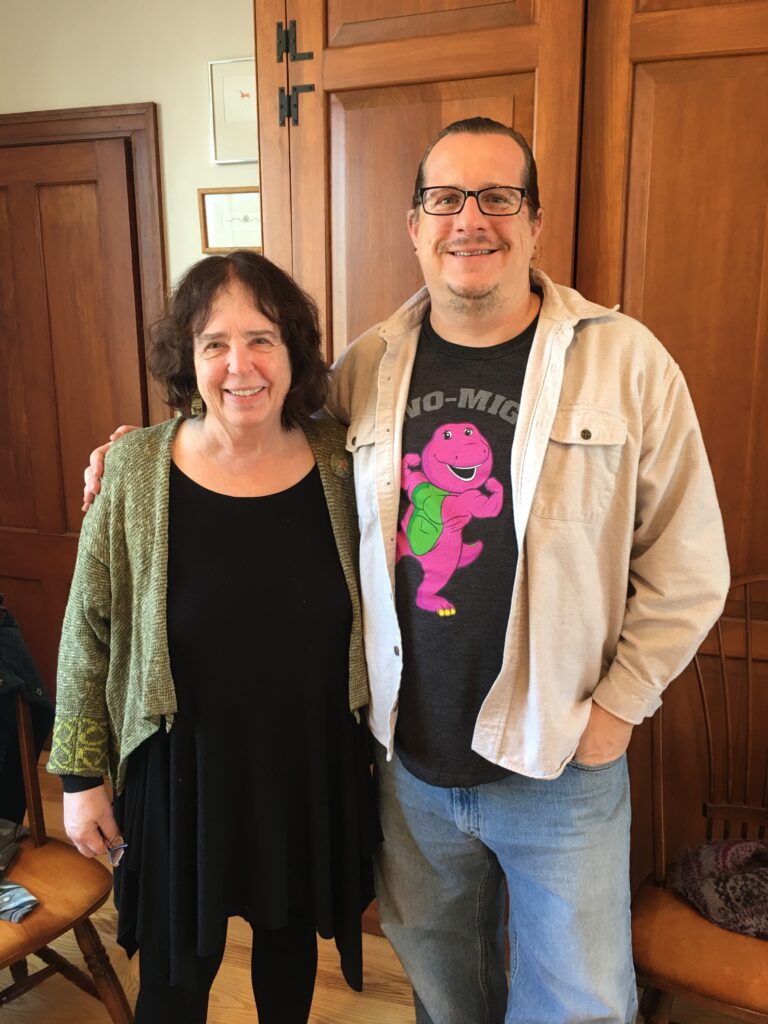

Here’s a hearty OPB welcome to Joy Peskin, Senior Executive Editor at Farrar, Straus, Giroux Books for Young Readers, an imprint of Macmillan Children’s Publishing Group.
Joy and I first crossed paths this past June at the WIFYR conference in Utah, where we were both on the teaching faculty (her virtually, me in person). I caught her afternoon Zoom talk to the entire group, and about halfway through I was already mentally drafting the invitation to bring her onto OPB. Yeah, she was great.
So, here we are.
A quick bio for context: Joy has spent three decades in kidlit, moving up the editorial ranks from Editorial Assistant all the way to the top. Her stops include Puffin, Scholastic, Viking, and now FSG BYR. She edits across picture books, middle grade, and YA, and her current picture book work includes the best-selling Escargot series, written by Dashka Slater and illustrated by Sydney Hanson. She’s also mentored a whole crew of editors coming up behind her, including Kendra Levin.
Alright, on to the questions!
RVC: You were weighing social work against publishing when you graduated. What tipped you toward books?
JP: My parents were willing to pay for what was then the Radcliffe Publishing Course, but not for a social work degree. That’s the honest answer. And I respected it. As a parent now of a 16-year-old myself, I get it—it’s not our job as parents to pay for everything our kids choose to do. We get to have a horse in the race.
RVC: As someone with two kids of my own, I say “yep.”
JP: They very graciously offered to pay for Radcliffe, and I took them up on it because I was happy to try out both paths and see which door opened first. Publishing was the door that opened.
What I ended up doing was finding a way to do both. I’ve always done social-work-adjacent work as a volunteer, and I’ve always done publishing as a paid employee. Both really matter to me.
One thing I try to convey when I mentor people is that you set yourself up for failure if you think one job is going to satisfy every professional need in your life. Same way you don’t choose one partner and expect them to satisfy every single need in your entire life. You can try. I don’t think it’s going to work.
RVC: What from the Radcliffe course actually stuck?
JP: A number of things, but the one I think about the most is the social element. The director of the program at the time was this amazing woman named Lindy Hess, who has since passed away. And as I recall, Lindy said that if we got into the program and completed it, we’d get a job—it was a job machine in 1996. Publishers recruited right out of Radcliffe. Faxes would come in with job listings and cover the entire wall by the end of the six weeks. You’d just walk up, pick one, and apply.
RVC: WOW. Stories like this just…wow.
JP: But the more enduring lesson was this: we literally had something called Sherry Hour every day. I did not drink sherry at it. I don’t know if any of the other students did. But we were meant to have a little snack and socialize with each other and with the publishing professionals who came to present that day. Lindy told us that was important, and she was right.
I think about that constantly now that we’re all working from home or hybrid. The proximity thing, learning by osmosis—that’s diminished. So the social piece has to be much more intentional now. Junior people have to be more curious and inquisitive. Senior people have to be more deliberate about teaching.
RVC: Amen to that. And speaking of learning from senior people…your first job in New York was at Puffin, and you clearly admired your boss there. What did that early apprentice period actually look like day-to-day?
JP: I remember starting and my boss saying, “Oh my gosh, I’m so glad you’re here—I have a project for you.”
I was like, “I’m going to get a project! An important project! It’s going to be creative!”
And then it turned out the project was: it’s winter, she’s organizing her Bologna schedule, and I need to make a grid and send out a million faxes. This was the olden days. So I had to learn how to use a fax machine, dial internationally, offer people slots, move them around the grid.
That’s the honest picture of starting out. In the beginning, your work is very administrative. Then it slides into a hybrid where you’re assisting some and doing some of your own books. Then when you move up to editor, most people aren’t assisting anymore—you’re doing your own work. At that level, I was at Scholastic, where I got projects handed down from senior people who acquired them and then dropped them onto us as if from the heavens. I didn’t start acquiring my own books until I moved to Viking as a senior editor. I was about 30.
RVC: But you got to run the department at FSG for about 13 years, which sounds pretty terrific.
JP: The big change when I became Editorial Director in 2012 was that I was acquiring my own books, editing my own books, and managing a team. That was 13 years. Now as Senior Executive Editor, I’m back to just acquiring and editing my own stuff and managing an assistant, which honestly is a nice reset. I love the mentorship piece and I still do plenty of that, but there’s something clarifying about being able to focus on just the editorial work itself again.
 RVC: Let’s talk picture books specifically. You’ve worked on the Sparkle series with Amy Young, an author-illustrator. What’s that dynamic like compared to when you’ve got a separate author and illustrator on a project?
JP: I love working with Amy. I worked with Amy years ago when I was at Penguin, and then we did the Sparkle books together at FSG. One reason I love working with author-illustrators—and I’ll admit this is a little selfish—is that it cuts out some of the approvals process. If you’re both the author and the artist, I know you approve the art because you made it! When there’s a separate author, obviously we want them happy with the art too, so we run every stage by them. Happy to do that. Always want to do that. But when it’s a one-stop shop, it’s just easier.
I also love that author-illustrators are using both parts of their brain at once. They’re picturing how the art looks and tailoring the text to that. There’s a unity of creative vision.
RVC: You’ve said the freshest picture books bring something new to evergreen topics—first day of school, new sibling, bedtime. What’s a recent example that made you go, “oh, THAT’s how you do this topic differently”?
 JP: by Bunmi Laditan, illustrated by Tom Knight. Absolutely perfect example. The ground floor of the story is the classic thing—your child is going from a crib or your bed into their own big bed. Every parent has some version of that conversation. Sometimes kids are excited, sometimes not. It’s a turning point in most children’s lives.
RVC: Here’s the OPB review of The Big Bed. It’s an interesting book for sure.
JP: Bunmi took that common thing and totally inverted it in a genius way. Instead of the parents sitting the little girl down to say, “You’re a big girl now, time for a big bed,” she flips it so that the little girl goes to the dad and is like, “Dad, we need to have a talk. It’s been the three of us in this bed—you, me, and Mom. There’s not room for you anymore. This is your own big bed, which will actually be a camping cot, so I can be with Mommy.”
Genius. We all get it, but I’d never seen it done that way before.
RVC: Agree. But back to mentoring. You’ve been on both ends of the equation. What makes it work in publishing specifically?
JP: Publishing is an old-fashioned apprenticeship. You don’t need a graduate degree to do it—some people have one, and that’s fine, but you don’t need one. You can’t just jump into a surgical suite and start cutting people up without a medical degree. But you can, in fact, jump into publishing with just a bachelor’s and learn the whole thing on the job. So mentorship has to be baked in.
Some people are more inclined to receive it or give it, based on a lot of factors. For me, I’ve been really lucky to identify people I wanted to learn from. Who you end up reporting to can really determine your path. But sometimes it’s not even your boss—it’s another senior person in the group.
RVC: Such a great point.
JP: What worries me now is that we’ve lost so much of the proximity piece. When I started, I sat in a cubicle right outside my boss’s office. I listened to everything she said because she was right there. That’s how you learn by osmosis. Now we don’t have that. So we have to be much more intentional—senior people have to actively teach, and junior people have to be genuinely curious.
AI is going to make this worse if we let it. The question with AI is: is it going to make us more human or less human? It could make us better at connecting. But right now I think it’s short-circuiting our brains. We can’t forget how to be people.
RVC: Kendra Levin (VP and Editorial Director at Simon & Schuster Books for Young Readers) has publicly credited you as a mentor. From your side of that mentorship, what did you spot in her early?
JP: Kendra is my heart. I was texting with her today. I met her when she was 19—and because everybody stays the age they were when I met them forever, in my mind she’s still probably 19, although she’s not.
David Levithan had hired her as an intern at Scholastic, and she came to work in my office on Fridays. I had this weird office that had been a copy room, no windows, but I had a long desk, so David asked if she could sit with me. And we just hit it off right away. She knows I’ve told this story a million times, but sometimes I’d come in cranky—I was in a relationship at the time with a lot of ups and downs—and Kendra’s presence would just pry me out of whatever mood I was in. She was warm and delightful and smart and great at the work.
RVC: Who doesn’t love people like that?
JP: So first I connected with her as a human. Then when I moved to Viking and brought her over as my assistant, she was just so impressive at the work. And what really stood out was this: we’d have a check-in and I and the other folks she reported to would be like, “You’re amazing, you’re the freaking best.” And she’d say, “Great. Are there specific ways I could grow and do better?”
She always wanted the critique. She had genuine passion for the work and this deep desire to keep learning. She never resisted the praise, but she wasn’t satisfied with just praise. That combination told me everything.
RVC: Now I want to hang out and work with Kendra. But back to you and your career–FSG has a clear identity as a publisher. In the picture book space specifically, how do you and your team define what feels like an FSG book versus what belongs elsewhere?
JP: What I really value about FSG—and it’s been this way from the start, even though I’m on my fourth boss over the years—is that the books I do are appreciated.
I brought something to acquisitions recently and people were like, “This is such a Joy Book.” And I felt very seen. Because a book I’m drawn to isn’t a specific genre—it’s a sensibility. It’s what’s baked into who I am and what I care about. And the house gets that. I don’t feel pressure to chase things outside my range.
 RVC:…thinking hard about what’s a Ryan Book…hmmm…
JP: For picture books specifically, the example I’d hold up is the Escargot series by Dashka Slater. It came in through her agent, Erin Murphy, as this quirky little one-off. A snail breaking the fourth wall, trying to get to the end of the book, moving slowly. Voicey and funny. It came from a really organic place for Dashka—she’d brought a snail puppet to author visits for her other books and just started talking in this snail voice as a gimmick, and kids loved it. So the book grew out of that.
RVC: For the deep dive on agent Erin Murphy, here’s the OPB interview with her. Back to you, Joy!
JP: I like an organic build. I tend to be much more comfortable with projects that start as some unusual thing I liked and then other people liked it too. Not a too-big-to-fail thing where somebody spent $6 billion on a 40-book series and then everyone’s job is to like it, so you can’t get sincere answers about it. That doesn’t create good art.
Escargot just did its thing, and now we’re building a 20-book series. That’s the kind of thing I love.
RVC: As do tons of readers, too. But let’s shift to talking about the WIFYR (Writing and Illustrating for Young Readers) conference now, since that’s where I “met” you. Sort of. You had a room full of writers hanging onto your every word despite you Zooming in. What’s the piece of advice you find yourself giving—both to writers and to the editors on your team?
JP: “Make it work.” That’s straight from Tim Gunn on Project Runway, which I’m sure my kids have watched too many episodes of.
RVC: Me too!
JP: Tim would go up to a designer working on some assignment—make a dress out of stuff you found in a dumpster, whatever—and he’d say, “Tell me about this.” And then he might say something like, “I’m concerned, I don’t really get what you’re doing here…” But if the person loved it, he pushed them to, you know, make it work.
What I took that to mean is: All I can do is tell you if it’s working for me. If you give someone that feedback, they’ll either say, “Yeah, I agree, this is not coming together”—and then great, we’re on the same page. Or they’ll say, “No, I really love this.” And then it’s like: Okay, it’s not working now. If you love it, let’s find a way to make it work. If you can’t find a way, do something else.
I give some version of that advice all the time. “It’s not working for me. That doesn’t mean you can’t make it work. I don’t know exactly how, or maybe I have a couple ideas too. But—make it work.”
RVC: Preparing for a conference like WIFYR: how does that compare to coaching an author through a manuscript in-house?
JP: I take WIFYR seriously. What’s heartbreaking about the industry is that not every organization out there is ethical. Some places make promises they can’t keep—pay us a thousand bucks, come to this workshop for the weekend, we’ll get you published. Not possible.
WIFYR is the opposite. It’s best in class. So when I’m invited, I really prepare.
RVC: What an endorsement!
JP: For the one-on-one critiques, I’ve drawn a lot from my professional coaching training, which I did at Rutgers—the co-active approach. You meet with the person, you listen, and then you basically ask them: What would feel like progress to you? What is it you want? Because not everybody wants the same thing. Some people want kind of what you’d expect—what did you think, what stood out, what’s not working. But some people are basically like, “Just tell me: Do I suck at this? Should I never do this again?”
So I don’t go in assuming what somebody wants. My goal is to be as clear and kind as possible while taking into account what the person is actually there for. That approach translates directly to the in-house editing work, too.
RVC: Best thing a kid reader ever said about a book you worked on?
 JP: This is easy. The 57 Bus by Dashka Slater—the same author as Escargot, a very multi-talented writer. The book comes out for its 10-year anniversary in Fall 2027. It’s a nonfiction YA about two teens whose paths cross when one of them—Richard, a Black teenage boy from a disadvantaged background—sets the skirt of the other teen, a white middle-class transgender youth, on fire on a bus in Northern California. The person whose skirt was set on fire is injured but recovers. It’s about that moment, but it’s also about what came before and after, and about race, class, gender, forgiveness, repentance, paying your debt.
Early on we got a letter from a reader—a white middle-class teenage boy—who said, essentially, that he’d gone into the book expecting to have a negative reaction to Richard. Like, how could you do what Richard did, how could you harm someone in that way? But he came out realizing he could have been Richard. Because Richard is essentially egged on by his friends to do a dumb thing. And I have a teenage boy living in my house. They can be stupid, God bless. They’re very peer-motivated to do silly things because their friends think it’ll be funny. Richard thought it would just be a little spark. He didn’t expect the skirt to go up in flames.
That “there but for the grace of God go I” moment—a book making a teenager have that realization? That’s the whole thing right there. That’s why we do it.
RVC: Great answer, Joy. Let’s ask one more to wrap up this part of the interview. What’s a question no one’s ever asked you in an interview that you wish they would?
JP: “What’s the one that got away?”
RVC: What’s the answer?
 JP: It’s Love, Aubrey by Suzanne LaFleur. It was a middle-grade novel, published in 2009, I think. I bid on it when I was at Viking. I still think about it. It was just the most stunning story about love and loss and recovery.
RVC: Alright, Joy—time for the SPEED ROUND. Zippy-quick questions, snappy-fast answers, please. Ready?
JP: Ready.
RVC: Sparkle the Unicorn but make it a cocktail. What’s in it?
JP: Oh, that’s so fun. I’m not great at cocktails—I’m a gin and tonic or whiskey on the rocks person—but okay. It would be one of those cocktails that’s a little blue and a little yellow. A little bubbly and froofy. It would definitely have a cute little toothpick in it with a unicorn on top. Fruity but light. Very summery.
RVC: If your inbox had a theme song, what is it?
JP: I can’t quite land on a song, but I have a visual, which is: a leaf pile, and I’m raking, but the leaves keep falling. So maybe “Hazy Shade of Winter”? Something seasonal, something fall. But cheerful. There are no grudges. I’m just always in there raking.
RVC: A picture book from the past year that deserves more buzz?
JP: Finding Forgiveness by Rebecca Gardyn Levington, illustrated by Diana Mayo. It got some very nice notice—it was a Sydney Taylor Notable—but I absolutely love it, and I think it deserves more. It’s a perfect example of what I always talk about with picture books: three points of entry.
One, it’s Jewish-themed—and specifically about Rosh Hashanah, which is underrepresented (bonus points for not being about Hanukkah or the Holocaust, no offense to either).
Two, it’s a sister story, and I love a good sister story.
Three, it’s a conflict story—the sisters have gotten into a fight the night before Rosh Hashanah and have to make up.
Plus there’s beautiful back matter about the tradition of Tashlich, and about how to make a good apology. Because we make kids say they’re sorry all the time—you hit your brother, you broke your sister’s necklace, say you’re sorry. But what does it actually mean to make a repair? To understand the difference between impact and intention? That book gets at all of it.
RVC: The single most useful habit an editorial assistant can build in their first six months?
JP: I have a new EA right now—Cassandra Gutterman-Johns (shout out! she’s crushing it)—and one of the things she’s doing so well is asking questions designed to help her understand me, and the other editor she supports, and how we each work. Not just “How do I do this task.” She’s taking over a tracking system from my previous assistant, and she said, “If it’s okay with you, I’m going to update it. But first I want to know what parts of it are useful to you, because I don’t want to change those.” I was like, I love you.
Not romantically. HR, relax.
But that’s such a good question. She’s not upending anything on day one. She’s learning the job first, then thinking about how she can tweak it for her own workflow and for what her bosses need. That’s the whole game.
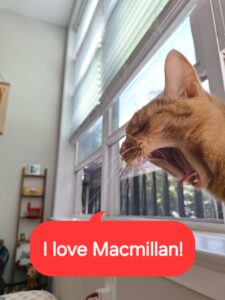 RVC: So you’ve got Pablo the sleepy cat, Pixie the fluffy guinea pig, and Clemmie the camera-shy guinea pig. Here’s the ultimate question. Guinea pigs–great pet or the GREATEST pet?
JP: That’s the hardest question you’ve asked me, Ryan.
Pablo is a prince among cats. But I feel like the cat-plus-guinea-pig combination is the lifestyle I want to have until I’m dead. Guinea pigs are the unsung heroes of pets. I bring my pigs outside to graze in the park, as anyone would, and when I went to our local town festival—which is called, I’m not kidding you, Maplewoodstock—I brought them out in their little outdoor pen, and I met probably 200 people of all ages and backgrounds who went absolutely out of their freaking minds for the pigs. They make people happy. They bring people together.
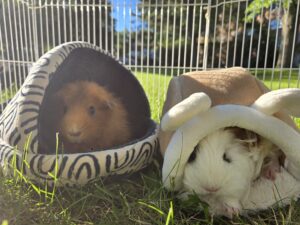 Everybody should get at least two—they’re herd animals. And they’re wasted on children. Do not throw them in a classroom. Be an adult. Get a couple of guinea pigs.
RVC: Well said. Thanks so much, Joy!