My two Writing Picture Book classes are doing a deep-dive on Jon Klassen this week as part of our ongoing “Meet PB Creators!” agenda. Among other things, they’re watching this interview between Jon and a former officemate at Dreamworks. It’s terrific.
Here are a few things that my classes and I noticed about some of the picture books he wrote and/or illustrated.
I first met Suzy the way I met so many OPB interview folks—via her books. In this case, it was Animals in Pants. I saw it at my library one day and picked it up because…well…it had a terrific trifecta (animals, pants, poetry!).
After some digging, I learned that Suzy’s the author of Animals in Pants (Abrams/Cameron Kids, illustrated by Kristen & Kevin Howdeshell) and Dinos that Drive (Tundra Books, illustrated by Dustin Harbin), with four more picture books arriving in 2027. Her poems have appeared everywhere from Highlights and Cricket to anthologies from Bloomsbury, DK, and Macmillan.
I’m also a fan of authors who have super-quotable things on their website, like this: “When I’m not reading or writing, I enjoy taking pictures, watching movies, and sliding around my apartment in socks, singing whatever ridiculous songs pop into my head. I live in New York with my sweet husband and our spicy cat.”
Intrigued, right? Let’s learn even more about Suzy right now.
RVC: So you grew up in Massachusetts making up weird stories on long car rides. What kinds of stories?
SL: There was something about the boredom of sitting in the car that would send me on these unhinged streams of consciousness. If I had a stuffed animal with me, he’d have a whole epic backstory. If I didn’t, I’d just anthropomorphize something else—a paper clip, whatever. For a while, I kept this little plastic green clown in one of our car’s empty ashtrays, and what a personality that guy had! Every car ride was an opportunity to workshop his stand-up routine. Then there were the fake ads, the jingles, the (embarrassing) raps. So many made-up songs! Sometimes I’d just stare out the window, singing random lyrics until my little sister screamed, “STOP, your voice SUCKS.”
I see now that I was almost writing. Almost. I wish I’d put some of it down on paper, but it never crossed my mind. Back then, “writing” meant doing a horrible book report for school, while this was just having fun, something to kill time between point A and point B. I didn’t realize it could count as something real.
RVC: Wow, what a way to start this interview. Thanks for that. Now, you were an actor before you were officially a writer. What stuck with you from that first career?
SL: My favorite parts of acting and writing have always been one and the same: diving into a character, finding their voice! The freedom of it! The sense of security, too. All the self-consciousness that comes with being myself falls away when I ask “What if?” and jump into someone else’s shoes. It makes me braver, counterintuitively more me.
RVC: You’ve said Shel Silverstein poems felt like “a thrilling gift” when you were a kid. Was there a specific one that flipped the switch?
SL: You know, I don’t think there was a specific poem that flipped a switch. I just remember being unreasonably psyched whenever a teacher would read a few of his poems in class. The conversational tone, the irreverence, the rhythm, the purposeful language that still managed to sound loose, the line drawings…there was a radical coolness to Shel Silverstein’s work that spoke to me then and still speaks to me now. Almost like a nudge to go ahead and be weird already.
RVC: Shel was awesome, no doubt about it. Back to you and your career. Before you were publishing your own picture books, you were placing poems in Highlights, Cricket, Ladybug—the whole magazine map. How much of your craft came from that grind?
SL: That grind was like grad school or something! Starting out, I looked at PB authors I knew and admired, like Diana Murray and Carrie Finison, with their long lists of magazine credits, and I saw a path forward. I saw achievable goals, so I wrote and submitted poems nonstop.
RVC: Love this.
SL: Of course, it wasn’t easy to sell to magazines. The competition was (and still is) fierce. I had to be strict, focusing on craft: clear imagery, natural-sounding phrasing, strong word choice, flawless meter, kid-friendly voice, sharp punch lines! If even a single word sounded off, the poem wasn’t ready yet. My critique partners put me through the wringer, and that’s why I started to see results. It’s how I got better at this!
RVC: Absolutely. Now I’ve been told that Animals in Pants started with a Brooklyn class prompt and a cat in pants. What was it about the pants that wouldn’t let you go?
SL: Strange mash-ups make for satisfying prompts. After I wrote that first cat-in-pants poem, I realized the possibilities were kind of endless. I jotted down a list of animals and a list of pants styles, then made some matches, taking the inherently nutty premise and applying good old-fashioned common sense—logistics! For example, what type of pants would best suit a monkey’s lifestyle? What problems might a manatee face while wearing denim? How would certain elephant traits influence their garment maintenance?
RVC: Ah, COMEON…I’ll be pondering these all evening now.…
SL: It was so fun that I mostly ignored my trepidations about no one in publishing ever buying poetry collections and kept going.
RVC: Cameron Kids acquired the book with a note that it needed more of an arc. What did retrofitting structure onto a finished collection teach you?
SL: First off, it taught me the power of intros and outros in this sort of narrowly focused collection, to get the ball rolling and give the work shape. Plus there’s a lot you can do just by being intentional with the order of your poems, creating the hint of an arc if not a traditional story arc—city-to-country, day-to-night, cold-to-hot, that sort of thing. Even the most subtle structure can give the book momentum, pushing the reader forward, letting them know they’re in good hands and not about to fall off some literary cliff.
RVC: You clearly applied those lessons early with Dinos that Drive. Was there a moment during drafting where you thought, “Oh, that’s what my editor meant last time”?
SL: Oh, right at the beginning! You can be sure I wrote my intro poem first this time! As opposed to tearing my hair out, writing five different potential intros, praying that one could be slotted in after the fact! Ugh!
RVC: It’s pretty clear that you’re passionate about meter. And I mean not merely counting syllables, but ACTUAL meter. What’s the misconception about meter that you correct most often?
SL: Ooh. Deep breaths. I could rant and rave on this topic for DAYS. I won’t, but I could…
RVC: I’m okay with whatever!
SL: I’d say the trickiest thing about meter is convincing smart, talented people who are only starting to write in rhyme that they can’t just “wing it” because they’re smart and talented. Meter isn’t easy; it isn’t counting syllables; and if you ask me, when it comes to rhyming verse, it isn’t optional.
RVC: I’m going to jump in here and say…YES! Please continue.
SL: I beg rhymers to avoid doing what I did, which was wasting at least a year thinking I could wing it, then wondering why no one was buying what I was selling. Even if you’ve got the world’s best ear, it takes a good class to learn how to do it properly, then tons of practice to learn how to do it well.
RVC: You’ve said humor is about surprise, but also that you’re not the class clown in real life. What lets you loosen up on the page?
SL: It probably goes back to that sense of security I mentioned earlier. When I’m writing, I don’t have to be myself. I can get a little wild and crazy. I don’t have to be overthink‑y, worrying about every choice for fear of making a mistake—sounding stupid, or rude, or inauthentic. What’s the worst that’ll happen if I make a mistake while writing? I’ll have to hit delete too many times? That’s a risk I can handle.
RVC: You already said it–rhyming collections are famously hard to sell. What finally cracked the door open for you, and what would you tell rhymers still stuck on submission?
SL: Yes, they’re ridiculously hard to sell, which is why I feel like a total goof whenever I write one. But hey, they sometimes sell! Look at my first two books! What finally cracked the door open for Animals in Pants, after years and years of nothing, was meeting my agent, Rachel Orr.
SL: She just got it from the start, and was willing to take a chance that someone else would get it, too. And Amy Novesky was the editor who wound up being that someone. So in other words, two wonderful people and a bit of good luck!
RVC: And here’s the OPB interview with Amy! Yeah, the kidlit world’s smaller than many might think. Speaking of which–remind me, who’s your editor at Tundra for Dinos?
SL: That’s Margot Blankier–another wonderful person who’s helped make my poetry-collection dreams come true.
RVC: Sounds like it. Now, what would you say to fellow rhymers working on a collection?
SL: First off, you need a killer concept, something kids are going to love. I know a lot of us look at collections by, say, Shel Silverstein and think maybe ours can also cover a broad range of topics, but I’ve found that very few poets get away with that these days, unless they’re a big name and/or celebrity (eye roll). Narrower topics seem to sell more easily, probably because publishers know how they can market them. Of course your meter has to be tight, your rhymes fresh. Your poems should vary in sound while remaining pretty consistent in tone—meaning if you’re writing a funny rhyming collection, maybe don’t include that dark poem about death, even if it’s really good?
And while you’re waiting for those collections to sell, keep subbing one-off poems to magazines and anthologies! Agents and editors like to see a few of those credits. I think it makes them feel more confident that you know what you’re doing.
RVC: Speaking of things that can happen with poems beyond your own collections, “Iguano-Gone” became an actual country song. How did that happen, and can we hear it anywhere?
SL: For a long time I’ve been fascinated by the thin line between children’s poetry and song lyrics, probably because I secretly dream of being a lyricist although I’m not a musician. When I look at Shel Silverstein, or Sandra Boynton, or Cece Bell, all who’ve more than dipped a toe into the songwriting world, I feel empowered. So when I realized nothing was stopping me from writing a poem that’s a fake song in Dinos that Drive, I went for it!
And then “Iguano-Gone” became a real song, woohoo! Long story short, my sister and her partner, who are both in the music industry in Montréal, introduced me to a friend of theirs, an awesome country artist named Wood Andrews. He agreed to work with me, taking my poem and adding music and performance. He crushed it. We wound up with a really cute song! You can take a listen here.
RVC: You co-taught the Lyrical Language Lab with Renée LaTulippe. What’s the single most useful revision habit you’d hand a rhyming writer today?
SL: Yes, this fall I’m actually co-teaching the Lyrical Language Lab for the third time! What an honor. I took the class back in 2014, and it was a complete game-changer for me. I’m not exaggerating when I say everything I’ve achieved in my writing career happened as a direct result of that class. I’ve basically told Renée I owe her for LIFE.
RVC: Very cool.
SL: I think it’s important for rhymers to scan their work, actually writing out those little scansion marks, particularly when they’re just starting out; it helps to train your ear and make meter part of your muscle memory. And remember to put your manuscript down for a while, at least overnight, then read it aloud the next day. That little break always seems to expose stumbly bits that sounded smooth the night before! It’s very annoying, but helpful!
RVC: Since COVID, I like to ask people a health and wellness question. What’s your go-to for keeping yourself steady when a deadline stretch (or a launch, or a rejection) starts messing with you?
SL: I struggled for years—first as an actor, then as a writer. We’re talking far too many rejections for one lifetime, brutal on my self-esteem. I’d wonder if I was fooling myself, chasing pipe dreams. But there was one weirdly good thing that came out of that, which was learning to be resilient. Nothing gets me out of a rejection funk more than trying the next thing—well, that and complaining. Complaining to my writing friends feels healthy, because then they complain back, and suddenly it’s a full-on vent sesh and I’m kind of enjoying myself?
I will add that nowadays, it’s nearly impossible for me to take my wins for granted. I’m not skipping around like Pollyanna, but even when I’m venting to my crit group about this or that rejection, part of me is still thinking, “YES! I’m finally in a position where I get to complain about this stuff!” There’s an undeniable baseline joy that comes after years of ugh, now that things are (occasionally) working out.
RVC: Last question for this part of the interview. In all your experience in the kidlit writing and publishing world, what has most surprised you?
SL: I think I’m most surprised by how the work allows me to keep growing into myself, discovering new branches of who I can be, while also bringing me closer to who I was as a kid—you know, rapping about snack food in the car and stuff. Writing’s allowed me to reconsider the parts of myself that I always thought were too weird, and see them now as they really are—my greatest strengths. I’m surprised by how healing it’s all been.
RVC: Speed Round time, Suzy. Quick questions, fizzy-fast answers. Ready?
SL: Yeah. Bring it!
RVC: Best milkshake flavor?
SL: Coffee. I grew up within walking distance of a Brigham’s in Wellesley, MA, and man, that ice cream shop knew what to do. It was like sucking a solid pint of coffee ice cream through a straw. Oh, I’m supposed to be giving speedy answers, right? Hmm. Maybe the next one.
RVC: Guacamole, math, or small talk—which is marginally less awful?
SL: Ha! Surprisingly, small talk. I don’t love small talk, but I don’t love awkward silences more, so I’ve gotten fairly adept at chatting it up when required. I’ve met people at parties who probably took me for an extrovert, never suspecting I later went home and passed out from sheer social exhaustion. Okay, the next answer will be speedy, I swear.
RVC: Which Who Wants to Be a Millionaire? question got you?
SL: THANKYOU for bringing it up. I’ve been fuming over this stupid question for 17 years! Let’s air it out:
The African Charrier coffee plant produces coffee with what unique property?
‘Ask the Expert’ lifeline used
⬥ A: Caffeine-free
⬥ B: Protein-rich
⬥ C: Odorless
⬥ D: Naturally sweetened
So, Ryan, have YOU ever heard of African Charrier coffee? Because no one else I’ve talked to has, including my “Ask the Expert”! Not that I’m bitter or anything. At that point I quit and took the cash.
RVC: Which Dark Crystal character would you least want as a critique partner?
This is Fizzgig!
SL: Fizzgig! I’m guessing he’d be at least as unhelpful as his namesake (my cat, Fizzy), especially at mealtimes.
RVC: One piece of advice you’d give your pre-Animals in Pants self?
SL: If you’re doing something that makes you feel like you’re constantly banging your head against a wall, pivot! Pivoting is not a failure! The only failure would be sticking to something you hate just because you think you need to be good at everything. Take a leap and dare to find the thing you actually enjoy doing!
RVC: What makes a picture book worth returning to, again and again?
SL: Art and heart! No, I didn’t mean for that to rhyme, it just happened.
RVC: LOL. Thanks so much, Suzy!
SL: Wow, Ryan, these questions were awesome. You did your research. You’re like the Sean Evans of kidlit interviewers! Thanks so much!
Christian Robinson was an easy pick for a creator spotlight this week, and here’s why: his books look plain until you sit with them, and then a fourth or fifth read hands you emotional information you swear wasn’t there before. Sneaky guy. Here are three books that show off different corners of what he does.
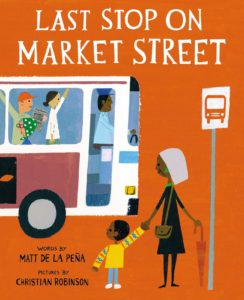
Quick note first: Robinson didn’t write this one (Matt de la Peña did) but the art carries so much of the book that this fully belongs in any Robinson conversation. I’m here for what he’s doing with collage.
The story: CJ and his grandmother ride the bus home after church, and Robinson draws the whole ride.
Craft stuff I keep noticing:
Look at how packed that bus is. Every rider has posture and clothing and a way of taking up space. Nobody is background. (Shoes tell you a lot in this book.)
Nana sits rooted in every spread while CJ is the one turning, fidgeting, looking around. The whole grandmother-grandson dynamic is happening in body language.
The palette stays warm even where the book gets into hard stuff—hunger, need, a soup kitchen line. That warmth is a choice.
Wordless, and totally committed to it. A girl’s bedroom opens sideways into a city that’s almost hers, and doubles start turning up everywhere.
Craft stuff I keep noticing:
Wordless books are hard. This one is hard done well. Kids can follow it because every page hands them exactly enough to know where their eyes go next.
Repeated shapes, repeated colors, repeated figures at different sizes—you feel the “another” of it before you’ve thought about it.
The move from bedroom to elsewhere happens like it’s the most ordinary thing in the world. No splash page announcing THEMAGICBEGINS. Robinson just lets it happen and trusts you to come along, which is why the whole book feels like a weird dream you half-remember.
Huge subject, and zero interest in shouting about it. Robinson lets one kid look at one bug on one page and stakes the whole world on that.
Craft stuff I keep noticing:
Robinson isn’t going to try and out-do his own art with words, and thank goodness for that.
Scale is the whole engine here. One tiny kid on a big page reads completely different from one face filling the spread. Robinson picks his spots.
There’s always a bug or a face or a hand somewhere in the frame, some specific small thing for a kid to land on, even when the book is aiming at something as massive as the whole planet.
A book with a message this size could easily be unbearable. Robinson gets away with it because he does “important” without ever going solemn about it.
Got a favorite Robinson book I skipped? Toss it in the comments. I’m betting Gaston and School’s First Day of School show up fast—Robinson didn’t write those either, but the art in both is WOW.
Oge Mora was an easy yes for this month’s Creator Spotlight. Why? Because her work has so much life on the page. For example–torn paper, bold color, and people moving through spaces that feel warm and familiar.
I’ve taught quite a few books she’s made or illustrated in my Writing Picture Book class, though I’ll limit myself to three here and share a few of the things I frequently say about them.
Corey R. Tabor was an easy pick for this month’s Creator Spotlight.
He’s very good at making a picture book feel easy and effortless when it absolutely isn’t. And he keeps things kid-friendly without making them bland.
Yes, I could’ve picked more than three to talk about here, but I stuck with the structure I’ve been using with these creator spotlights. So, three it is!
Fox gets a kite stuck in a tree, then keeps “solving” the problem in ways that make everything worse.
A few things that caught my eye:
Fox is so sure of himself the whole time. That confidence makes every bad idea funnier.
The repeated problem/big idea/new problem pattern gives the book a strong shape. Very young readers get it fast.
Corey lets the short, repeated sentences play things straight while the illustrations carry a lot of the comedy.
**A quick note: this title is technically an early reader, though it nicely shows the humor and visual storytelling that make Corey’s picture books terrific.
This month’s Creator Spotlight shines on Matt Forrest Esenwine.
He’s one of those picture book creators whose poetry background shows up on the page in all the right ways. His books have music, momentum, and a sense of wonder, and they clearly come from someone who understands how picture books work as visual experiences. That combination makes him well worth a closer look.
He’s got plenty of books worth considering, but I’m limiting myself here to three favorites.
Here’s the setup for Flashlight Night: three kids head out into the backyard with a flashlight, and that ordinary nighttime adventure keeps opening into something bigger, stranger, and much more bookish. Along the way, they encounter tigers, pirates, and more before circling back to the books that sparked it all.
Some craft things worth noticing:
Matt gives the book an imaginative engine right away. The flashlight beam becomes the doorway, and sure enough, that just gives the whole story instant energy.
The language has a lovely musical quality (which makes sense given Matt’s poetry background), and he still keeps the story moving.
The book keeps one foot in the real world and one in the imagined one. That tension gives the illustrations a lot to do (in a good way).
This is a terrific example of a book that celebrates reading by showing what books do to a kid’s mind instead of simply announcing that books are wonderful.
In I Am Today, a young girl finds a sea turtle tangled in wire on the beach near her town and realizes she doesn’t have to wait until she grows up to take action. The publisher describes it as an empowering story about a child who chooses to make change now, and that feels spot on.
Some craft things worth noticing:
Matt builds the book around a big idea, though he gives it a very concrete starting point.
The text is spare and poetic, which leaves a lot of storytelling room for the illustrations. In fact, the turtle-saving narrative is carried heavily by the art, which is part of what makes the book so worthy of studying.
The title itself has oomph. It turns the usual “what will you be someday?” question into something much more immediate.
This is a useful book for anyone trying to write toward activism, stewardship, or social awareness in a way that still feels kid-centered and alive on the page.
The publisher frames A Beginner’s Guide to Being Human one as a humorous and heartfelt look at what it means to be human and how to be a good one, and that’s a pretty apt summary. And Matt runs with that idea.
Some craft things worth noticing:
Matt takes a potentially heavy social-emotional topic and keeps it light on its feet.
The voice speaks directly to the child reader in a way that feels inviting rather than finger-waggy.
The book appreciates that warmth can carry a lot of wisdom.
This is a first-rate mentor text for anyone trying to write a concept-driven picture book with an emotional or behavioral focus that still has a lively reading experience.
If you’ve got a favorite Matt Forrest Esenwine title, drop it in the comments.
Cookie Consent
We use cookies to improve your experience on our site. By using our site, you consent to cookies.
Contains information related to marketing campaigns of the user. These are shared with Google AdWords / Google Ads when the Google Ads and Google Analytics accounts are linked together.
90 days
__utma
ID used to identify users and sessions
2 years after last activity
__utmt
Used to monitor number of Google Analytics server requests
10 minutes
__utmb
Used to distinguish new sessions and visits. This cookie is set when the GA.js javascript library is loaded and there is no existing __utmb cookie. The cookie is updated every time data is sent to the Google Analytics server.
30 minutes after last activity
__utmc
Used only with old Urchin versions of Google Analytics and not with GA.js. Was used to distinguish between new sessions and visits at the end of a session.
End of session (browser)
__utmz
Contains information about the traffic source or campaign that directed user to the website. The cookie is set when the GA.js javascript is loaded and updated when data is sent to the Google Anaytics server
6 months after last activity
__utmv
Contains custom information set by the web developer via the _setCustomVar method in Google Analytics. This cookie is updated every time new data is sent to the Google Analytics server.
2 years after last activity
__utmx
Used to determine whether a user is included in an A / B or Multivariate test.
18 months
_ga
ID used to identify users
2 years
_gali
Used by Google Analytics to determine which links on a page are being clicked
30 seconds
_ga_
ID used to identify users
2 years
_gid
ID used to identify users for 24 hours after last activity
24 hours
_gat
Used to monitor number of Google Analytics server requests when using Google Tag Manager
1 minute
Marketing cookies are used to follow visitors to websites. The intention is to show ads that are relevant and engaging to the individual user.
AddToAny provides share and follow buttons that let visitors post your pages to social networks, messaging apps, and bookmarking services.



 I first met Suzy the way I met so many




 You Matter


 He’s one of those picture book creators whose poetry background shows up on the page in all the right ways. His books have music, momentum, and a sense of wonder, and they clearly come from someone who understands how picture books work as visual experiences. That combination makes him well worth a closer look.

