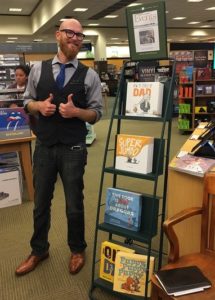
Welcome to Ashlee MacCallum, a junior literary agent at Howland Literary who has one of the most delightfully eclectic backgrounds you’ll find. Originally from Glasgow, Scotland, Ashlee has been a preschool director, a special education teacher, a US History teacher, a Dean of Students, and—to this day—a high school English teacher in Nevada who makes her sophomores dramatically reenact Macbeth. (Yeah, we love that energy!)
Ashlee joined Howland Literary in 2025 after interning with Brent Taylor at Triada US. Specifically on the picture book side, she’s drawn to stories with multiple hooks, original concepts, and concise writing—with a particular soft spot for creepy tales, quirky humor, and anything “delightfully weird.”
And she’s also a kidlit writer herself, represented by Kaitlyn Katsoupis at Belcastro Agency, which means she knows what the submission trenches feel like from both sides of the desk.
When she’s not reading submissions or grading essays, Ashlee says that she’s “probably mapping out her next Disney adventure, binging a true crime podcast, or humming show tunes in the kitchen.”
Let’s find out a bit more about Ashlee and her work!
RVC: You grew up in Glasgow surrounded by folklore and superstitious storytelling. What’s a moment from your childhood that still lives in your head when you think about what makes a great story?
AM: What a fun question! My mum’s mum, my Nana, is quite the storyteller. I have vivid memories of her telling me about the goblins who lived in the woods behind her house. If we were misbehaving (which my brother usually would), she would tell us the King Goblin was coming to sort us out. Looking back, I think what made her stories great was how compelling they were and the emotional engagement she drew from us.
RVC: Love the goblin stories. Wow. Now, you’ve had one of the most zigzag career paths of anyone we’ve featured on OPB—in a good way! How do all those roles inform the way you work as an agent?
AM: Haha! Outside of traditional publishing internships and training, I have drawn on the skills from my “day job” to help launch my agenting career. I actually think being a high school English teacher utilizes many of the same skills that literary agents use every day: literary analysis, editorial/revision skills, a knowledge of storytelling and literature, understanding readers and audiences, organization, and strong communication. Even in previous jobs I’ve held, such as a Dean of Students, I negotiated, exercised strong judgment, and worked in an advocacy role.
RVC: You’re a picture book writer yourself, and rumor has it that you queried over 100 times before landing your first agent. What were the top two lessons you took from that experience?
AM: Yes! I learned a lot about myself through the querying process, namely, how I navigate rejection. I realized that while successfully finding an agent is about writing a great book, it’s also about resilience and persistence.
RVC: Amen to that!
AM: I also came to appreciate the power of revision. Feedback and refinement are constant in this industry, and I’ve learned to really lean into and love those things.
RVC: How are things going with your own submissions, and does that in any way affect how you work with other authors as an agent?
AM: Things are moving along! I hope to have good news on that front soon, but again, resilience and persistence. Because I have an intimate understanding of what the sub process looks like, I can guide my clients with empathy, prepare them for the submission process (things like timelines and editor responsiveness), and advocate for their work with a clearer understanding of how editors evaluate projects.
RVC: I see you’re making the bold choice of showcasing your own manuscripts-on-submission on your website. Should more authors do that?
AM: It’s a personal decision, for sure. Some authors prefer privacy during the submission process, which is completely valid. For me, it’s about modeling transparency. If writers can see that even someone working inside the industry experiences the same timelines and uncertainty, it helps normalize the realities of publishing. So, I wouldn’t say more authors should do it, but I do think the more honest conversations we have about the process, the healthier the writing community becomes.
RVC: Since we have so many people listening/reading here (and a lot of them are industry gatekeepers), go ahead and give us the elevator pitch for one of your on-submission picture books and one other kidlit project.
AM: Haha! This made me giggle. I won’t say too much, but I’m a girlie with ADHD, so my favorite picture book I’ve ever written highlights that experience, but with a little magic and mischief. It’s been through countless revisions, but it’s officially back on sub, and I’m hopeful someone loves it as much as I do.
RVC: Thanks for that! Now, tell me the story of how you ended up working at Howland Literary. What made you say, “This is my home”?
 AM: Good question! When I connected with Carrie, the founder and president of Howland Literary, it felt like a natural fit right away. What I love most about working at Howland is how our team champions authors and approaches publishing with both creativity and care. There’s a collaborative spirit in our agency (full of girl power, I might add) and I’m so proud to work alongside them.
RVC: According to interviews, voice is the single most important thing you look for in a submission. In a picture book with only 600 words or 300 words or maybe even just 200 words, what does a “distinct, captivating voice” actually look like?
AM: Yes, voice is critical in any writing space, but especially in children’s books. For picture books in particular, voice isn’t about the number of words, but it’s about how much personality each word carries. When you have a limited number of words to tell a story, every sentence has to do multiple jobs like reveal character, create tone, move the story forward, and of course, for picture books, sound fun and engaging when read aloud!
RVC: Your MSWL includes something I don’t see enough agents asking for: creepy picture books. Tell me more!
AM: YES! Please, someone, send me a creepy picture book! The tone I’m looking for here lands somewhere between spooky, mischievous, eerie, and darkly funny. I think kids love controlled fear (think every Disney villain ever) and tension that makes the story memorable (like my Nana’s scary tales about the goblins). This is definitely a high-priority item on my wish list.
RVC: You also list “inventive and clever nonfiction, particularly STEAM themes and lyrical narrative nonfiction that sings.” What separates a STEAM picture book that excites you from one that feels like a textbook in disguise?
AM: Oooh this is a fantastic question. For me, it comes down to this: is the story driving the science, or is the science driving the story? So, instead of trying to explain how something works, the concept should naturally unfold in the narrative. I’m personally drawn to STEAM stories that still have heart and a strong emotional tie.
RVC: Can you name a book or two that’s a good model for this?
 AM: Yes! I think Great Carrier Reef by Jessica Stremer is a great example of a STEAM picture book with heart. In fact, her book is also a strong example of a non-human character that brings real emotion. In the story, the shop is treated like a real character with a life cycle. When reading it with my son (we read it many times!) he gravitated to the hope-forward narrative and felt a real connection to “The Mighty O.”
RVC: When you’re editing a picture book before submission, where do you find yourself pushing authors the most?
AM: Probably word count. I want to make sure every word in our submission sparkles and is perfectly placed. Sometimes we can eliminate fluff or text that could be shown in the illustrations instead. These little things matter.
RVC: Let’s briefly talk about rhyme. Should people send those projects your way or find another option?
AM: I am admittedly not the best fit for rhyme, but at the same time, I don’t want to discourage someone from querying me if they think we’d be a great match, so if your projects meet other items on my wish list, then feel free to give me a shot.
RVC: Since COVID, I’ve tried to ask every interview subject a health and wellness question. Here’s yours. What’s your best tip for kidlit writers who need a hand dealing with the stress and grind of the submission process?
AM: Nice! I’d say take a break if you need one. It’s okay to give yourself a moment if your mental health is suffering. Constant rejection can be tough, and if it stops feeling like redirection and you’re no longer enjoying writing, take a little break and come back when you’re ready. Self-care is so important!
RVC: One last question for this part of the interview. What’s next for you?
AM: I recently signed my fifth client, Cate Townsend! Her YA paranormal romance just went out on submission and it’s quite literally to die for. I can’t wait to see who snags it up.
RVC: Alright, Ashlee. It’s time for the much-anticipated, never-duplicated, always-spectacular SPEED ROUND. Snappy questions, rapid-fire answers. Are you ready?
AM: LET’S DO THIS!
RVC: You’re trapped in a haunted Scottish castle overnight. What picture book character do you want right by your side?
 AM: I’m 100% going to need Dennis from The Book of Rules by Brian Gehrlein. Not only is this one of my son’s favs, I know that hungry little purple monster will take care of business if necessary. Ghosties are no match for Dennis.
RVC: Your students have to perform a picture book as a dramatic reading instead of Macbeth. What picture books gets the gig?
AM: Haha! I’d have to say We Don’t Eat Our Classmates by Ryan T. Higgins. Can you imagine? I have some student actors who could really bring Penelope Rex to life.
RVC: Disney is making a theme park ride based on any picture book you choose. What’s your choice?
AM: Since I love creepy picture books, I’m going to say—you guessed it—Creepy Carrots by Aaron Reynolds. Disney + Twilight Zone vibes is a yes, please for me.
RVC: A picture book from the past year or two that deserves way more attention than it’s gotten?
 AM: I think Ghost Makes a Friend by Maggie Edkins Willis is the sweetest story for kids trying to make friends. It really speaks to the shy kiddos, for who sometimes, the scariest thing can actually be making a friend. If you haven’t checked it out, you should!
RVC: Who sets the standard for creepy-but-kid-appropriate picture books?
AM: I think everyone in the kidlit space does in a way: writers, agents, editors, readers… but there are for sure some big names who have helped shape this space like Jon Klassen, Aaron Reynolds and Peter Brown.
RVC: Complete the sentence: “Ashlee MacCallum is an agent who…”
AM: …loves bold voices, big feelings, and stories that refuse to behave.
RVC: Terrific. Thanks so much, Ashlee!



 Every Dreaming Creature