This month’s PB review is by Ryan G. Van Cleave (chief rabbit aficionado at Only Picture Books) and OPB newcomer, freelance author/illustrator Kelly Light.
–Ryan’s Review of the Writing–
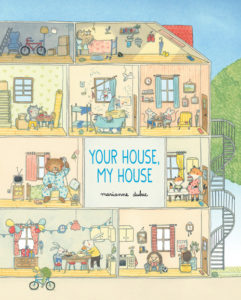
Marianne Dubuc’s new picture book, Your House, My House, almost seems like one of those seek-and-find books my kids loved so much in their k‑1 years. On every page of this book, a little block of text is tucked into the leaves of a tree at the top left while the rest of the page–the bulk of it–offers a look inside a multi-level house full of animals engaged in a variety of actions. Yes, it’s a very special day at 3 Maple Street since it’s Little Rabbit’s birthday. But there’s so much more going on at the same time.
I confess that I find it a bit challenging to connect the text to the characters being referenced since the art is disproportionately large on the page. I’m almost more inclined to just peruse the pictures and imagine my own stories to pair up with the interesting characters versus try to bring the existing text into some kind of connection with the art. Is that a good thing? I’m not sure what to think about it.
Since my responsibility in these reviews is to focus on the story, though, I’ll leave it to Kelly to dive deep into the compelling artwork. While I have lots of appreciation for this book as a whole, I’m giving this a slightly lower ranking than I’d give were I reviewing the entire book as a single thing. With it being such a clearly art-centric book, there’s almost no other option.
It’s worth checking out, though. Let’s not lose track of that fact.
4 out of 5 pencils
–Kelly’s Review of the Illustrations–
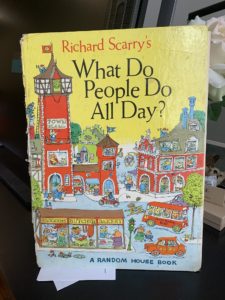
I’d like to ask Marianne Dubuc if she’s a fan of the book What Do People Do All Day? after pouring over her new book Your House, My House. Before I even received the book to review, the cover of her book struck a chord deep inside of me. I ripped tape off of boxes from my recent move, to find my own tattered copy of Richard Scarry’s book.
Was it the cross-sectioned home revealing the inside of the building and goings-on of what appears to be an early twentieth century, very large old apartment building? The viewer never sees the house with its front wall. That invisible wall allows us to take in all that happens on a very, very busy day at 3 Maple Street.
The SUPREMELY detailed drawings in Marianne’s book appear to be done in great, old-fashioned pencil and watercolor. Simply–the best. Some touches of colored pencil, here and there. The palette emits a sunny day in soft washes with just the right amount of puddling. My inner art geek is dying to know. Did she work to size? (which means the size of the printed book.) I wonder if that’s the case because there is so much detail. I would imagine working larger to fit it all in, but if Marianne did that, perhaps all of this lovely graphite would close up and darken and lose its silvery tone.
These are the thoughts that fill my head when inspecting another illustrator’s work.
The details are ABUNDANT and the art tells most of the story. The writing here is mostly visual but WHOOOBOY, what kinds of lists Marianne must have made to keep this all straight as she drew! The day of the tiny Bunny’s birthday is filled with four floors of activity, one tree, two sides of the house, and the street out front. The inhabitants are all drawn with charm and deceptive simplicity. Marianne manages to convey all kinds of mood and emotion in her characters. An annoyed Owl, a sick Bear, Terrible Two Mice Triplets, Expectant Fox Family, Hedgehogs waiting for Dad, Cats moving in, Rabbits burning baked goods, Birds in the branches, a Post-Cat, a Goldilocks breaking and entering, a Wolf chasing down some pigs and a Little Red Riding Hood walking on by. The tiniest of the characters, the ghost, the ladybug, the bee, the mice children, and a very odd Gnome are the only ones that are hardest to read.
Some of their drawings got tight. It was the Gnome that made me put this book onto my Cintiq and blow it up. I stared. ”ISTHAT A…GNOME? A GNOME, TOO??” I started to question my own eyes and rubbed them and wondered if Marianne had eye strain, too, after creating the art. It is quite a feat to draw what is the visual equivalent to a silent movie. I had to go back through all of the pages and see where and when this crazy Gnome came into 3 Maple Street! By making me do that, I knew, Marianne had hooked me into this book experience.
I imagine a child POURING over this book, over and over and over to see all of the details, just as I did with my own Scarry book. This feels very classic, looks very classic, and is illustrated with a lot of class. It feels very real in these times that we stay so close to home and perhaps feel so much more together than we have for a long time.
My ONLY wish? That the book was BIG. 11x15 BIG , like my old Richard Scarry book.
Pure pencil, pure watercolors, pure picture book perfection.
4 out of 5 colored pencils
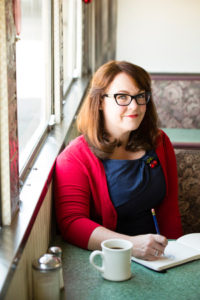
Kelly Light lives in Amherst, MA but grew up down the shore in New Jersey surrounded by giant pink dinosaurs, cotton candy colors, and Skee-Ball sounds. She was schooled on Saturday-morning cartoons and Sunday funny pages. She picked up a pencil, started drawing, and never stopped.
Hold on to your collective literary hats, folks, because this month’s Industry Interview subject—Amy Novesky, the Children’s Book Editor + Director @ Cameron Kids—said “I would love to have some fun” with this interview.
So, to get things off on the right foot, let’s begin with a semi-biographical free association thing. I’ll start a sentence, you finish it. Ready, Amy?
If Netflix is the answer, the question is…
what do you waste time endlessly scrolling?
If Sausalito were a sandwich, the right condiment for it would be…
RVC: As an editor and writer, you’ve been involved with making kidlit books for two decades. Are you a writer who edits, an editor who writes? Or do you have some other way of thinking about it entirely?
AN: Both, depending on the day. But I think of myself as a writer first, always. Writer is who I am, editor is what I do.
AN: I do have a thing for women artists—especially painters. And I have consciously wondered why, and made the connection to my mom who paints, and to our ancestors, a large family of artists called the Peales, who were known for their early American portraits. My great (x4) grandfather, Raphaelle, painted still lifes; he was the rebel of the family. So maybe the artist/portrait/still life gene got passed down to me, and manifests in words, instead of paint.
RVC: That’s such a cool story.
AN: I am drawn to the arts, and to artists, because I have always been in awe of one who can paint, play the piano, dance, sing. What an amazing life. For me it’s not just the art but the way these artists lived their lives like works of art. Frida was a walking canvas.
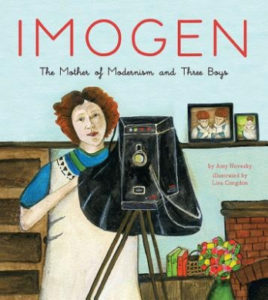
Incidentally, one of the things that connects almost all of the artists I have written about is flowers, which, I also love: Georgia’s giant red poppies, the flowers Frida wore in her hair, the signature gardenia Billie wore behind her ear. The magnolia flower Imogen photographed close-up. And, all of these artists, Louise Bourgeois included, were especially bad ass. Imogen, was probably the most bad ass of all: she managed to be an artist and make art, while raising three boys. That’s what my book, Imogen: The Mother of Modernism and Three Boys, is about.
RVC: Speaking of your books, let’s examine the launch of your picture book author career. What’s the story of that first book?
AN: I wrote Elephant Prince after a trip to India. Among the many things that amazed me was this elephant-headed god named Ganesh. Who was he? And why did he have the head of an elephant? The story is also, simply, the story of a mother who longs for a child, which was something I could relate to; my son, Quinn, was born a year after the book published.
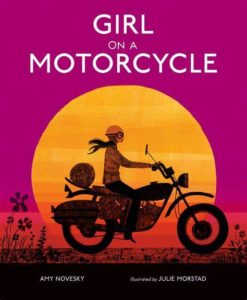
RVC: You just had another picture book come out this month—Girl on a Motorcycle. Congrats on that! What’s your 20-second pitch for the book?
AN: Thank you!
Girl with a good job in Paris, leaves it all, jumps on a motorcycle, carries only the essentials (pocket knife, tarp, anti-diarrheal, eyeliner, bikini, paper & pen …), rides around the world—from France, through Canada to Alaska…to India and Afghanistan…—breaks down, fixes bike, falls, gets back up, finds the world is beautiful and good, writes about it, returns home.
RVC: And all in one sentence, too? Consider me grammatically wowed!
I’m curious. Like the unnamed young Parisian in this story, have you ever dreamed “to go Elsewhere”?
AN: Every day.
RVC: Don’t we all, right? Even before the COVID world we now live in. [sigh]
What was the biggest challenge you faced when creating this book?
AN: Not being fluent in French (despite—I’m appalled to admit—15 years of studying it in school). Luckily Anne-France Dautheville, the subject of Girl On a Motorcycle, speaks decent and, comment dit-on, colorful English. But I would love to be able to talk with her and read her books in French. When I visited her at her home outside of Paris, I felt tongue-tied, in addition to totally jet-lagged. Not the best combo for meeting and interviewing your heroine.
RVC: Well, if you ever want help with French, let me know. I am très good at it! (Spoiler–I might be overstating this a bit. “Très” might be the only thing I actually recall from my Ph.D. crash-course semester in French.)
Moving on–what do you most admire about Julie Morstad’s accompanying artwork for your book Girl On a Motorcycle?
AN: I’ve been a fan of Julie’s work for some time, and she immediately came to mind for this book for her exquisite illustrations, her stylish characters, her sublime palette, which, in this book—beginning with those gorgeous sunset colors on the cover; the coppery brown, uncoated, separate ends; and the muted, earthy and airy hues throughout—takes my breath away.
RVC: Let’s switch gears to your work as an editor. What fulfills you most about that type of work?
AN: Working with words, and in a form that is so distilled, poetic and visual. And, because I am an equally visual person, looking for and working with illustrators and artists.
RVC: How did you get the editing bug?
AN: I’ve been writing since I could write. I studied poetry in college and got a masters in writing, with a focus on short story. It’s hard to make a living writing poetry and short stories, and so I went to work for a publishing house. When I didn’t get the fiction editorial assistant job, I applied to the other editor job that was open: children’s editorial assistant. I fell in love with the picture book form and discovered it was a really good fit for me, and I’ve been doing it since.
RVC: What was the most memorable thing about working for Chronicle Books, where you got that first job in editing?
AN: Living and working in San Francisco in my 20s, making beautiful books, and, the people—many of whom are still close friends, and some I even work with (2 of the 12 Cameron employees worked at Chronicle).
RVC: What was the first picture book you acquired there?
AN: Oh boy. The Go Go Dogs, about two dogs who travel the world, a consistent theme for me. It’s got to be about 3000 words and was clearly influenced by my love of Maira Kalman.
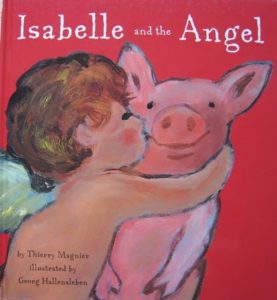
And then there was Isabelle and the Angel, illustrated by Georg Hallensleben, a French buy-in about an art-loving pig who falls in love with an angel in a painting at a museum. She loves him so much she becomes a security guard so she can be near him all night. I know, it’s a little odd. But the art is so gorgeous! I have a soft spot for esoteric French picture books, what can I say. The English-language edition is, sadly, out of print, but I did fairly recently find the original book on the bookstore shelf at the Musée D’Orsay.
RVC: A few years back, you left Chronicle and ended up acquiring titles for two presses at once. How did that happen?
AN: I left my job in 2000 to write and raise a son, and I have been a freelance editor since. Being a freelancer can be tough. I’ve had many many jobs over the years—some I wish I never took and at least one, like my stint at Pixar, which was great fun. Such is the life of a freelancer.
RVC: Tell me about it! My up-to-date resume is 40+ pages long to accommodate all the people/company I’ve worked with over 20+ years of being a writer.
AN: I started working for Cameron + Company, beginning in 2010, book-by-book, and then helped launch their children’s book imprint in 2015. Still, it was only part-time. When Creative Editions, another small, family-owned press, offered me part-time work acquiring for their list, I couldn’t turn it down. Living in the Bay Area on a freelance editor’s income is not easy. Luckily, I was able to do the latter from home, and the two lists are aesthetically different so, creatively, it worked out. I left Creative in February to focus on growing Cameron Kids. And, as of September 1, 2020, I can report that I am a full-time employee of Abrams, New York, which acquired Cameron + Company.
In short, yes, we editors often wear many hats.
RVC: Why is this super-new role at Cameron + Company (congrats on that!!) such a good fit for you?
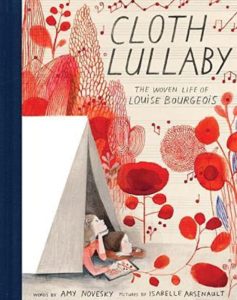
AN: To be the editorial director of a beautiful, thoughtful, well-curated list of books I helped create; to work with people I respect and adore; and now to be a west coast division of a major New York publishing house, whom I also adore (and who published two of my books: Me, Frida and Cloth Lullaby), is a dream job. It was a long time coming, a lot of hard work, patience, and literal blood, sweat and tears, and I couldn’t be happier.
RVC: What’s the most common misconception about picture book editors?
AN: That we like children. Just kidding!
RVC: Who or what has influenced you most as an editor?
AN: I will give you a who and a what.
RVC: Way to overdeliver!
AN: Who: Victoria Rock at Chronicle Books. I learned so much, mostly from typing up her long, handwritten letters to authors and illustrators.
What: traveling the world. The places I’ve been and have lived and loved—India, Mexico, Paris, New York, Southern California, San Francisco, Kauai—influence my books.
RVC: How do picture books create an opportunity for adult readers to be present with kids?
AN: A picture book is a beautiful, tactile object. It takes time to turn a page, to read the words, to stop and define a difficult word or concept or two. One misconception about picture books is that they are simplistic, but they can be quite sophisticated and profound. The best books stop time, allow you to be present, and isn’t that what we strive for with our kids?
RVC: Well said, Amy.
Let me ask an industry question. I’m hearing mixed answers these days. Is COVID making things better or worse for writers? Some argue that editors working from home are able to get more done. Some argue that editors working from home are just as swamped as ever, or even more so. What’s been your experience? And what have you seen/heard from colleagues?
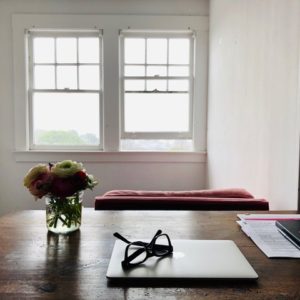
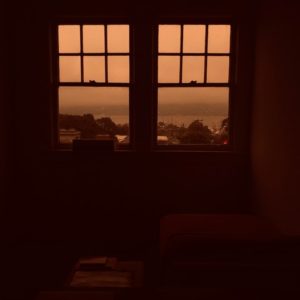
Amy’s home office in March 2020.Amy’s home office in September 2020.
AN: For me, despite it all, I have been incredibly lucky. I have space. I live in a beautiful place. I have work and I can work from home. My son is old enough now to manage his online schooling and make a sandwich. And so, while I’ve surely gone through as many pandemic phases as stages of grief—from the urgency of it in those first few months, to heaviness and depression and rage, to a measure of acceptance, to moments of stillness and creativity–I’m doing okay, getting work done, chasing new books, even writing a new story or two.
But I know many people, friends and colleagues, who are struggling to do it all. It’s a lot. And here in California, we have pandemic + wildfires + smoke + heat + power outages, and there’s always a few earthquakes rattling about. September has been a particularly harrowing and heartbreaking month. When I can get to the office, 1⁄2 hour north, I keep a go-bag, a 7‑gallon jug of water, and masks for multiple emergencies, in my car.
2020 is making us all bad ass.
RVC: Bad ass, indeed!
Circling back now to your work as a bad-ass picture book author—you’ve got an author trailer on your website. Not a book trailer, but an AUTHOR one. So cool! Where’d you get that idea?
AN: I have a good friend who is a talented documentary filmmaker, and she and the co-founder of her company generously offered to make a short film about me. I am super camera-shy, so it was pretty excruciating for me, which is probably apparent in the pained look on my face. That and I’m not great at promoting myself and my work. And so I am so grateful to have such a beautiful piece in my portfolio. It’s at least 10 years old at this point, but the heart of it is still current.
RVC: How have people responded to it?
AN: I’ve gotten some really nice feedback.
RVC: Rightly so. It’s terrific.
AN: Thank you!
RVC: One last question for this first part of the interview. Craziest thing that ever happened re: a school visit you did?
AN: Okay, I’ve got a good one for you. On my way to a book event at a school an hour from my house, it was first thing in the morning, rush hour, I’d drunk a pot of coffee, and there was traffic, I was running late, hundreds of elementary kids were waiting for me, and, I had to go to the bathroom really really, like painfully, badly; I wasn’t going to make it. I pulled the car over as soon as I got off the freeway, jumped out and peed in a bush. I’m guessing some homeowner has probably got some good security footage of this children’s book author squatting on their property.
RVC: This from the lady who said her life wasn’t all that exciting! OMG!
Regardless, it’s your time to shine, Amy, because it’s the…LIGHTNINGROUND! Electrifyingly fast questions and shockingly quick answers, please. Are you ready?
AN: Let’s do this.
RVC: Smurfs, fraggles, or trolls—most underappreciated not-so-tall creatures in pop culture?
RVC: The three most important characteristics that lead to picture book success.
AN: An authentic voice, a compelling story, and a Hell Yes manuscript (Cameron Kids’ motto).
RVC: Thanks so much, Amy. And not that anyone’s keeping score, but I think I won on both counts regarding our challenges. Fun and excitement was indeed had by all. 100% of my pre-pub focus group of 2 agree.
So, thanks for sharing a bit of your literary journey with us today. It was great having you stop by OPB. Best of luck with the new book, too!
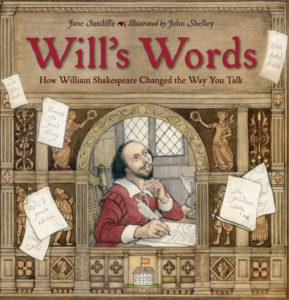
I’m a big Shakespeare fan, so when I saw this book, I knew I had to include it in OPB in some way.
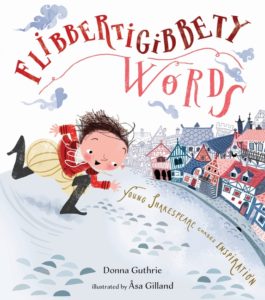
Book description from Goodreads: “With quotes and sly references to the famous works of William Shakespeare and the words he invented, this adventurous ode to language will delight readers young and old.
It all starts one morning when words fly into William’s window. He wants to catch them, but they are flibbertigibbety and quick and slip right through his fingers. Soon whole lines of verse are leading him on a wild goose chase as they tumble, dip, flip and skip all through town, past a host of colorful characters the observant reader may find as familiar as the quotes. William remains persistent, and with time and the proper tools he finds a way to keep the words with him.”
Before Reading–From looking at the front and back cover:
What does the word “flibbertigibbety” make you think of?
Where and when do you think this story takes place?
What do you already know about William Shakespeare?
What emotion does the boy on the back cover seem to be feeling?
After Reading–Now that you’ve read the story:
What is the main message of this book?
Why does young Shakespeare want to chase down and catch strange words?
If you wanted to go outside and catch words, what might you try to do?
The book is full of fun new words. What are some of your favorites? Zany? Madcap? Frivolous? Coax?
What other story does Flibbertigibbety Words remind you of?
What happens–or should happen–after the ending?
What feedback would you give to the author?
Writing–Shakespeare is known for writing amazing poems. Try your hand at writing a poem of your own. Here are some specific prompts to help you along:
Create a poem about weather using first person (“I” or “we”), in which you give the reader clues about what kind of weather you are. The very last line of the poem should reveal your identity–for example, “I am a windstorm.”
Write out the words to a nursery rhyme, song, or short poem. Swap in new words to make an entirely different version of it. Here are a few options you might choose to start with:
Performing–While you can certainly listen to or read a poem, there are more things you might try as well. Consider singing, dancing, or acting out any of the following poems. Perhaps get a friend or adult to help out?
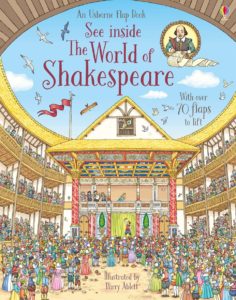
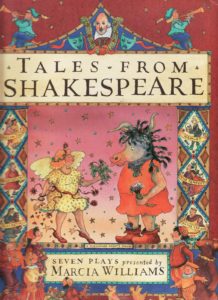
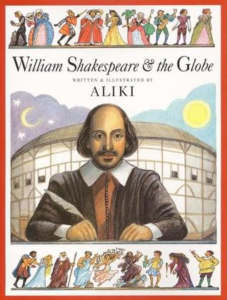
Further Reading–Which of these other picture books about Shakespeare have you read? (Click on the book cover for more information on any of these titles!)
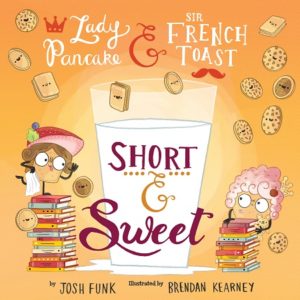
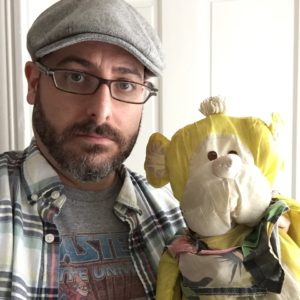
With a writing career as big as Josh has (coupled with a full-time day job!), getting this interview to work out took some finessing, but we did it thanks to his generosity and some fortuitous timing related to his new book, Short & Sweet, coming out. So, yay! And a syrupy hooray!
You probably know a lot about him already, but just in case not, he provides a Mad-libs-style bio on his website. Here’s the template:
Josh enjoys _______ during ________ and has always loved __________. He has played ____________ since age __ and his biggest fear in life is being eaten by a __________.
And here are what I can only assume are the totally-true-fact answers he fully expects everyone to come up with from this interactive bio.
Josh enjoys living one day at a time powered by the awesomeness of a freshly baked cookie during his weekly attempt to make the Kessel Run in less than twelve parsecs, and has always loved putting the “elation” in writerly “public relations.” He has played the role of a passionate cherry limeade lover since the moment he reckoned to be a force to reckon with, and his biggest fear in life is being eaten by a vampire porpoise that sometimes just wants to give it all up and become a handsome aquatic billionaire.
Just in case that’s not yet enough of a deep dive into All Things Josh, I’ll add these final even-truer-than-those-facts facts sleuthed up by our crack research team (consisting of a single penguin intern named Lefty who’s an especially gifted napper), with a little help from Josh himself.
RVC: Welcome to the world of Only Picture Books, Josh!
JF: Thanks for all of the kind words, Ryan! It’s a pleasure to join you.
RVC: Once people knew you were visiting OPB, they all insisted I ask you about rhyme, so let’s start with that. While I realize you can talk for days on the topic, help us understand a specific way or two that we might move from amateur rhymes to elegant ones.
JF: Great question! The most important thing you need to consider is that to be a successful book, loads of different people are going to be reading these words (agents, editors, reviewers, librarians, teachers, parents). However, not everyone pronounces words the same way you do. The English language, even just in the U.S., has many different accents and you want ALL of those accents to pronounce your words properly. So pay attention to each word and each syllable and each whatever-is-less-than-a-syllable (I’m not a linguist)!
There are only ~549 words in a picture book–take the time to make sure each one is PERFECT.
RVC: What’s more important? Rhythm or rhyme?
JF: That’s a trick question. The most important aspect of a rhyming picture book is the STORY. If it’s not a good book without the rhyme, it won’t be good when you add the rhyme.
But between rhythm and rhyme, RHYTHM is more important. It’s harder to learn and more important to focus on. Any first grader can rhyme. Rhythm can be very tricky.
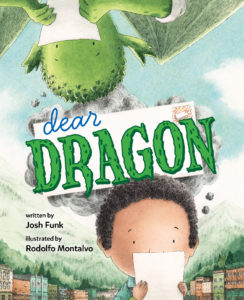
RVC: Which of your books gave you the most trouble in terms of getting rhymes to really sync up in the way you need them to? I’m going to guess Dear Dragon because of all those pen pal letters. But, you know, pastries! And fairy tale folk!
JF: I don’t really think of rhymes as tricky. Writing a rhyming picture book is more like a puzzle–and I enjoy solving puzzles. There’s always another way to say something. If I can’t get a word to rhyme properly, I’ll use a thesaurus and replace it with another that will work.
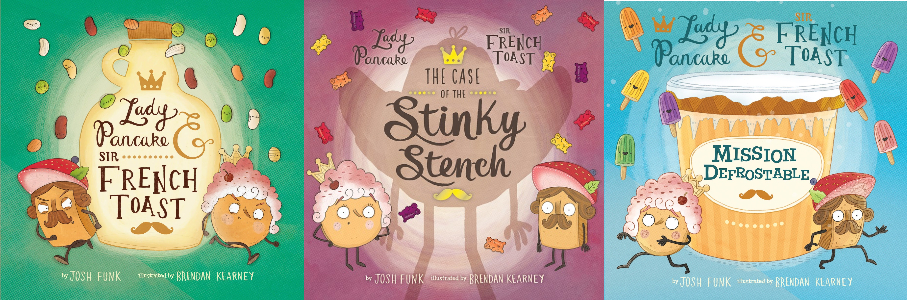
RVC: Volume four of the Lady Pancake & Sir French Toast series comes out this month—Short & Sweet. Congrats on that! Is it getting harder or easier to write sequels for your various series?
JF: In general, as long as I have a good story mapped out for characters I’ve written about previously, writing sequels gets easier. I have a sense of what the pacing will be, what the illustrator will be able to add, and a general sense of what I want to do to differentiate one book in each series with the next.
RVC: Just curious—are the publishers asking for sequels beyond those required in your contract, or are you pitching new ideas to extend any of your series beyond what anyone initially expected?
JF: It’s a combination of both. Usually my agent and I approach the publisher with ideas to see if they’re interested. And most of the time, the answer is based on two factors:
1) Did the previous book do well?
2) Is the new story one worth telling?
I’ve been very fortunate that several of my books have performed well enough that publishers considered the sequels.
And Short & Sweet is a combination of a scifi-comedy (think Honey, I Shrunk the Kids or The Absentminded Professor) mixed with a magical-bodyswap (like Freaky Friday or Big). In this one, Lady Pancake and Sir French Toast begin to grow stale and visit Professor Biscotti who has a DE-spoiling ray. Unfortunately, they shrink back into toddlers and run amuck through the fridge causing culinary chaos once again.
If I get to write more, maybe it’ll be an alien invasion or horror. Who knows?
RVC: If might suggest a genre, I’d say Western featuring their Old West ancestors in a breakfast saloon. “There’s not enough room on this here plate for the two of us…”
But let’s circle back to you. What was the biggest challenge you had in writing Short & Sweet?
JF: The ending. Not the plot part of the ending (Lady Pancake and Sir French Toast return to normal), and not the final page (of course there’s a party at the end and a gatefold), but the emotional wrap-up. Figuring out how to show the character changes and saying it concisely–that spread took several emails back and forth to and from my editor–and she was right to keep pushing me, because it took a while to get right.
RVC: Got a favorite rhyme from Short & Sweet?
JF: Not yet. But maybe after I read it a few hundred times I’ll be able to pick one. Ask me again in a few years.
RVC: Will do. I’ve got you down for an interview part II thing in October 2022. Put it in your Google calendar, please!
JF: Actually, I’m washing my hair that month. Maybe November?
RVC: Deal.
Now, while every author is in some way every character they write, who has more Josh Funk DNA—Lady Pancake or Sir French Toast?
JF: Baron von Waffle.
Lady Pancake and Sir French Toast were inspired by my kids–but deep down, I know that I’d sacrifice myself and have the last drop of syrup if it stops my kids from bickering.
RVC: What else are you working on these days? What books should we be looking for from you in the near-ish future?
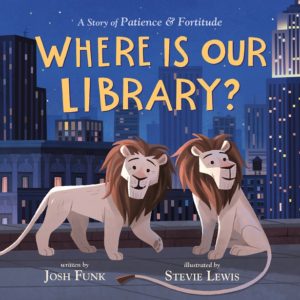
JF: I have two books coming out on October 27th, 2020. Where Is Our Library?: A Story of Patience & Fortitude, the sequel to Lost in the Library, in which the two lion statues that guard the New York Public Library on 5th Avenue venture into the children’s room one night, only to find that all of their books have gone missing. Together they search throughout all of Manhattan for their books, visiting literary statues (like Alice in Wonderland and Hans Christian Andersen) and other library branches before finding them … well, you’ll have to read the book to find out.
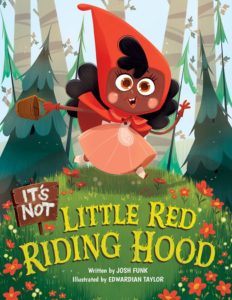
On that same day, the third book in the It’s Not a Fairy Tale series is being released: It’s Not Little Red Riding Hood. In this tale, our beleaguered narrator tries to tell the traditional story of Little Red Riding Hood, but Red rips her hood and borrows her sister’s blue one, the Wolf calls in sick and is replaced by Captain Hook, and pretty much nothing goes according to plan.
RVC: Sounds like a frolicking good time. I’ll be sure to check it out.
Now, you’re often noted as someone who handles book PR better than most. What are two specific things most authors don’t do (or don’t do right) when it’s time to get out there and plug new books?
JF: Well, it’s important to start building your network early. Like now. Before you have an agent or a book deal. Or at the latest, as SOON as you have a book deal–before it’s announced for sure. If you don’t build your network soon, you’ll run into problem number two, which is: don’t say “buy my book.” Ever.
You can share all the good news you have (“I sold a book!” or “I got a good review!” or “Here’s my cover reveal!”), but never say “buy my book.”
RVC: Book trailers. What kind of mileage are you getting out of them?
JF: It’s nearly impossible to tell. But I figure every little thing could possibly help get word of my books out there. And I enjoy making trailers. Some of the best marketing advice I ever received is to do what you like–and conversely, don’t do what you don’t like.
I like making musical book trailers. So I keep making them. I have no idea if they lead to many book sales. But, going back to the previous question, saying “check out my book trailer!” is not saying “buy my book”–yet it still gets my book out there … so why not make them?
RVC: One last question for this part of the interview. What’s the one question you’ve been waiting for someone to ask in an interview, but no one’s teed it up for you yet?
JF: What were Lady Pancake & Sir French Toast going to do with the syrup if they got it?
RVC: How can I NOT ask that question now, right? So, what’s the answer? What WOULD they do?
JF: I don’t know.
RVC: Alrighty, Josh. It’s time to shift gears from Standard Interview Mode to all that’s required of you to succeed in the Sudden-Death-Quadruple-Overtime-No-Holds-Barred Wrap Up. Are you READY?
RVC: Rumor has it Lady Pancake’s secretly writing a tell-all. Any idea what the title might be?
JF: Fresh Takes: From Flour to Fame
RVC: I’ve got a universal translator for catspeak on backorder at Indiegogo. If it ever arrives and I pop in the bio your cat wrote for you, what will it say?
JF: “Josh Funk cleans my poop and feeds me.”
RVC: Five things we’d see if we checked out your fave writing place.
JF: Coffee, Sharpies, coffee, laptop, and coffee.
RVC: A recent picture book where you absolutely loved the rhyming.
RVC: Two lines that sum up your picture book aesthetic. (FYI—if this isn’t a rhyming couplet, the comment section below might explode like an overfilled jelly donut that got squooshed by a woolly mammoth!)
JF:
Goofy, silly, sometimes smart,
Funny with a little heart.
RVC: Thanks a zillion for swinging by today, Josh. Best of luck with the new books! And if you’d ever like to be part of a non-Monday Bonus Goody for OPB, let me know. We’ll cook something up! I’ll bring the blog, you bring the pastries.
About Lady Pancake & Sir French Toast: SHORT&SWEET
This month’s PB review is by Ryan G. Van Cleave (#1 Paper Fan at Only Picture Books) and OPB newcomer, freelance artist Sharon Holm.
–Ryan’s Review of the Writing–
It’s fitting that a book like this is published by Parallax Press, a publisher founded by Zen Master Thich Nhat Hanh, and one that’s committed to producing books on mindfulness. Why? Because the book’s first line is very Zen.
“There is nothing here.”
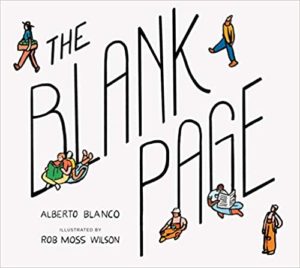
And just as Zen can plunge one past the surface of life, so, too, does this picture book by acclaimed Mexican poet Alberto Blanco seek to send the reader into an unexpected journey into the profound interconnectedness of all things. To look at a single page of paper is to sense the tree it was made from, as well as the rain and sunlight that helped it grow, and so on.
Eventually, “we can see the trees, the rivers, the clouds, and the mountains…and we can see people, like you and me.” That’s a pretty deep concept for picture book readers. But if we’re fine with board books like Nietzsche 4 Babies or Metaphysics for Babies, why not this, right?
Still…is the idea that the book in your hands is something that connects you to the whole universe too big of idea for little ones to grasp? Is it too abstract? I’m not certain. It’s ambitious, to be sure. And there’s a clear sense of community and connection here, which I applaud.
The best line is the last one: “Where nothing happens, there is a miracle that we are not seeing.” A note on the copyright page attributes that to someone other than the author, though it certainly feels like a line that a poet as accomplished as Blanco might have created.
Ultimately, the book might be more about prompting discussions and thought than providing answers or entertaining readers. For the right adult companion reader, that might be a great fit for what they want to share with a child.
3.75 out of 5 pencils
–Sharon’s Review of the Illustrations–
The Blank Page has a clever introduction, especially for a children’s picture book–a blank page that says “There’s nothing on this page.” But is there really nothing there? There’s the page, after all. And the book goes on to examine the process of making the paper that makes up that page, as Ryan noted above.
One might suggest that the story is rather simplistic. But is it really? Can a child see that this is more than just another life cycle of a tree book? The words created a depth I wanted to read into.
Let’s see if the art helps readers explore those depths.
I found the design of the cover to be simple yet effective. I’m also pleased by how that design simplicity is carried throughout the interior spreads. The composition of the interior pages–with the use of sparse text and brightly colored vignettes–pop on a solid white background.
Overall, the illustration style of bold black outlines with bright digital color come across well.
But I wanted more of a connection between the actual artwork and the words of the story. Instead, the heavy lines and flat digital color caused the illustrations to lack the same emotion and depth of the words. It seemed like a missed opportunity.
The art and text didn’t quite work as well as I hoped to support a picture book that isn’t nonfiction, but doesn’t have a main character or narrative throughline.
The book’s message seems to be that everything has a connection, and that we’re all working together in conjunction with our universe. And that we must ALL work together as one, with the universe, to succeed. That’s a great message for any child.
3.25 out of 5 crayons
Sharon Holm is an artist, mother, sister, daughter, wife, friend, black belt kick boxer, and animal rescuer.
She’s also a professional children’s book illustrator/work-in-progress writer. She graduated with honors from the Art Institute of Fort Lauderdale with a degree in Visual Communications, and was an award-winning art director for various advertising agencies in South Florida before turning her attention to children’s illustrating.
Since then, she’s built an art career through illustrating trade books, fiction, nonfiction, activity books, educational products, and bath books, as well as greeting cards, puzzles, and calendars.
I’m always excited to see when there’s a fifth Monday in a month, because that means it’s time for a Bonus Goodie. The Picture Book Lists have been popular–or so you’re telling me!–so that’s what we’re going with again.
The theme this time?
Girl Power!
Here are some of the most empowering girl-centric picture books I’ve found in my library or coming in via the many advance-reader copies OPB gets each month.
See what you think! And please do what you can to get the young girls in your life to check out some of these titles. They’re well worth the re-read!
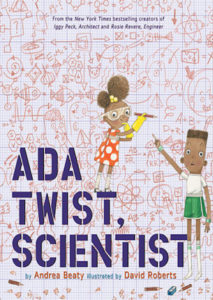
From Goodreads: “Scientist Ada has a boundless imagination and has always been hopelessly curious. Why are there pointy things stuck to a rose? Why are there hairs growing inside your nose? When her house fills with a horrific, toe-curling smell, Ada knows it’s up to her to find the source. What would you do with a problem like this? Not afraid of failure, Ada embarks on a fact-finding mission and conducts scientific experiments, all in the name of discovery. But, this time, her experiments lead to even more stink and get her into trouble!”
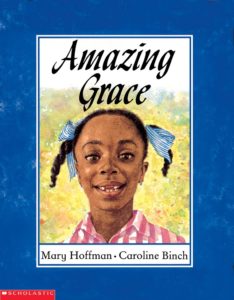
From Goodreads: “Grace loves stories, whether they’re from books, movies, or the kind her grandmother tells. When her school decides to perform Peter Pan, Grace longs to play the lead, but her classmates point out that Peter was a boy. Besides, he wasn’t black.
With the support of her family, Grace learns that she can be anything she wants to be, and the results are amazing!
Remarkable watercolor illustrations give full expression to Grace’s high-flying imagination.”
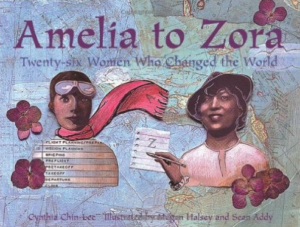
From Goodreads: “Twenty-six amazing women; twenty-six amazing stories. From Amelia Earhart, pilot and adventurer, to Zora Neale Hurston, writer and anthropologist, learn about the hardships and triumphs that inspired each woman to change the world around her. Detailed collages and illustrations draw from various events in the women’s lives.”
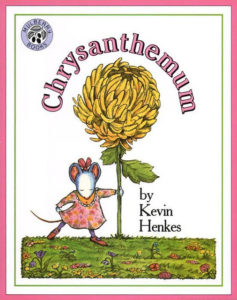
From Goodreads: “Written and illustrated by Kevin Henkes, the nationally bestselling and celebrated creator of Lilly’s Purple Plastic Purse, Owen, and Kitten’s First Full Moon, Chrysanthemum is a funny and honest school story about teasing, self-esteem, and acceptance to share all year round.
Chrysanthemum thinks her name is absolutely perfect—until her first day of school. “You’re named after a flower!” teases Victoria.
“Let’s smell her,” says Jo.
Chrysanthemum wilts. What will it take to make her blossom again?
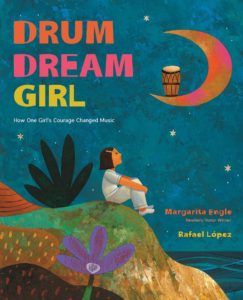
From Goodreads: “Girls cannot be drummers. Long ago on an island filled with music, no one questioned that rule—until the drum dream girl. In her city of drumbeats, she dreamed of pounding tall congas and tapping small bongós. She had to keep quiet. She had to practice in secret. But when at last her dream-bright music was heard, everyone sang and danced and decided that both girls and boys should be free to drum and dream.
Inspired by the childhood of Millo Castro Zaldarriaga, a Chinese-African-Cuban girl who broke Cuba’s traditional taboo against female drummers, Drum Dream Girl tells an inspiring true story for dreamers everywhere.”
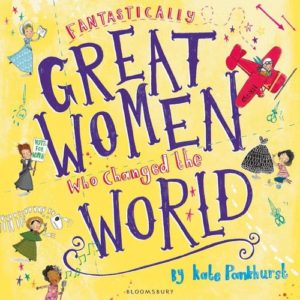
From Goodreads: “Kate Pankhurst, descendent of Emmeline Pankhurst, has created this wildly wonderful and accessible book about women who really changed the world. Discover fascinating facts about some of the most amazing women who changed the world we live in. Fly through the sky with the incredible explorer Amelia Earhart, and read all about the Wonderful Adventures of Mary Seacole with this fantastic full colour book. Bursting full of beautiful illustrations and astounding facts, Fantastically Great Women Who Changed the World is the perfect introduction to just a few of the most incredible women who helped shaped the world we live in.
List of women featured: Jane Austen, Gertrude Ederle, Coco Chanel, Frida Kahlo, Marie Curie, Mary Anning, Mary Seacole, Amelia Earhart, Agent Fifi, Sacagawa, Emmeline Pankhurst, Rosa Parks, Anne Frank.”
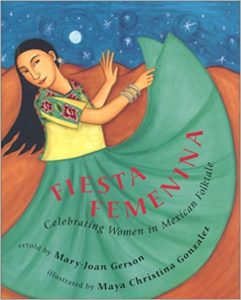
From Goodreads: “A collection of folktales from various cultures in Mexico, all focusing on the important roles of women, such as Rosha, a young girl who rescues the sun; the goddess Tangu Yuh; Kesne, a Zapotec princess; and the Virgin Mary.”
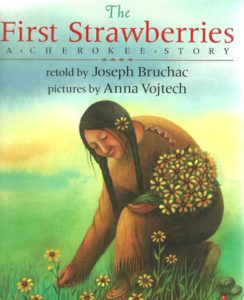
From Goodreads: “From an award-winning Native American storyteller comes this captivating re-telling of a Cherokee legend, which explains how strawberries came to be. Long ago, the first man and woman quarreled. The woman left in anger, but the Sun sent tempting berries to Earth to slow the wife’s retreat. Luminous paintings perfectly complement the simple, lyrical text.”
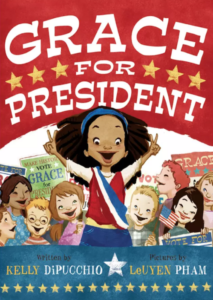
When Grace’s teacher reveals that the United States has never had a female president, Grace decides she wants to be the nation’s first and immediately jumpstarts her political career by running in her school’s mock election! The race is tougher than she expected: her popular opponent declares that he’s the “best man for the job” and seems to have captured the votes of all of the class’s boys. But Grace is more determined than ever. Even if she can’t be the best man for the job, she can certainly try to be the best person!
This timely story not only gives readers a fun introduction to the American electoral system but also teaches the value of hard work, courage, independent thought–and offers an inspiring example of how to choose our leaders.”
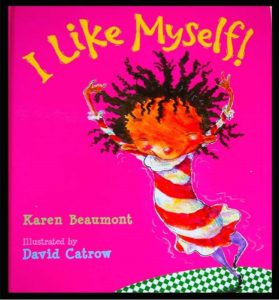
From Goodreads: “High on energy and imagination, this ode to self-esteem encourages kids to appreciate everything about themselves–inside and out. Messy hair? Beaver breath? So what! Here’s a little girl who knows what really matters.
At once silly and serious, Karen Beaumont’s joyous rhyming text and David Catrow’s wild illustrations unite in a book that is sassy, soulful–and straight from the heart.”
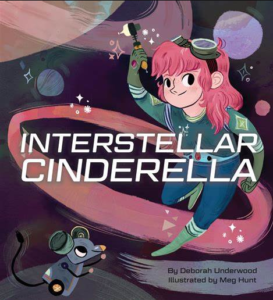
From Goodreads: “Once upon a planetoid,
amid her tools and sprockets,
a girl named Cinderella dreamed
of fixing fancy rockets.
With a little help from her fairy godrobot, Cinderella is going to the ball–but when the prince’s ship has mechanical trouble, someone will have to zoom to the rescue! Readers will thank their lucky stars for this irrepressible fairy tale retelling, its independent heroine, and its stellar happy ending.”
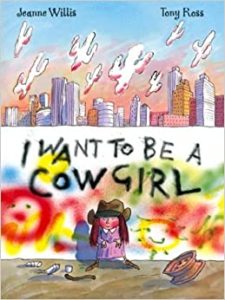
From Goodreads: “Meet a city girl with a big Wild West dream.
“I don’t want to be a good girl- Good girls have no fun. I can’t play quiet games indoors, I love the rain and sun. I don’t want to be a girly girl Who likes to sit and chat. I just want to be a cowgirl, Daddy, What’s so wrong with that?”
From the window of a high-rise city apartment, a little girl imagines a very different view and dreams of a very different life, but does it have to be just a dream?
The big city meets the wild Wild West in Jeanne Willis’s lyrical text, accompanied by hilarious illustrations from Tony Ross.
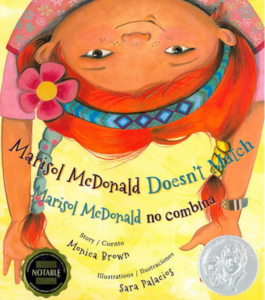
From Goodreads: “ ‘My name is Marisol McDonald, and I don’t match. At least, that’s what everyone tells me.’
Marisol McDonald has flaming red hair and nut-brown skin. Polka dots and stripes are her favorite combination. She prefers peanut butter and jelly burritos in her lunch box. And don’t even think of asking her to choose one or the other activity at recess–she’ll just be a soccer playing pirate princess, thank you very much. To Marisol McDonald, these seemingly mismatched things make perfect sense together.
Unfortunately, they don’t always make sense to everyone else. Other people wrinkle their nose in confusion at Marisol–can’t she just be one or the other? Try as she might, in a world where everyone tries to put this biracial, Peruvian-Scottish-American girl into a box, Marisol McDonald doesn’t match. And that’s just fine with her.
A mestiza Peruvian American of European, Jewish, and Amerindian heritage, renowned author Monica Brown wrote this lively story to bring her own experience of being mismatched to life. Her buoyant prose is perfectly matched by Sara Palacios’ engaging acrylic illustrations.”
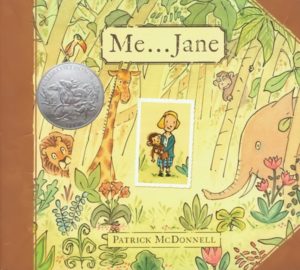
From Goodreads: “Patrick McDonnell-beloved, bestselling author-artist and creator of the Mutts syndicated comic strip–shares the inspiring story of young Jane Goodall, the legendary and inspiring conservationist featured in the hit documentary film Jane.
In his characteristic heartwarming style, Patrick McDonnell tells the story of the young Jane Goodall and her special childhood toy chimpanzee named Jubilee. As the young Jane observes the natural world around her with wonder, she dreams of “a life living with and helping all animals,” until one day she finds that her dream has come true. With anecdotes taken directly from Jane Goodall’s autobiography, McDonnell makes this very true story accessible for the very young–and young at heart.
One of the world’s most inspiring women, Dr. Jane Goodall is a renowned humanitarian, conservationist, animal activist, environmentalist, and United Nations Messenger of Peace. In 1977 she founded the Jane Goodall Institute (JGI), a global nonprofit organization that empowers people to make a difference for all living things.”
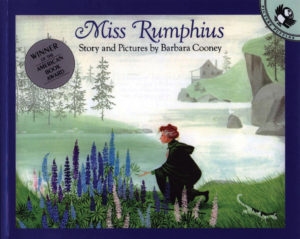
From Goodreads: “Barbara Cooney’s story of Alice Rumphius, who longed to travel the world, live in a house by the sea, and do something to make the world more beautiful, has a timeless quality that resonates with each new generation. The countless lupines that bloom along the coast of Maine are the legacy of the real Miss Rumphius, the Lupine Lady, who scattered lupine seeds everywhere she went. Miss Rumphius received the American Book Award in the year of publication.
To celebrate the thirtieth anniversary of two-time Caldecott winner Barbara Cooney’s best-loved book, the illustrations have been reoriginated, going back to the original art to ensure state-of-the-art reproduction of Cooney’s exquisite artwork. The art for Miss Rumphius has a permanent home in the Bowdoin College Museum of Art.”
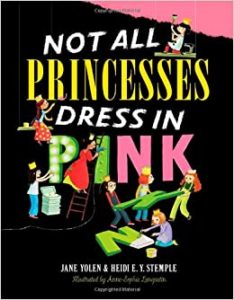
From Goodreads: “Not all princesses dress in pink. Some play in bright red socks that stink, blue team jerseys that don’t quite fit, accessorized with a baseball mitt, and a sparkly crown!
Princesses come in all kinds. Exuberant text from Jane Yolen and her daughter Heidi Yolen Stemple paired with charming illustrations prove that girls can jump in mud puddles and climb trees, play sports and make messes—all while wearing their tiaras! Not every girl has a passion for pink, but all young ladies will love this empowering affirmation of their importance and unlimited potential.”
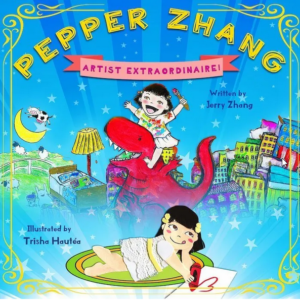
From Goodreads: “This is an extraordinary story about an ordinary little girl who discovers an interest in art and transforms into an Artist Extraordinaire! Through her journey into fame and stardom, Pepper learns an important life lesson about humility. This book was made into reality through a Kickstarter Campaign that received more than $30,000 in pledges! Pepper has been featured on Huffpost, Mashable, Bustle, Upworthy, Now This, Babble and more!”
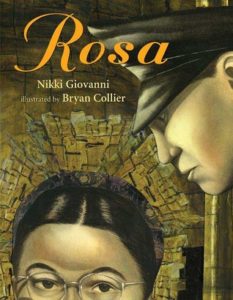
From Goodreads: “She had not sought this moment but she was ready for it. When the policeman bent down to ask “Auntie, are you going to move?” all the strength of all the people through all those many years joined in her. She said, “No.”
A picture book account of Rosa Park’s historic choice.”
From Goodreads: “A is for Activist is an ABC board book for the next generation of progressives: Families that want their kids to grow up in a space that is unapologetic about activism, environmental justice, civil rights, LGBTQ rights, and so on.”
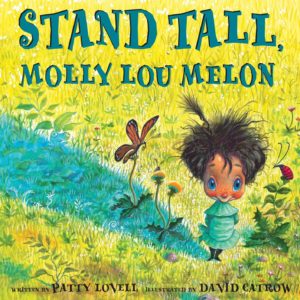
From Goodreads: “Be yourself like Molly Lou Melon no matter what a bully may do.
Molly Lou Melon is short and clumsy, has buck teeth, and has a voice that sounds like a bullfrog being squeezed by a boa constrictor. She doesn’t mind. Her grandmother has always told her to walk proud, smile big, and sing loud, and she takes that advice to heart.
But then Molly Lou has to start in a new school. A horrible bully picks on her on the very first day, but Molly Lou Melon knows just what to do about that.”
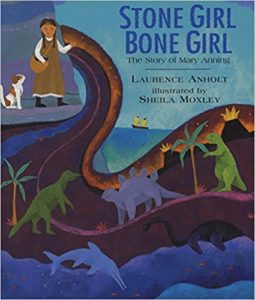
From Goodreads: “A brief biography of the English girl whose discovery of an Ichthyosaurus skeleton in 1811 when she was twelve led to a life-long interest in fossils and other important discoveries.”
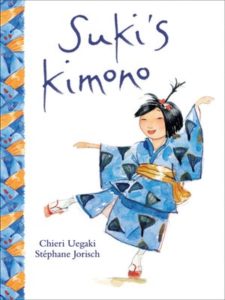
From Goodreads: “Suki’s favorite possession is her blue cotton kimono. A gift from her obachan, it holds special memories of her grandmother’s visit last summer. And Suki is going to wear it on her first day back to school — no matter what anyone says.
When it’s Suki’s turn to share with her classmates what she did during the summer, she tells them about the street festival she attended with her obachan and the circle dance that they took part in. In fact, she gets so carried away reminiscing that she’s soon humming the music and dancing away, much to the delight of her entire class!
Filled with gentle enthusiasm and a touch of whimsy, Suki’s Kimono is the joyful story of a little girl whose spirit leads her to march — and dance — to her own drumbeat.”
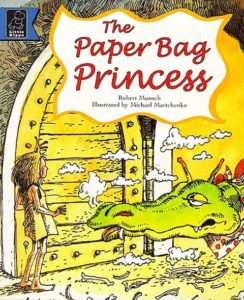
From Goodreads: “The Princess Elizabeth is slated to marry Prince Ronald when a dragon attacks the castle and kidnaps Ronald. In resourceful and humorous fashion, Elizabeth finds the dragon, outsmarts him, and rescues Ronald–who is less than pleased at her un-princess-like appearance. Full color.”
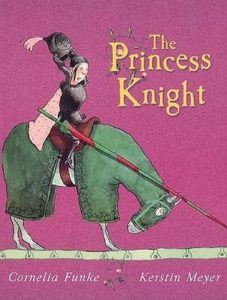
From Goodreads: “Violetta is a princess. But she wants to be a knight. At night, she practises at becoming the best knight in the land. When her father, the king, stages a tournament for Violetta’s hand in marriage, she knows she must win the greatest battle yet, for the most important prize of all–herself.”
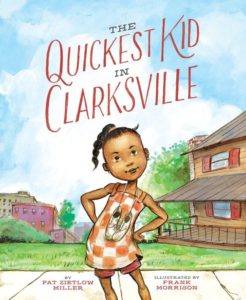
From Goodreads: “It’s the day before the big parade. Alta can only think about one thing: Wilma Rudolph, three-time Olympic gold medalist. She’ll be riding on a float tomorrow. See, Alta is the quickest kid in Clarksville, Tennessee, just like Wilma once was. It doesn’t matter that Alta’s shoes have holes because Wilma came from hard times, too. But what happens when a new girl with shiny new shoes comes along and challenges Alta to a race? Will she still be the quickest kid? The Quickest Kid in Clarksville is a timeless story of dreams, determination, and the power of friendship.”
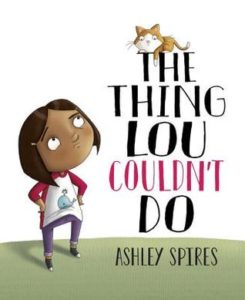
From Goodreads: “Lou and her friends are BRAVE adventurers. They run FASTER than airplanes. They build MIGHTY fortresses. They rescue WILD animals. But one day, when they re looking for a ship to play pirates in, Lou s friend has an idea: Up there! The tree can be our ship! Ummm … says Lou. This is something new. Lou has never climbed a tree before, and she s sure she can t do it. So she tries to convince her friends to play a not-up-a-tree game. When that doesn t work, she comes up with reasons for not joining them her arm is sore, her cat needs a walk, you shouldn t climb so soon after eating. Finally, she tells herself she doesn t want to climb the tree. But is that true, or is this brave adventurer just too afraid to try?
This delightful picture book from Ashley Spires, bestselling author of The Most Magnificent Thing, perfectly depicts what children go through when confronted with something difficult. With humor and endearing artwork, Spires sensitively portrays Lou procrastinating, making excuses, imagining alternatives and denying she cares. Ultimately, Lou faces her fear, and although she fails, the effort empowers her, encouraging a growth mindset. All the while, Lou s friends model compassionate friendship by offering to teach her how to climb and then moving the game. This book makes a perfect choice for a character education discussion about courage or resilience, or a life-skills lesson on facing challenges. The story also promotes the joy of imaginative play in the outdoors.”
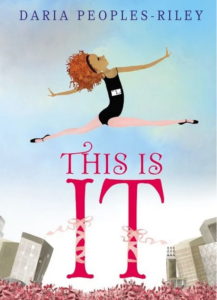
From Goodreads: “Daria Peoples-Riley’s debut picture book is a celebration of individuality, self-expression, and dance. Fans of Misty Copeland’s Firebird and Matt de la Peña’s Last Stop on Market Street will want to read it over and over again.
When a young dancer is nervous about her upcoming auditions, her shadow springs to life and leads her on a joyous exploration of their city. Soon enough, the young girl finds confidence in her skills, her body, and her ability to shine.
With an energetic, rhythmic text that begs to be read aloud and striking, exuberant artwork, This Is It is a love story to originality and the simple joy of movement.
The future is in your footsteps.
Freedom is in your feet.
Put one foot in front of the other,
and greet your destiny.”
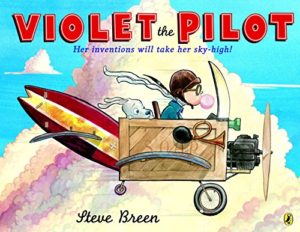
From Goodreads: “By the time she’s two years old, Violet Van Winkle can fix nearly any appliance in the house. And by eight she’s building elaborate flying machines from scratch, mind-boggling contraptions such as the Tubbubbler, the Bicycopter, and the Wing-a-ma-jig. The kids at school tease her, but they have no idea what she’s capable of. Maybe she could earn their respect by winning the blue ribbon in the upcoming Air Show. Or maybe something even better will happen, something involving her best ever invention, a Boy Scout troop in peril, and even the mayor himself! A classic underdog story full of humor and sweetness and retro pizzazz, Violet the Pilot is both endearing and adorable. It’ll fly right into your heart.”
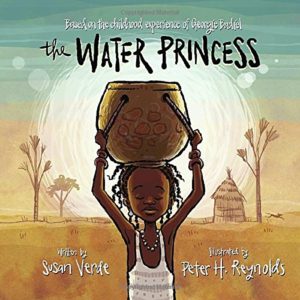
From Goodreads: “Based on supermodel Georgie Badiel’s childhood, a young girl dreams of bringing clean drinking water to her African village.
With its wide sky and warm earth, Princess Gie Gie’s kingdom is a beautiful land. But clean drinking water is scarce in her small African village. And try as she might, Gie Gie cannot bring the water closer; she cannot make it run clearer. Every morning, she rises before the sun to make the long journey to the well. Instead of a crown, she wears a heavy pot on her head to collect the water. After the voyage home, after boiling the water to drink and clean with, Gie Gie thinks of the trip that tomorrow will bring. And she dreams. She dreams of a day when her village will have cool, crystal-clear water of its own.”
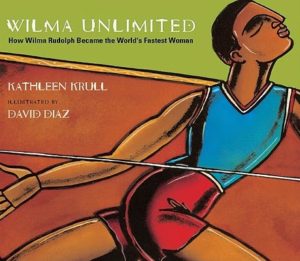
From Goodreads: “Before Wilma Rudolph was five years old, polio had paralyzed her left leg. Everyone said she would never walk again. But Wilma refused to believe it. Not only would she walk again, she vowed, she’d run. And she did run–all the way to the Olympics, where she became the first American woman to earn three gold medals in a single olympiad. This dramatic and inspiring true story is illustrated in bold watercolor and acrylic paintings by Caldecott Medal-winning artist David Diaz.”
AGES 4–7
Cookie Consent
We use cookies to improve your experience on our site. By using our site, you consent to cookies.
Contains information related to marketing campaigns of the user. These are shared with Google AdWords / Google Ads when the Google Ads and Google Analytics accounts are linked together.
90 days
__utma
ID used to identify users and sessions
2 years after last activity
__utmt
Used to monitor number of Google Analytics server requests
10 minutes
__utmb
Used to distinguish new sessions and visits. This cookie is set when the GA.js javascript library is loaded and there is no existing __utmb cookie. The cookie is updated every time data is sent to the Google Analytics server.
30 minutes after last activity
__utmc
Used only with old Urchin versions of Google Analytics and not with GA.js. Was used to distinguish between new sessions and visits at the end of a session.
End of session (browser)
__utmz
Contains information about the traffic source or campaign that directed user to the website. The cookie is set when the GA.js javascript is loaded and updated when data is sent to the Google Anaytics server
6 months after last activity
__utmv
Contains custom information set by the web developer via the _setCustomVar method in Google Analytics. This cookie is updated every time new data is sent to the Google Analytics server.
2 years after last activity
__utmx
Used to determine whether a user is included in an A / B or Multivariate test.
18 months
_ga
ID used to identify users
2 years
_gali
Used by Google Analytics to determine which links on a page are being clicked
30 seconds
_ga_
ID used to identify users
2 years
_gid
ID used to identify users for 24 hours after last activity
24 hours
_gat
Used to monitor number of Google Analytics server requests when using Google Tag Manager
1 minute
Marketing cookies are used to follow visitors to websites. The intention is to show ads that are relevant and engaging to the individual user.
AddToAny provides share and follow buttons that let visitors post your pages to social networks, messaging apps, and bookmarking services.
 boxes from my recent move, to find my own tattered copy of Richard Scarry’s book.
 Kelly Light lives in Amherst, MA but grew up down the shore in New Jersey surrounded by giant pink dinosaurs, cotton candy colors, and Skee-Ball sounds. She was schooled on Saturday-morning cartoons and Sunday funny pages. She picked up a pencil, started drawing, and never stopped.
 Hold on to your collective literary hats, folks, because this month’s Industry Interview subject—Amy Novesky, the Children’s Book Editor + Director @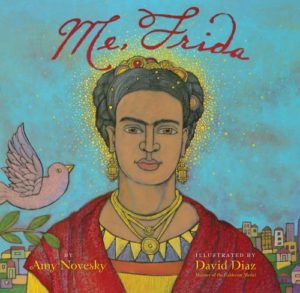

 On that same day, the third book in the It’s Not a Fairy Tale series is being released: