Author Interview: Caron Levis

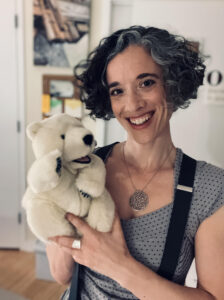
I’m especially excited about this month’s Author Interview because Caron Levis wrote one of my favorite picture books–you’ll figure out what it is easily enough in a moment!

In addition to writing terrific picture books, Caron’s stories for teens and adults have been published in magazines and anthologies, her short-​plays have been selected for several festivals, and the film adaptation of Attendant won Best Short in Sunscreen Film Festival West (2018) and was selected for the Garden State Film Festival. Pretty cool, right? Caron’s also a professor at NYU and The New School’s Creative Writing MFA program where she serves as the advisor for the Children/​YA concentration.

Caron has an LMSW from Hunter College and has facilitated young people’s loss and bereavement groups for The Jewish Board. After many years as an arts educator, Caron now loves using acting and writing to teach social, emotional, and literacy skills to students of all ages through her author workshops. Having trained in acting and dabbled in playwriting, Caron “enjoys turning theatre techniques into writing tools for groan-​ups through her workshop Act-Like-A-Writer.

With that, let’s get to that interview and learn more about our new writer pal, Caron!


RVC: What were some of those early formative experiences that got you on the pathway to being a writer?
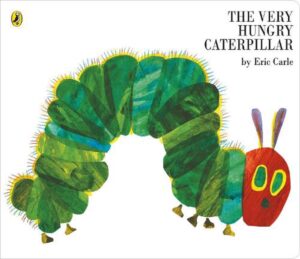
CL: I have this cassette tape recording of my mother when I was around two or two and a half. She read to me a lot every night–she always read to me lots of picture books. Anyway, she was leaving me with a non-​family babysitter for the first time, so she thought it would be helpful to record herself reading our nightly picture books. The one that stuck with me when I listened to it was The Very Hungry Caterpillar. It was amazing because my mother’s Brooklyn accent was so strong, which made it fun to listen to.

You can hear me in the background, calling out the words that I knew–you know, “hungry!” “cherry pie!” that sort of thing. Clearly, I was lucky to have that time in my life where I absorbed so many words and books. As we now know through research and science, that’s one way you learn to read and enjoy books.

I also had a Brooklyn grandmother who was a kindergarten teacher. She loved to read with me. As I got older and became a reader myself, we’d watch Wheel of Fortune together. That all helped me fall in love with words.

RVC: When did you first realize you’re a writer?
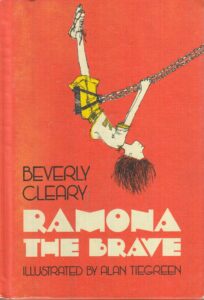
CL: The moment cemented in my memory is reading Ramona in second grade and feeling like someone knew me. I enjoyed feeling very validated in the messiness of Ramona. I realized I wanted to write books for other kids so they could know that feeling, too.

RVC: That’s awesome.

CL: I was lucky. I had wonderful elementary school teachers who validated me, or at least I read it that way. Looking back at my journals, there’s not necessarily a budding writer there. There’s a lot of “Can you actually write MORE next time?” But they were always really encouraging.

I’m still in touch with my second- and fourth-​grade teacher. She’s in second grade now, still teaching at the same school, and with each new book of mine, she’s invited me to visit her classroom. It’s such a special treat to be able to do that.

RVC: So, along the way, you got all kinds of degrees and training that seemed you had a non-​writer path in mind.

CL: I always wanted to be writer, but in elementary school, though, I got taken to A Chorus Line and The Fantasticks, because I lived in New York City. I fell in love. “I’m going to be an actor!” I decided.

Around sixth grade, I wrote a term paper on a famous case of pretty intense child abuse and neglect that I learned about from the TV coverage. It really shook me. I thought about it a lot. I remember thinking, “Why isn’t the world literally stopping to fix this for kids?” That led me to thinking about being a counselor, or at least somebody who worked to help kids.

RVC: That’s a lot of different directions.

CL: I’m still trying to sort it all out! It all comes together though in my author workshops for kids and adults, where I use acting and writing to explore emotional skills and subjects.

RVC: How did that morph into you becoming a published writer?

CL: As an undergrad, I was studying creative writing with the goal of writing short stories and plays. I was taking acting classes, too, and absorbing child psychology through a couple of classes. I was always working with kids through children’s theater, which was influential for me. I combined those loves. I performed a show that was about dating, violence, healthy, unhealthy relationships.

Anyway, I graduated with my undergrad degree while remaining fairly lost about how to pursue those things. Nobody really gave me directions such as “Okay…THIS is what you should do next.”

RVC: Too few students get that kind of useful advice, it seems.

CL: I puttered around, and I’d get jobs in education, doing various things for both love and money. I was writing fiction plays and stuff for kids–a bunch of different things. And I was auditioning and taking part in super off-​off-​Broadway stuff. I was trying everything.

At some point, I decided, “Okay, I’m not really making headway on trying to do all of these things.” I started feeling that I needed to pick something to dive into and pursue. I realized that I wasn’t really pursuing my acting career aggressively like I could’ve been. I had knowledge. And I had contacts I wasn’t using. Honestly, I found the auditioning process to be soul sucking, and I kept walking out of auditions because I’d look at the script and decide, “I don’t want to do that.” I didn’t want to do commercials either, which is how you earn money as an actor.

I remembered advice I’d gotten during acting training in my undergrad classes. At the time, it made me so mad. A visiting teacher said to only pursue a career in acting if there’s nothing else in the world you can do for work that will bring you joy. Only do it if you’d truly be miserable without it.

I decided I was going to give that a try–I’d completely drop the goal of acting for six months. I started working for a company that hired actors to teach conflict resolution and communication skills in K‑12 schools through push-​in programs before SEL was an accepted and understood term. I loved that work so much. It just filled me.

I checked in after six months, and I wasn’t miserable about not acting. I still loved acting as a craft, but I was more in love with the skills and other things it gave me that I could incorporate into my educational work. Acting totally informs my writing process. And it informs me as a human, quite frankly.

RVC: And that’s when you turned to writing?

CL: I was writing more. I tried giving up writing a few times, too, but I’m always too miserable without. So, I’m stuck with it.

RVC: I’ve been there!

CL: I wanted to be a novelist and a playwright and be writing for children all at the same time. At the time, I was still in my 20s and I was working in this wonderful school, in a kindergarten classroom. I loved that. And even when I was writing for kids, I was writing YA and MG. I’d never thought of myself as a picture book person because I wasn’t a visual artist. But I was absorbing so many picture books. I’ve always loved them and never stopped reading them.

I ended up with a notebook full of ideas from students I was working with, and one in particular was really, really sticky. It came from a chat with a kiddo who was feeling blue. I decided, “You know what? I think I want to focus on writing for children.” When I finally said it out loud, everyone around me was like “Duh!”

RVC: Hah!

CL: That led me to reading more intentionally, and checking out books on writing for children, and that led me to SCBWI back when they were borrowing space in an office around Union Square. I went to a few talks with editors, and that led me to finding my first writing-​for-​children writing group. Truly wonderful folks.

Two of the women there kept nudging me to go to the New School MFA Writing for Children and Young Adults program. At the time, I said, “I’m not going to graduate school for writing!” That seemed like a really bad idea. But I ended up there, and it was wonderful. It was a great investment of time and money. I met other like-​minded people, and I got to study with David Levithan, Sarah Weeks, Tor Seidler, and Susan Van Metre.

RVC: Were you submitting work at the time?

CL: Before I got to MFA program, I’d written a few picture books and sent them out old-​school style in the actual mail with SASEs [self-​addressed stamped envelopes] and gotten a bunch of rejections. And the one that meant most to me was for a book based on sadness, Stuck with the Blooz.

I keep those rejection letters., When I visit elementary schools, I bring those letters and read them with the kids. Some are form rejections, and some are encouraging. I had one amazing editor who asked for an exclusive and held it for a few months, but finally passed. And I, of course, got totally stuck with my own blues, but kind of came out of it thinking, “Oh, that was close.” That’s when I ended up with the writers group and the MFA program. But at the time, the business was telling me that picture books weren’t selling, and breaking in with a picture book was impossible. So, I was working on YA material instead. My plan was to finish the YA book and look for an agent.

RVC: I’m guessing the plan didn’t go as planned?
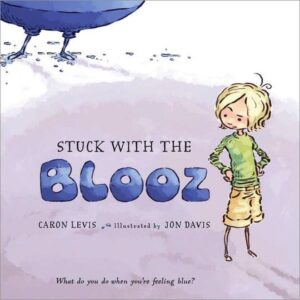
CL: Exactly. What happened instead was the kind of luck you get when you’re working for it. I ended up being introduced through someone to Adah Megged Nuchi, an editor who just got the power to acquire books at her job at Houghton Mifflin. I sent my picture book manuscript to her, thinking it was a long shot.

She loved it. And she fought for it. I think it was about eight months of waiting but I got a contract.

The idea for that book–Stuck with the Blooz–came to me 10 years before publication. I still have the notebook from that kindergarten class where I jotted down that idea.

RVC: I save notebooks like that, too. Just in case.

CL: I hope the wait’s not that long for everyone else. But I loved how it came out. It was worth the wait.

RVC: What’s the most important lesson that book taught you?

CL: I had this weird belief that you’re supposed to be really excellent at something before you announce that you’re trying to do it. It couldn’t be worse thinking. Find other writers to support you sooner than I did. Get out there.

RVC: Joining SCBWI can help.

CL: Absolutely. SCBWI, a class, an MFA program, a writer’s group—whatever works for you.

RVC: What happened next?

CL: I was reading a lot at the time, really absorbing all these books. But I don’t think I understood how to read like a writer the way I do now. Instead, I was engaging and listening to the kiddos which I just enjoyed doing so much. And then letting my imagination go.

I learned persistence, as well, both in the drafting and the craft, and obviously in pursuing publication.

RVC: Amen to that.

CL: Another writing lesson I learned is that ideas are plentiful. A lot of them can come in. For me, the hard work isn’t coming up with ideas but rather figuring out which ones have enough juice to become a book and are important enough for me to stick through all of the rough parts of the writing and the business.

RVC: You mentioned “reading like a writer.” How does one do that?

CL: That’s one of the best things I got from grad school–learning how to read books like a writer, which is to figure out the names of the craft elements. I mean that both objectively–like what makes something work–but also just for you, as in when you find something that you think is awesome, how do you identify it so you can use it? It’s pulling the story apart to figure out what’s actually being done, such as how to infuse emotion at the line level.

RVC: What is something about your writing or revising process that might surprise people?

CL: It can be really long. I revise forever. This reality wouldn’t surprise established writers, but if you’re new to writing or if you’re a young reader and you learn this? When I explain this in schools, kids look shocked and teachers love having this as a reference when they ask students for more drafts.

RVC: Care to share a bit more about your revision process?

CL: My revision process is very nitpicky. I go over and over things. You have to kind of tear it away from me. With my last few books, my very patient editor has let me nitpick to the very end.

There’s always a place that I get to that’s what I call “the pit of despair,” where I can’t figure something out, or it’s not working. If it’s a contracted book, I now have the experience of knowing that it’s merely part of my process. That doesn’t prevent me from being in the pit of despair, but I have this other part of my brain that’s saying, “Oh, here you are. This is THAT part. You’ll be here for a while.” But I know I’ll figure something out.

RVC: I want to talk about one of my favorite books, which is Ida, Always. I first heard it when Emma Ledbetter (read her OPB interview here!) read the entire thing aloud at an SCBWI conference event in Orlando some years back. She included spreads via an overhead projector, too.
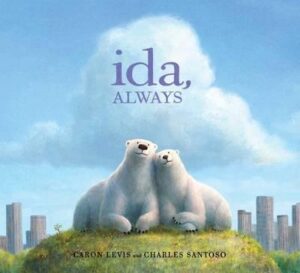
CL: She was my editor.

RVC: Ah, that’s right–I remember that fact now. She clearly loved your book and was using it as an example of great writing. People in the audience were literally crying over it–not fake crying but real crying. 

CL: Wow.

RVC: Please tell me how that book came about.

CL: People knew I was interested in social emotional learning for a long time, and they started asking me if I’d considered writing something that deals with death–specifically death and grief. A neighbor once asked this because their elder cat was ill. “I have no idea how to talk to my four year old about this. Have you ever thought about making a book to help with this?” Stuck with the Blooz had come out by this point and during a school visit in Newtown, Connecticut, a teacher asked me about that topic as well.

Meanwhile, I also had that notebook where Stuck with the Blooz came from, and I saw that I’d written about a moment that struck me. During playtime, a group of kindergarten students constructed an in-​depth funeral for a bug. They set up seats, they gave eulogies, and at one point, somebody said, “And now we’re supposed to cry.” It was incredible.

And then my editor from Blooz who knew I was playing around with this type of idea sent me an article about Ida, the polar bear that died. Gus and Ida lived in Central Park Zoo for a very, very long time, which is also near where I grew up.

Those two things came together. It just felt like the perfect vehicle to explore the story I wanted to because while there were books about death, they tended to focus very specifically on grandparents or a pet. I wanted one that could be open for all kinds of relationships.

RVC: It’s so lucky that your editor sent that article to you. How did the writing process go?

CL: When I started, I was thinking about the story being after the death of Ida, with Gus being there, and having the main character be a child who visited Gus. I wrote many drafts that way, and it was sort of inspired by a photo and an article I’d seen. Plus, I visited Gus. It was just me and Gus hanging out when I did that.

I didn’t have an agent, by the way, but my wonderful editor was looking at this uncontracted manuscript because she wanted to publish it.  Yet it wasn’t quite working. I don’t remember exactly what happened, but I’m going to give her the credit because she probably posed the question–since the story is really about the two bears, can they be the main characters?

I took the story back and spent some time making it about the two of them. That took a while. Eventually, I had a bunch of what you see now, but my editor said that we need to love their relationship before we start losing Ida. That’s when I started thinking about establishing their bond a lot more because it’s easy to think, “Well, OF COURSE everyone’s going to be engaged and moved by someone losing someone they love,” But you need to let people feel what is precious. It’s an idea I’ve carried with me since. Make sure you’re establishing what we care about before the challenges arise.

At some point, I discovered the city was how they connect. It became not quite another character, but a representation of the connection between them.

RVC: What were some of the other challenges you were facing?

CL: It was important to me to use the word “die.” In fact, I wanted to use it twice, but that didn’t end up happening. Euphemisms have their place, for sure, but with a lot of kids, they can actually lead to more emotional difficulties because they can be taken literally. For example, “just went to sleep” can at times cause very young kids to worry about their parents “going to sleep” or themselves falling “asleep.”

It was important to me to use the correct word, but also to do it gently. I’d read the story to imagined kids to see if I felt like I was being dishonest or too harsh.

RVC: Ida, Always has serious emotional resonance. In your mind, who sets the standard for books like this? Who do you recommend when you want to show someone the true level of emotion a picture book can generate in a reader?
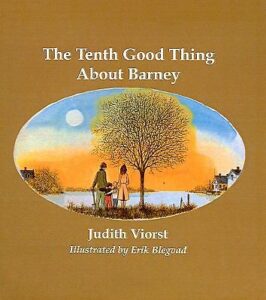
CL: There’s just so many people who do it well. It takes my breath away. But who comes to mind right now? A writer who surely influenced me–though I wasn’t consciously aware of it at the time–was Judith Viorst. I felt lucky that I somehow didn’t make that connection while I was writing Blooz or Ida because I realized later, “Oh, I’ve been trying to be her because her great Alexander books are about being sad. And The Tenth Good Thing About Barney is about death.”

In terms of recent books, I like Jessixa Bagley’s Boats for Papa. It’s just gorgeous, and she makes some interesting emotional choices. It’s a good example of creating characters that has enough distance from real life and events that allows a young reader to move forward emotionally into the book as opposed to feeling like they need to be protective.
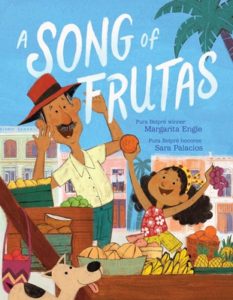
Anastasia Higginbotham has very different kinds of books. They’re much more direct explorations and so useful. And there’s A Song of Frutas by Margarita Engle and Sara Palacios. It’s such a gorgeous book that deals with family and also separation.

Then, of course, you have The Rabbit Listened. Cori Doerrfeld just nails it. That book is one of my favorites.

RVC: Let’s talk about your new book, Feathers Together, which isn’t so much about death as it is about separation and ambiguous loss.
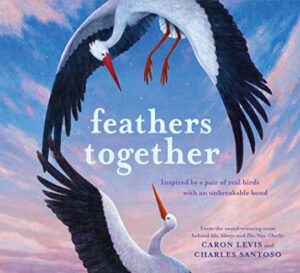
CL: This was a doozy. It’s the third animal book I’ve done with Charles Santoso, and we have a fourth one coming out next year that features elephants.

Feathers Together has been the hardest, longest, most tumultuous revision of any book I’ve done. And, of course, it was one of the ones that I thought was going to be the easiest.

RVC: Isn’t that always the case? Tell me more!

CL: I was very purposely trying to come up with another story that was inspired by a real-​life animal that I could pitch to Emma [Ledbetter] and have Charles [Santoso] illustrate. For the first time, I was intentionally seeking an idea.

I was staying with my aunt while doing book research and she said, “This friend of mine sent me the cutest video about these ducks.” Now, there’s so many adorable animal relationship videos out there, and you could spend your life watching them, but as wonderful as they are, most don’t have a real story in them. It turned out that they weren’t ducks but rather storks, and their story was incredible. I was in love with it for so many reasons.

The real story takes place in Croatia, when a man found a female stork whose wing was injured by a poacher–she’d been shot and couldn’t fly anymore. She couldn’t get fish, and she couldn’t get up to a nest. So, the man took her in, and he created a nest for her with a ramp because they like to nest up high. What Charles created for the book is pretty close to what it really looks like.

RVC: I’m not surprised. Illustrators often do as much–or more!–research as their writer partners.

CL: She couldn’t migrate. So, the man took care of her in the winter. I’ll share the real story with you because it goes into making choices about the book.

The two storks had babies, and the human man and the male story helped her raise the babies and teach them to fly. But each year, for 19 years, this male stork would migrate to South Africa with the rest of the flock and bring the babies with him over 8000 miles and return to Croatia later when the weather was right.

This story struck me on multiple levels. It has the relationship with the human and her that was just so incredibly moving. And then there’s the forced separation, which was my primary interest. I immediately was thinking about kids that I knew and families I worked with and how they had to deal with separation from the military life, from immigration, etc. For some people, separation is just a consistent part of their lives. It’s interesting, too, that I wrote this before the pandemic.

RVC: Which created all kinds of separations.

CL: I also saw in this story a way to address gun violence because the poacher had shot her. There was the whole story of chosen families with this wonderful man Stjepan taking Malena in. The book also deals with the way injury or disability can affect relationships on both sides–not being able to do things that were planned.

At first, I tried to write all of these ideas into the same 40-​page picture book. I tried to do that for months and many revisions. On maybe the fifth revision, my editor helped me realize I needed to focus on the separation. That while I can touch upon everything, I couldn’t responsibly go deeply into everything at the same time.

So, I had to let go of this huge part of the story that I’d wanted to tell and that took me a while. It was a big part of that long process.

RVC: That had to be hard.

CL: I was trying to stay true to my original vision, but it created too many stories to tell, which hearkens back to the lesson I learned with Ida about establishing the relationship first. Before you know the loss or the event that is the bulk of the story, you need to have that connection. There wasn’t enough real estate in the picture book format to go through Malena discovering and forming relationships with the human, and then forming a relationship with Klepetan and then losing him. You have to make these time frame choices for your book. What is the most important part of the story? Where does it need to actually start?

So, I changed some details as I fictionalized the story. It’s inspired by real-​life animals. It’s not nonfiction, however.

RVC: That’s a huge difference.

CL: I started out with them just being friends. Then I had to make a choice, and I decided to focus on the aspect I really loved–that this was a long term, seasonal thing. These were hard choices, but I had to make them or the emotional resonance would be lost. I knew the emotional aspect that I wanted to create though getting there took SO many drafts.

RVC: Are you open to confessing to how many drafts you have for Feathers Together?

CL: It’s fair to say dozens of drafts. For sure.

Some are big revisions and other times they’re just line-​level revisions. But because of the emotional aspect of this, I spend so much time on one line or one moment because that’s the thing with picture books–you’re trying to get it as succinct as possible. I’m constantly trying to get them shorter but also be nuanced.

RVC: Not an easy task.

CL: Not for me. But I love it. I love doing it. And it’s meaningful to me.

RVC: I hear you there. Now, one final question for this part of the interview. What are you working on next?

CL: Charles is now doing his part working on Mighty Muddy Us, which is our book about elephant siblings. I just saw sketches for it and WOW, they’re amazing. It’s another inspired-​by-​true-​life animal tale about a young elephant with a birth injury and how he gets along with his older sister. It’s about that relationship and how your sibling roles get established, and how, as your relationship ages, you can get stuck in these roles, and that can cause conflict, and about how they navigate it.

I’ve got another idea I’m very excited about, but my editor hasn’t seen or heard about it yet, which is why I’m not talking about it specifically. Just crossing fingers.

RVC: Okay, Caron. It’s time for the LIGHTNING ROUND. Let’s get zippy and zoom right along. Are you ready?

CL: Let’s do it!

RVC: What outdated slang do you use on a regular basis?

CL: Geez louise.

RVC: What word do you always misspell?

CL: Oh, here’s a good one for me to confess. I can’t even say it, and I use it in my books all the time! Onomatopoeia.

RVC: What moment from a picture book do you wish were real?

CL: One of my early favorite Hans Christian Andersen stories has a little girl whose flowers are wilting, yet they come to life at night and they all dance at a ball. I always wanted to go to that ball and I think I still do.

RVC: Which picture book author would you want to write your life story?

CL: I’m going to cheat and just say Julia Sarcone-​Roach because she knows me. And I know she’d be very kind. And the story would be beautiful. And there’d be lots of animals in it.

RVC: What picture book do you recommend for those who don’t normally read picture books?
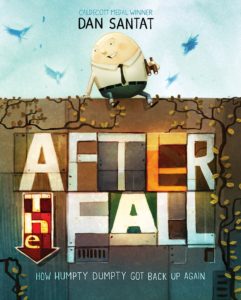
CL: There’s so many. I guess…After the Fall by Dan Santat, because I feel we could all use this beautiful encouragement to climb back up the wall right now.

RVC: Six words that speak to your picture book philosophy.

CL: Seriously playful work for important people.

RVC: Thanks so much, Caron. This was a real pleasure.
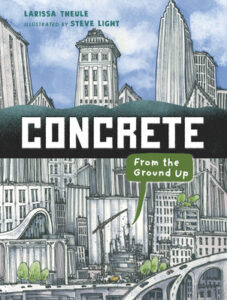
Picture Book Review: Five-​word-​reviews on Five Picture Books (Abbreviated Hurricane Ian Version)

In case you didn’t know, the OPB mother ship/​home base/​lair is in Sarasota, FL, and Hurricane Ian caused a bit of havoc with my house/​yard and my ability to get online to handle the blog. Since my illustrator review partner for October also lives in this area, the OPB plan regarding today’s post went kablooey.

I considered just skipping a week, but decided to simply go with a change of pace instead. Here it is–my five-​word reviews on five new picture books!

**For those who are concerned, my house is still safe to live in, I have power and Internet (thanks, FPL!), and my family is doing well. But I’m sending supplies down to Lee County, though, which took the real brunt of Ian’s strength here on the Gulf Coast of Florida. I encourage others to do whatever they can to help, too.**


Author: Larissa Theule
Illustrator: Steve Light
Candlewick
27 September 2022
32 pages

Ryan’s five-​word review: Engaging. Eye-​opening. Surprisingly fun. Solid!

4.75 out of 5 concrete blocks


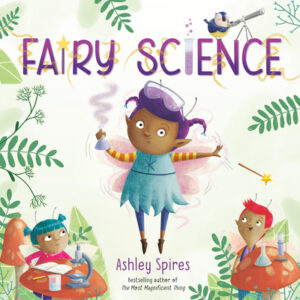
Author: Ashley Spires
Illustrator: Ashley Spires
Dragonfly Books
6 September 2022
40 pages

Ryan’s five-​word review: STEM and magic? Discussion worthy.

4 out of 5 magic wands Bunsen burners


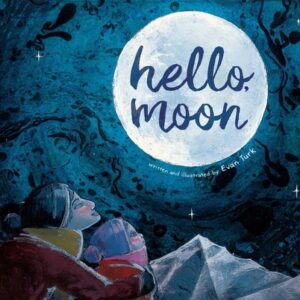
Author: Evan Turk
Illustrator: Evan Turk
Atheneum Books for Young Readers
20 September 2022
40 pages

Ryan’s five-​word review: Luminous. Richly emotive. Child-​like curiosity.

4.25 out of 5 moon phases


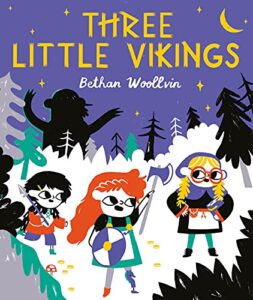
Author: Bethan Woollvin
Illustrator: Bethan Woollvin
Peachtree Publishing
30 August 2022
32 pages

Ryan’s five-​word review: Small voices matter. Appropriately clever.

4.5 out of 5 Viking axes


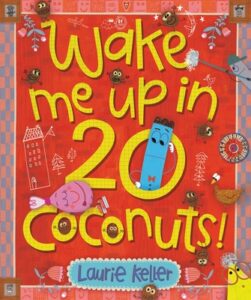
Author: Laurie Keller
Illustrator: Laurie Keller
Christy Ottaviano Books
20 September 2022
32 pages

Ryan’s five-​word review: Jam-​packed fun. Asking questions = good.

4.25 out of 5 coconuts

Editor Interview: Frances Gilbert (Doubleday Books for Young Readers/​Random House Children’s Books)

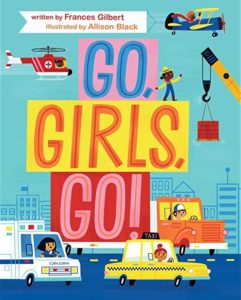
This month’s Industry Insider is Frances Gilbert, Editor-​in-​Chief at Doubleday Books for Young Readers/​Random House Children’s Books. In addition to editing some of the top picture book writers working today, she also authored the picture books Go, Girls, Go! and Too Much Slime!, as well as numerous Step Into Reading titles and an abridgment of The Secret Garden. Among other things, Frances is well known for offering clear, supportive writing advice on social media and at writing conferences.

Let’s get to the interview to hear some of that wisdom ourselves firsthand!

Frances’ Twitter


RVC: At what point did you realize you were absolutely going to work in publishing? 

FG: I grew up in a blue collar family in a blue collar town where people didn’t have jobs like the one I have now. When I got to University of Toronto, I was surrounded by élite students whose parents had jobs I didn’t even know existed.

One friend’s mother was a sales rep at a big publisher. I asked if I could visit her office and as soon as I saw the stacks of books in everyone’s cubicles, I decided it was the place for me. She actually tried to talk me out of it! I think she was pretty burnt out. But in my head I kept thinking, “Nope, nope. This is what I’m going to do.”

RVC: What happened next?

FG: A couple of lucky breaks. A friend noticed a posting on a job board at University of Toronto while I was finishing my Master’s degree in English. It was for a Book Club Editor at Scholastic Canada. I knew I wanted to work in publishing but had my sights set on literary fiction. I applied anyway and was hired by the brilliant and wonderful Iole Lucchese, who thankfully read to page two of my resume and saw that I’d worked in the children’s department of my town library for four years in high school. She saw potential that I’d completely missed. Within days of starting, I knew I wanted a career in children’s books.

RVC: What kind of duties does a Book Club editor have? 

FG: A Book Club Editor manages the monthly book club—those flyers we all ordered from as kids. My responsibility was to select and purchase the Canadian content for each list, in addition to writing the copy and hitting monthly financial targets, so I was essentially a book buyer with a large business to manage and account for. I met with every Canadian publisher a few times a year and liaised with my counterpart in the New York office. Looking back, I still can’t believe they gave me such a big job. It allowed me to leap over assistant and associate positions and start right in the deep end. I was so lucky.

RVC: This might seem like a silly question, but I know people are wondering. Were books being published by Scholastic Canada solely for the Canadian marketplace? 

FG: Like any publisher, Scholastic Canada publishes primarily for their own country first, the Canadian marketplace, but not exclusively. Every publisher also has an international sales and foreign rights team who both sell English language copies around the world and license the rights to foreign translations.

RVC: How much French did you pick up while there?

FG: I lived in Canada from age five till I was thirty and took French in school through my second year of university, so I can get around in French at a schoolgirl level.

RVC: Très cool! Now, what are your thoughts on the Tim Hortons Double Double?

FG: I picked up a Tim Hortons Double Double each morning on my way to work. I still hit one up as soon as I land in Canada. Not Double Double anymore, but it’s still my favorite coffee.

RVC: Before getting to Doubleday where you’re at now, you spent a good bit of time working at Sterling (for those of you who don’t know, it’s owned by Barnes & Noble).

FG: Sterling was family-​owned when I was hired. I knew them as one of my suppliers for Book Clubs and Book Fairs. I bought books from them. The owner wanted to start a children’s editorial division and asked if I was interested in moving to New York to set one up. I was twenty-​nine when I got the offer, and had never actually edited a book, as my position was as a buyer and product manager.

RVC: What were some of the highlights of working at Sterling?

FG: Looking back, Sterling’s family-​owned, maverick spirit was certainly a highlight. They were nimble and independent and could take chances. When I protested during my interview that I had no editorial experience, they said, “You’ll learn!” And I did! I’ve often described those early years as “I’ve got a barn, let’s put on a show.” I was teaching myself a lot of stuff on the spot, but I had their full support to find my place. I’ll always be grateful to the former Sterling owners and executives for what they did for me. We had a large and very profitable children’s business when I left twelve years later.

RVC: How is working for Doubleday (a Big 5 publisher) different than what you experienced at your previous editorial jobs?

FG: The feeling of coming to Random House was definitely that of arriving at the Mother Ship. It’s impossible not to be impressed by basically everything–the resources, the systems, the offices, the history, the authors, the backlist, the bestsellers, the brilliant and in many cases legendary staff. But in some ways, my job was very similar to the one I left. Doubleday Books for Young Readers hadn’t published anything for a number of years when Chip Gibson, then the President of Random House Children’s Books, asked me to come over and see what I could do with it. Just like when I started at Sterling, I had to build a business from the ground up, so that was a task I was really comfortable with at that point.

RVC: Let’s help some of the aspiring writers out there. What’s a common misconception about kidlit editors?

FG: I know our industry can feel opaque when you’re trying to break in. One thing I always let people know is that we’re always earnestly trying to find exciting new works. I think people have the idea that we enjoy rejecting things, when in truth it’s the opposite. We’re always avidly trying to find great writing. We don’t enjoy saying “No” as often as we must. “Yes” is always more exciting.

RVC: What kind of things are you most looking for with picture book submissions?

FG: I’m always looking for that intangible thrill you get when you read something and it grabs you, either because it’s incredibly unique or stunningly beautiful or blistering funny. It’s hard to quantify but I know it when I see it. One thing none of us are looking for is formulaic writing. I do worry that picture book manuscripts fall into this category too often. I’m not looking for anything that simply ticks a lot of boxes that someone has heard in a seminar. That’s not how it works.

RVC: One more question for aspiring writers—what are your feelings on art notes? 

FG: If I don’t know what you envision happening in the book without art notes, then give me art notes. It’s that simple. I don’t understand why people worry about them so much.

RVC: In November 2019, you tweeted, “Gulp, so I’m a published book author.” How did your debut picture book Go, Girls, Go! come about?

FG: I actually wrote Go, Girls, Go! as a sort of practice piece. I was thinking about how most cars and trucks books have male characters behind the wheel and wondered what one would look like if we featured girls instead. I wrote it quickly and then put it away for a couple of years, never meaning to have it published. But I kept stumbling across it and finally shared it with a handful of editors. Andrea Welch at Beach Lane /​ Simon & Schuster clicked with it and made me an offer, and I ran about my apartment screaming. The feeling was as if I’d never set foot in the industry before. It was such a thrill.

RVC: What was the most important lesson you learned thanks to that book?

FG: I learned how important it is for authors to roll up their sleeves and really hustle for their books. It became like a second job to me in the evenings, writing to people, begging for favors, posting online. Now that I’ve done it myself, I feel even more emboldened in expecting it of the authors I work with.

RVC: How do your various identities—editor and author—inform each other?

FG: Certainly as an editor I can already envision how a manuscript I’m writing will fit into a publisher’s program—how it will be pitched at list launch, how it will be positioned within the larger list of books, what kind of marketing hooks the sales, marketing, and publicity team can use to help them sell and promote the book. Basically, all the things I think about when I’m acquiring, I also think about when I’m pitching one of my own manuscripts.

RVC: You’ve gone on to publish more picture books. Which one has the most unusual path to publication story?

FG: I have a new picture book coming out with Beach Lane /​ Simon & Schuster next spring. I wrote it during the first summer of the pandemic after receiving an email from an environmental group in my neighborhood. The subject line of the email sparked an idea and I immediately went out on my deck and wrote Can You Hug a Forest? I felt like I knew the entire manuscript in that one second; it just landed in my head and there it was. One moment you’re not thinking about writing something, the next moment you have an entirely new manuscript to share with your editor.

RVC: Do reviews hit you differently as a writer versus an editor?

FG: I’m thick-​skinned as both an author and an editor and can easily read a negative review and think, “Well, you didn’t understand what I was trying to do, and that’s too bad for you that you’re missing out on something really nice.”

RVC: In all of your experience as a picture book author, what has surprised you the most?

FG: How much I love doing it! I was an editor for close to twenty-​five years before it even occurred to me to write something. I can’t explain why; it just never crossed my mind. Being a writer has opened up a whole new part of my imagination.

RVC: What’s next for you as a picture book author? 

FG: Outside of Can You Hug a Forest?, which comes out next May, I don’t have a new manuscript in the works. I have to get on it!

RVC: Here’s one last question for this part of the interview. Who sets the standard for picture book rhyming?

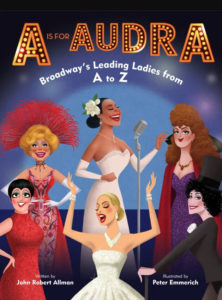
FG: John Robert Allman, author of A Is for Audra and B Is for Broadway on my list at Doubleday. He uses rhyme so smartly to add sass and humor. It’s brilliantly inventive, like he’s landing a quadruple axel in each line.

RVC: Alright, Frances. Now it’s time for THE SPEED ROUND. Boomy-​zoomy question followed by zappy-​cracky answers, please. Are you ready?

FG: Hit me.

RVC: What would you most want—personal chef, maid, or a masseuse?

FG: Paul Hollywood baking in my kitchen all day.

RVC: What makes you roll your eyes every time you hear/​see it?

FG: The phrase “cancel culture.”

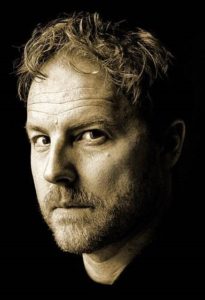
Samuel West, who indeed has a mellifluent voice!

RVC: If someone narrated your life, who would you want to be the narrator?

FG: The actor Samuel West, who has the most perfect voice on the planet.

RVC: What’s your editing superpower?

FG: I make really quick decisions. I know what I like the second I see it.

RVC: What’s a picture book you;ve edited that’s more awesome than the world realizes?

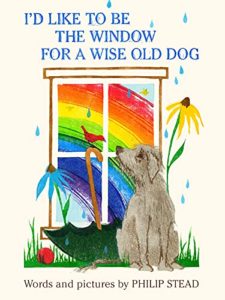
FG: Philip Stead’s I’d Like to Be the Window for a Wise Old Dog is an absolute masterpiece. Everyone who reads it will see I’m right. I don’t think it gets any better than this.

RVC: Your picture book philosophy in five words or fewer?

FG: “Grab me from line one.”

RVC: Thanks so much, Frances! This has been delightful. 

FG: Thank you for your great questions!

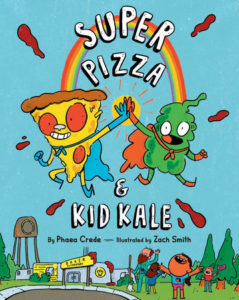
Educational Activities: Super Pizza & Kid Kale by Phaea Crede

Super Pizza & Kid Kale
Author: Phaea Crede
Illustrator: Zach Smith
27 September 2022
Viking Books for Young Readers
40 pages

Book description from Goodreads: “With great flavor, comes great responsibility.

Super Pizza and Kid Kale have been delicious do-​gooders and the best of friends since the day they came aleaf in the oven of the Baker Elementary cafeteria. But as they heroically foil one dastardly deed after another, Super Pizza’s popularity begins to go to their crust, and it leaves their veggie pal feeling rotten. The growing frustration that begins to drive a wedge in their friendship is now threatening to take the students of the school down with them! It’ll be up to Super Pizza and Kid Kale to patch things up so that they can get back to being the heroes that these kids knead.

For fans of Lady Pancake and Sir French Toast comes a hilarious and punny new picture book about navigating the ups and downs of friendship and the unintended consequences that actions can have on others, starring the Batman and Robin of food.”


Educational Activities inspired by Super Pizza & Kid Kale:

  • Before Reading–From looking at the front and back cover: 
    • What do you think about pizza?
    • What do you think about kale?
    • Where and when do you think this story takes place?
    • What differences do you see between the two superheroes on the front cover and the back cover?
    • What questions would you like to ask the author before you read the book?
  • After Reading–Now that you’ve read the story: 
    • How did you react when Kid Kale got upset about being ignored and undervalued?
    • Super Pizza & Kid Kale has a graphic novel/​comic illustration style. Why do you think the artist chose this style for this story?
    • Which of the pictures did you enjoy the most?
    • The book is full of puns (jokes that come from possible different meanings of a word, or words that have multiple meanings). Which were your favorites?
    • Did you like this book? Why/​why not?
  • Writing–The origin story of these unusual superheroes is a “freak cafeteria accident” on page one. What other school-​based superheroes might emerge from a different freak accident? Write one of those origin stories, and if you want, write one of their adventures, too. Use colored pencils, crayons, or markers to create your own story art, whether it’s comic-​style like Super Pizza & Kid Kale or something else entirely. Consider sharing your school superhero story with a friend or family member.
  • Crafting–Who knew there were so many kid crafts about pizza! OPB did, and here are a few of our favorites: 
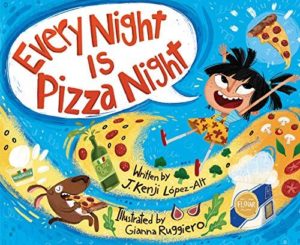
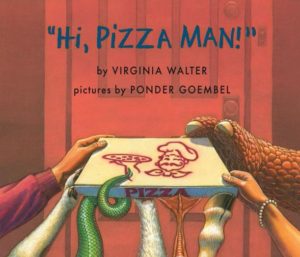
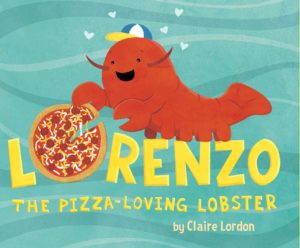
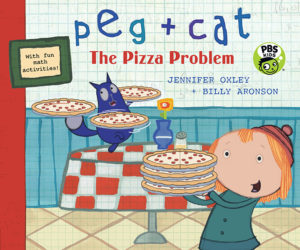
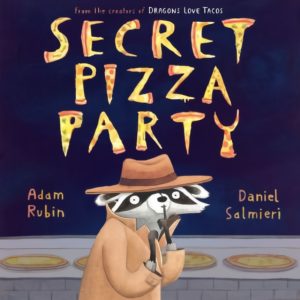
  • Further Reading–Which of these books about pizza have you already read? Which of the others would you want to read first? (Click on any book cover for more information on these titles!)

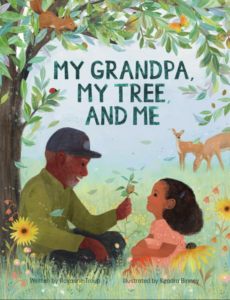
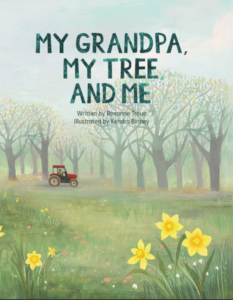
Cover Reveal: My Grandpa, My Tree, and Me by Roxanne Troup

I never want to drop a lone image in a Cover Reveal post without offering a bit more, so enjoy this bonus mini-​interview with author Roxanne Troup about her debut trade picture book, My Grandpa, My Tree, and Me (Yeehoo Press, March 2023). If you want more from Roxanne, check out the full-​length interview we did at OPB earlier this week.

Why are there TWO covers here?” you might be asking. The first one is the cover proper, and the one below it is the cover beneath the dust jacket–the “under cover,” as Roxanne called it. That makes this a two-​fer cover reveal, folks!

RVC: What’s the most important thing people should know or understand about My Grandpa, My Tree, and Me?

RT: That it’s about more than trees. It’s about family, and while (like a growing tree) family changes over time, love only multiplies.

RVC: What’s your favorite line from the book?

RT: The very last one…but I won’t spoil that. So, I’ll go with my “next favorite” which appears on the second spread.

Every winter, while the trees stand silent under a sleepy sun…”

RVC: What are your current book launch plans?

RT: Am I supposed to know that already?!

RVC: Hah. Maybe?

RT: I guess, now I know what I’m doing in October. 😉

I’ve actually been busy working on the teacher guide and new school visit presentation for the book, but since no one grows pecans in Colorado, I may end up doing two “launches”—a small celebration here with writing pals and family, and another back home in Missouri (with a school visit attached) where the pecans will just be leafing out for a new production year.

RVC: Last question: what’s been your favorite part about working with Yeehoo Press?

RT: Seeing the artwork for the first time was fantastic, but I love that (after the contract) everything at Yeehoo has moved relatively quickly. And I’m super excited to see the book produced simultaneously in English and Chinese. How cool is that?

RVC: Cool indeed! Best of luck with the book, Roxanne. And thanks for letting OPB be part of your kidlit journey!

Author Interview: Roxanne Troup

Welcome to Roxanne Troup, the subject of our September Author Interview.
These days, Roxanne lives in Colorado where she writes children’s books, hikes in the mountains, and cheers on her kids at sporting events. She also “visits schools to water seeds of literacy and teach about writing. (And sometimes remembers to water the plants in her own garden.)”

In addition to being the author of more than a dozen children’s books, she’s also a ghostwriter, a work-​for-​hire writer, a speaker, and a history fan (“I find history fascinating because it’s full of stories. But I only realized that as an adult. As a kid, I only remembered the history I lived.”)

Need a few fun facts, too? Try these:

  • She’s afraid of octopuses.
  • She grew up in a historic home along the waterways of Missouri.
  • She’s a certified chocolate lover (“If they gave out licenses for this, I’d definitely have one!”)

Let’s move straight to the interview to find out more about our new writer pal!


 RVC: You’ve got a very unusual story about how you discovered your love of reading. Care to share?

RT: I was an early reader. And while I don’t remember ever not reading, I vividly remember the summer I fell in love with reading. I was seven, and my little brother wasn’t too happy about it. He wanted to play imaginary games with me, not watch me read “boring books.” But I’d recently broken my neck in a tumbling accident, and after spending nearly six months in a neck brace followed by more months of physical therapy (and intermittent neck-​brace-​wearing), I’d gotten used to “boring.” For over a year, I couldn’t ride my bike or play on our swing set without wearing the brace. But I could read. And I read everything I could get my hands on.

RVC: Wow!

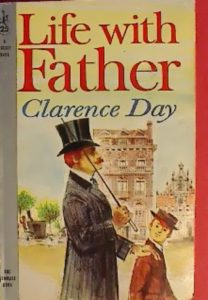
RT: During the school year, I was in the library every day. I sped through easy readers by Syd Hoff and Peggy Parrish. I checked out everything my library had by Judy Blume and Beverly Cleary. And that summer, I read whatever I could find in our house—from Disney’s Encyclopedia of Knowledge to old books like Life with Father. (And by “old,” I mean old. My dad was a teacher who couldn’t stand the thought of throwing books away, so every time his school updated their curriculum or the library updated their collection, we did too. Our attic was full of books!) Then, I stumbled upon Pippi Longstocking and The Borrowers and time disappeared. Reality melted away. I was no longer reading because I didn’t have anything else to do. I was hooked. I read those books over and over and over again.

RVC: I know exactly what you mean about reality melting way when you find the right books. It seems like you had every intention of being a lifelong educator. What appealed about the classroom?

RT: All the things I love about writing for kids: The curiosity; the creativity and resourcefulness; the humor. Kids are intuitively confident and smart. They’re artists, athletes, mathematicians, scientists, and engineers—all the things they forget they are and wish they could be as preteens. If I could help nurture that innate wonder and willingness to fail, even for a short time, I wanted to.

RVC: When did you first consider yourself to be a writer?

RT: Not until 2016. Even though I was consistently making money writing (I got my first writing-​related paycheck in 2009), it wasn’t until I decided to focus on kidlit that I started calling myself a “writer.” Instead, I’d say things like “I’m doing some freelance work” or “I’m ghostwriting.” Writing was something I did to help put food on the table and gas in the car. It wasn’t who I was. It took really immersing myself in the kidlit industry (and publishing my first kid’s book) to change that perspective.

RVC: Normally, I spend more time outlining an interview subject’s career and writing arc, but I want to jump ahead here. Why? Because I’m fascinated by how you’re keeping up successful careers as a picture book author, ghostwriter, freelance writer, freelance editor, and speaker. And all without an agent. Clearly, you have a good sense of the business side of things. So, how do you balance the creative side of writing with the business side?

RT: Some days not very well. But I had an epiphany a few years ago that if I wanted to do the thing I loved (write picture books), I had to start balancing and pruning my writing activities until all the writing I did connected to children’s books/​education in some way. I have an in-​depth presentation on this topic that I’ve given at my local SCBWI, but essentially, I discovered my writing niche—the thing that allows me to meet my goals (get paid via writing, get published under my own name, and write something I enjoy) without draining my creative reserves or taking time away from my family. Before that, I lived at the mercy of my inbox.

RVC: Please tell me more.

RT: Not to bore anyone, but as an example: I never advertised my ghostwriting services. Still, word has a way of getting around, and after a year or two ghosting, I found myself with so many clients I couldn’t do anything else. My family began feeling the pressure and I became frustrated. My clients were needy. They came to me unprepared, and, while the whole family enjoyed my paychecks, I didn’t enjoy what I was doing. So, I raised my fees to weed out clients and maintain my earnings, which gave me more time to do what I loved. I repeated that process several times before eventually deciding I wouldn’t take on any more adult ghosting clients. (I do still ghost for a few clients/​publishers I have a track record with.) Instead, I would focus on kidlit. Now I consult with one of the most prestigious ghosting firms in the nation—working almost exclusively on picture books. I have more time. I still get paid to write, and it’s good practice doing what I love. I’ve done that in each of my freelance service areas, and while there are still days that feel more “business‑y” and less “kidlit‑y” and creative than I like, publishing is a business that requires both. So, I just remind myself of that and work toward a better-​for-​me balance the next day. And on the days I don’t have anything pressing, I work on my own projects. It’s still not a perfect balance, but it is getting better.

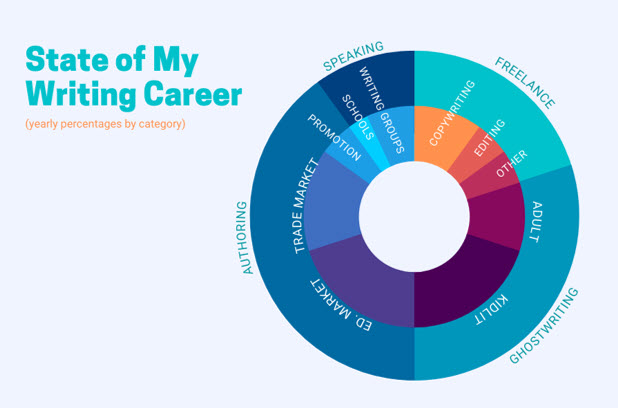
RVC: If you had to make a pie chart or Venn diagram to show your writing career right now, what would it look like?

RT: Nothing in real life is this neat and tidy, but in general, I spend the bulk of my writing time on…

RVC: How many different projects are you typically working on at any one moment?

RT: It varies from week to week (and I tend to think/​schedule in monthly chunks), so I’m not exactly sure how to answer this except to say—several.

Some of my work is seasonal, like writing websites for schools. Other stuff is tied to publishing cycles—like my upcoming picture book release—so even though it’s on my calendar, the work I need to do for it is sporadic. I nearly always have two or three different freelance projects in various stages of development on my monthly calendar, as well as trade market research and submissions to track (and, on occasion, contract negotiations!). Depending on the season, I may also have education market projects happening—but when I do, I try to limit the amount of time I dedicate to freelance gigs. I’m still building my income stream for speaking, so that piece of the pie is also sporadic. Everything considered, it’s unusual if I don’t have a least one writing-​related deadline each week.

RVC: Let’s talk books. This year, you’ve got not 1, not 2, not 3, not 4, not 5, but 6!!! kidlit books coming out this fall. These aren’t traditional trade books, but rather work-​for-​hire. Please explain the difference.

RT: Trade books are the books you’re familiar with; you find them in bookstores and associate each one to a specific author. Typically, that author has created the book from scratch and “sold” it to a publisher. (Publishers don’t actually buy books/​manuscripts. They purchase “rights” to a work—like the exclusive right to publish and sell a work in English, or the right to create an audiobook of the work, etc. Each of these rights is negotiated in a contract between the creator and the publisher, but unless sold, the copyright always remains with the creator.) Often, creators receive an advance against royalties for these books, and since they receive a royalty off every book sold, they’re heavily invested in marketing and promotion.

Work-​for-​hire books are different—from the copyright level up. Work-​for-​hire is a copyright term that means, “work made on behalf of another, in which the commissioner owns the copyright.” (That’s my layman’s definition.) It’s sometimes referred to as “work made for hire” or WFH. Work-​for-​hire can be anything from ghostwriting to the creative work you do as an employee. But in all WFH, the individual or company that hires you to create the work owns the copyright to whatever you created. Once the work is completed and you are paid, the individual or company can do what they like with that work—edit it, publish it, sell it, whatever—it belongs to them. Sometimes the creator gets credit for works made for hire. Sometimes they don’t. In general, WFH writers are paid a flat-​fee for their work, and thus are not expected to promote it.

RVC: Thanks for the explanation here. How does WFH work in kidlit?

RT: In kidlit, work-​for-​hire typically involves two markets: the education market and IP, or intellectual property. The education market is work created for (and sold to) schools and libraries. Publishers generate the ideas for these books/​series based on school curriculum and market need. They’re not typically available in bookstores, but authors do get credit for them. And since educational publishers have established relationships/​reputations with the schools and libraries that purchase these books, authors can expect that lots and lots of kids will read their work.

The IP market includes anything an author didn’t think up themselves. It can be a series cooked up by a publisher/​packager to meet a market demand, ghostwriting, or a book featuring licensed characters like Spider-​Man. IP books are generally sold in bookstores alongside other trade books. And, for the author, can range from flat-​fee to royalty-​based contracts (though you should expect any royalty to be lower than what you’d receive from a work you thought up and created yourself). These books sell really well! Some of your favorite series might even be on the list.

If you’re interested in learning more about work-​for-​hire writing, specifically in the education market, I have an article on LinkedIn you might enjoy.

RVC: What are some of the unexpected benefits of writing work-​for-​hire kidlit?

RT: WFH is a great source of additional income. Unlike trade projects, WFH is a guaranteed sale/​paycheck. It keeps me writing (which we all know is a necessary part of improving craft) and gives me experience working with and thinking like editors. It builds my portfolio and can give me books for use in soliciting author visits. And because WFH is generally flat-​fee, I’m not expected to participate in marketing—which, especially this year with six books coming out in one season, is a relief. (Can you imagine having to promote six books at once!?!?)

RVC: I sure hope so since I’ve got six coming out next year. Let’s talk about that later! Now, how are you getting these deals without an agent?

RT: With the exception of IP projects, most agents don’t handle WFH deals. The flat-​fee model just isn’t worth it for them. So, I contact publishers/​packagers directly with a submissions packet. A WFH submissions packet includes a cover letter expressing your interest and areas of expertise, a resume/​CV, and targeted writing samples. The publisher keeps your info on file and contacts you with projects that fit your experience and/​or samples.

RVC: What about the ghostwriting gigs?

RT: The ghostwriting I do for adults has all happened organically. The kidlit ghostwriting I do comes both organically and through the firm I consult with. I’d love to get more licensed character IP work—especially in the early reader and chapter book markets—but from what I understand, those jobs typically route through an agent or established editorial relationships.

RVC: Are you actively seeking an agent?

RT: Yes and no. I don’t currently have anything out with agents, but if I see that someone is reopening to subs or has a specific wish list item that fits what I create, I don’t hesitate to query. I’m just not spending a ton of time researching agents or sending them work. I’m not opposed to working with an agent—I’d love to be able to walk through the doors an agent can open for me—I’m just not waiting around for one either. I know, whether I have an agent or not, my career is in my hands.

RVC: What’s the most common misconception about work-​for-​hire work?

RT: That it’s a fast and easy “back door” into publishing. While WFH timelines are shorter (books typically release a year or less after contract), the work itself does not require any less effort. Good writing is good writing regardless of genre or sales avenue. And readers are readers. They deserve for authors to be just as meticulous with research, just as purposeful with word choice and mechanics, just as enthusiastic and creative (if appropriate) with WFH as any other contract.

RVC: You’re doing a lot of adult work, too, with your writing. In what ways does that affect your kidlit efforts?

RT: I do try to limit the amount of adult work I’m taking on so I don’t completely derail my kidlit efforts. But even adult projects are beneficial. The paychecks I get for adult freelance work helps subsidize the work I really want to do. It also improves my writing craft and marketing skills. To succeed in this industry, I have to be able to transfer thought to page in a coherent manner. I also have to be able to “sell” myself and/​or my work to agents, editors, booksellers, parents, teachers who might want to invite me into the classroom, and all sorts of other “gate keepers” (which is really just an ominous-​sounding phrase for book buyers.) And all those things take practice. Adult freelance forces me to practice.

RVC: This is a picture book blog, so I have to ask this—what’s the story of your first published picture book, My Grandpa, My Tree, and Me (Yeehoo Press, March 2023)?

RT: Somewhere on social media, I saw a post about a new publisher. I went to their website and saw they were looking for agricultural books so I started researching. When I ran across a YouTube video of a farmer harvesting pecans, I knew I had my topic. I couldn’t get the image of the farmer shaking that tree out of my head—all those pecans falling like torrential rain.

Growing up in a farming community, I had some experience with agriculture and pecans. But no one I knew harvested pecans by tractor. We gathered pecans like the wild products they were, not from hundreds of trees at a time. This dichotomy provided the structure of the story, and my first draft came together quickly.

Unfortunately, I was the most experienced writer in my critique group and started submitting before I should have. I sent the manuscript to four different publishers with no response. On the fifth try an editor saw enough potential in the work to request an R&R (revise and resubmit). I didn’t agree with the direction they wanted me to take the story, but tried to figure out what underlying issue they were pointing out. Eventually I realized my draft was too “education market‑y.” I had to figure out how to make it work for the trade market. I went back to work and a month or so later had an opportunity to submit my new draft to the wonderful Katie Heit at Scholastic. The story was too quiet for Scholastic’s list, but she was so complimentary I knew I’d hit the right note with my revisions. I spent the next year-​and-​a-​half submitting, but now, I was getting responses.

I finally found my publisher in May of ’21—Yeehoo Press. Yeehoo pubs picture books that work for both the US and Chinese markets, so my informational fiction was perfect for them. Four months later, it was official. My first trade PB was under contract!

Yeehoo contracted Kendra Binney to illustrate. Her soft watercolors were the perfect pairing for my lyrical text. I’m excited for its upcoming cover reveal!

RVC: What was the most valuable lesson that book taught you?

RT: To be patient—and keep working. Good writers get turned down all the time. Published writers get turned down, too. But as cliché as it sounds, it really does take just one “yes.” Publishing is a partnership. You have to be patient to find the perfect partner for your particular story, and you have to keep working to make sure your story is the perfect fit for a particular publisher.

RVC: Please talk about the role of community in your writing life.

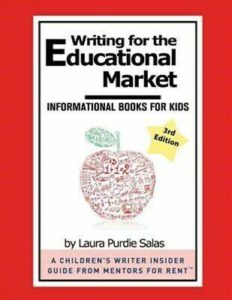
RT: When I first started writing kidlit, I couldn’t justify the cost of writing classes or even an SCBWI membership. But I joined Laura Purdie Salas’ Facebook group for writers (now defunct) and started lurking and learning. Laura taught me a ton—just by following her career and reading her comments on people’s posts. She was so helpful and kind, but also honest. When she created Writing for the Educational Market, I knew it would be practical and encouraging, just like her. I purchased it immediately and got my first book contract shortly thereafter. I highly recommend her workshop-​in-​a-​book to everyone interested in the education market. It’s full of info I couldn’t find anywhere else. (And believe me; I looked!)

RVC: Thanks to your rec, I just ordered a copy myself. Watch out, educational market!

RT: After a few WFH books, I wanted to jump the fence, so to speak, into the trade market. Laura’s career convinced me it was possible, but I needed to find a regular critique group—not just occasional online swapping partners. So, I joined SCBWI and started getting involved in my local group. It was so refreshing to find people who got what I was trying to do. They understood the struggles of writing kidlit, but also the joy of finally finishing a decent draft.

Today, I co-​lead that group. And over the years, I’ve come to realize how incredibly generous and supportive the entire kidlit community is—if you are willing to put in the work.

RVC: What’s your most important good writing habit or routine?

RT: To write—whether I feel like it or not. I can’t wait for the muse to strike. I have deadlines. I have to get something on the page. If it’s no good, I can edit it. But I can’t edit a blank page. Eventually, if I put in the work, I’ll have something I’m proud of.

RVC: Lastly, what advice do you give to aspiring picture book writers?

RT: Learn the business and take the time to develop your craft. While writing may be creative, publishing is a business. You have to get both right to be successful. How? Read. A lot. Write even more. And find a group of creatives who can help you get better (not just those who will gush over whatever you create).

RVC: One final question for this part of the interview. Beyond the six work-​for-​hire books coming out this fall, what’s something upcoming that you’re really excited about?

RT: My debut trade picture book releases in March. That’s really exciting! (As a newbie, I’m still not sure what all that will entail, but I’m doing my best to learn as I go.) And I just signed a contract for another trade picture book slated for Spring 2024.

RVC: Congrats on that, Roxanne. But now the first part of the interview is over. Now it’s time for…the…LIGHTNINGROUND!!! Are you ready?

RT: Ready.

RVC: What secret talent do you have that few would expect?

RT: I randomly remember lines to songs and movies from my childhood and use them in everyday life. When my children are being overly emotional—“Calm yourself, Iago” (in the voice of Jafar from Disney’s Aladdin). When my mother-​in-​law finally goes home—“I think we’re alone now” (from Tommy James and the Shondells). When someone asks me a stupid question—“It’s possible, pig” (as Westley from The Princess Bride)—though not always out loud!

RVC: Pick a theme song that describes where your life is at right now.

RT: “The Hustle” by Van McCoy.

RVC: What picture book author would you want to write YOUR life story?

RT: She doesn’t write nonfiction, but Beth Ferry. I love everything she creates.

RVC: Five things you can’t do your work without.

RT: A computer and Internet connection, Microsoft Office, a big desk calendar, and the library.

RVC: Who sets the standard for picture books about history?

RT: Oh gosh. There are so many really good ones … Barb Rosenstock.

RVC: What’s the best compliment a child ever gave you or your books?

RT: Now, I get it!

RVC: Thanks so much, Roxanne! And for those of you who read to the very end, OPB has a treat for you. Watch for an OPB cover reveal this week for Roxanne’s forthcoming picture book, My Grandpa, My Tree, and Me!