
Reading Activities: Flora and the Jazzers by Astrid Sheckels

Flora and the Jazzers
Author: Astrid Sheckels
Illustrator: Astrid Sheckels
7 October 2025
Waxwing Books
40 pages

Book description from Goodreads: “What will become of the music in Flora’s heart?

Flora the ferret longs to attend a concert someday, but she is only a lowly scullery maid. She must save every penny.

When she discovers that the Jazzers, her favorite band, are performing at the hotel where she works, Flora is determined to hear them. But her manager forbids her from going. “Music is not for someone like you,” he tells her.

It turns out, however, that the Jazzers have a problem, and Flora might be just the one to help…

A Cinderella-​like animal story set in the 1920s for readers with a song in their heart, written and illustrated by Astrid Sheckels.”

Want some reviews of Flora and the Jazzers?

Here’s the book trailer for Flora and the Jazzers.

Reading Activities inspired by Flora and the Jazzers:

  • Before Reading–From looking at the front cover: 
    • What kind of story do you predict this will be–realistic, a fairy tale, or something else?
    • What time period do the clothes, hair, and setting suggest?
    • What do you think “the Jazzers” are: a band, a group of friends, a nickname, something else?
    • What questions would you like to ask the author-​illustrator before reading the book?
  • After Reading–Now that you’ve read the story: 
    • What does Flora want most at the beginning, and what stands in her way?
    • What moments show Flora’s courage, even when she feels small?
    • How does the story use music as more than background?
    • Which scene felt most like a turning point, and why?
    • What did the illustrations help you understand about the hotel world and Flora’s place in it?
    • What does the ending suggest about belonging and being seen?
    • Would you recommend this book to a friend? Why or why not?
  • Soundtrack of a Scene:
    Pick one spread and imagine the music playing underneath it. Is it fast or slow? Loud or soft? Smooth or bouncy? Write three “sound words” that match the mood, then read them out loud like a tiny poem.
  • Jazz Improv Drawing:
    Fold a paper into four boxes. In each box, draw Flora in the same pose. Now “improvise” the details each time: change the hat, the background, the lighting, the expression By the last box, Flora is ready for the stage!
  • Hotel Map Challenge:
    Draw a simple map of the hotel from Flora’s point of view. Include places she works, places she dreams about, and places she feels unwelcome. Add arrows showing how she moves through the space during the story.
  • Your Own “Music Is For…” Poster:
    The manager says music is for certain people. Flora proves otherwise.
    Make a poster that begins with: Music is for…
    Fill it with drawings and words showing who belongs in the audience, on the stage, backstage, everywhere.
  • Fairy Tale Spin Workshop:
    This story carries Cinderella energy. Create your own spin in three quick steps:
    Choose the setting (hotel, diner, subway, amusement park)
    Choose the dream (dance, cooking, painting, science)
    Choose the “helper” (band, neighbor, stray cat, librarian, teammate)
    Write a 6–8 sentence summary of your version.
  • Books, Books, and More Books! Check out these picture books about music, rhythm, and finding your voice:

Before John Was a Jazz Giant by Carole Boston Weatherford, illustrated by Sean Qualls

A look at John Coltrane’s childhood, where ordinary sounds shape the way he hears the world. Notice how rhythm and repetition turn everyday noise into the beginnings of music.


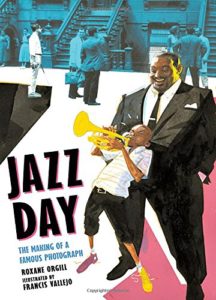
Jazz Day: The Making of a Famous Photograph by Roxane Orgill, illustrated by Francis Vallejo

A neighborhood parade grows as jazz spills into the streets and pulls everyone along. Notice how rhythm and repetition in the text mirror the way music gathers a crowd.


Rap a Tap Tap: Here’s Bojangles—Think of That! by Leo and Diane Dillon

This lively tribute follows the rise and style of Bill “Bojangles” Robinson through sound-​driven language and motion-​filled art. Pay attention to how page design and pacing create a sense of dance.


The Sound of All Things by Myron Uhlberg, illustrated by Connie Schofield-​Morrison

A boy who is deaf experiences the world through vibration, motion, and visual rhythm rather than sound. Watch how the illustrations translate music and noise into movement and pattern, inviting young readers to rethink what it means to “listen.”


Trombone Shorty by Troy “Trombone Shorty” Andrews, illustrated by Bryan Collier

A New Orleans kid with a trombone and a dream keeps pushing his way toward the music he loves. Look at how color captures energy, ambition, and a strong sense of place.
Picture Book List: Nine Terrific Poetry Picture Books

One of the pleasures of reading poetry is to witness the urgency, the intensity, and the sheer beauty of language. This is as true in well-​written picture books as it is in the classic “adult” poems of Rumi, Emily Dickinson, Robert Frost, or Yusef Komunyakaa.

As I think about which relatively-​recent picture books most embrace the wonders that poetry offers, I recall what Romanian-​born German poet Paul Celan once wrote:

A poem … can be a message in a bottle, sent out in the–not always greatly hopeful–belief that somewhere and sometime it could wash up on land, on heartland perhaps. Poems in this sense, too, are under way: they are making toward something.”

Each of the following picture books all are a “making toward something” that’s remarkable thanks to their use of poetic forms and a keen sensibility for language.

See for yourself.


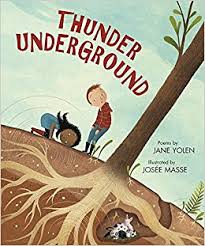
Thunder Underground by Jane Yolen (illustrated by Josee Masse)

In this collection of 21 playful poems by kidlit master Jane Yolen, readers learn all about the things beneath the Earth’s surface: subways, fossils, pirate treasure, caves, magma, and even tectonic plates. A Kirkus starred review notes that the poems honor “the ability of young readers to navigate syntax, imagery, and wordplay… a thoughtful exploration of nature expressed in poetry that should open the eyes of children to unseen worlds.”


Jazz Day: The Making of a Famous Photograph by Roxane Orgill (illustrated by Francis Vallejo)

In playful verse and vibrant images, this book captures an amazing real-​world moment from 1958, when Esquire magazine and graphic designer Art Kane brought together a group of 57 beloved jazz musicians to be photographed outside a Harlem brownstone. Celebrate Picture Books notes that author Roxane Orgill “recreates the syncopation of jazz and the exhilaration of the photo shoot in twenty poems that capture the sights, sounds, conversations, horseplay, and vibe of that special day that forever commemorate the Golden Age of Jazz.”

One especially cool feature? A fold-​out page in the book shares the final product of that historic photo shoot.


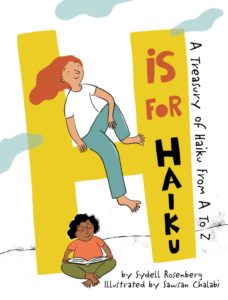
H is for Haiku: A Treasury of Haiku from A to Z by Sydell Rosenberg (illustrated by Sawsan Chalabi)

Writer’s Rumpus reports that this book is “a delightful exploration of the alphabet through Haiku. Each page explores a moment in time with lovely, lyrical and luscious language. Colorful, playful illustrations complement the poetic text.” As the late Rosenberg once shared: “The split second one starts to touch a flower–real or plastic? That’s haiku. Before the hoof comes down–that’s haiku.”


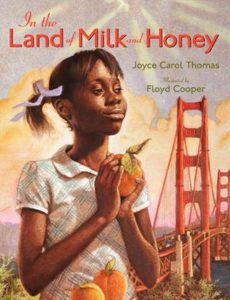
In the Land of Milk and Honey by Joyce Carol Thomas (illustrated by Floyd Cooper)

This book tells the true story of Joyce Carol Thomas’ trip as a girl from Oklahoma to California in 1948. A Booklist review shares that “clear free verse captures the excitement of the journey–the steaming train, the hissing wheels, the long lonesome whistle.” But don’t neglect Floyd Cooper’s masterful pastel artwork and oil wash paintings which are equally impressive and help make this book a must-read.


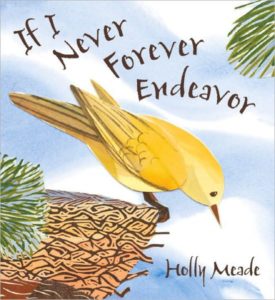
If I Never Forever Endeavor by Holly Meade

This book tells the inner story of a fledgling thinking about leaving the nest, but isn’t quite ready to go. To fly or not to fly? That is the question explored in these poems that emphasize rhyme, repetition, and onomatopoeia.

A Storypath review says that “the bird’s soliloquy is rhythmic and memorable and will be picked up by the listeners by the second reading.”


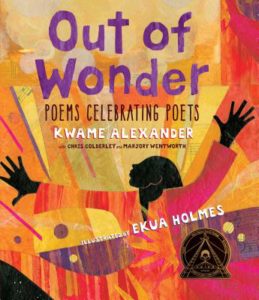
Out of Wonder: Poems Celebrating Poets by Kwame Alexander and Chris Colderley and Marjory Wentworth (illustrated by Ekua Holmes)

Newbery Award-​winning author and poet Kwame Alexander–with Chris Colderley and Marjory Wentworth–writes poems about great poets … in the style of those poets themselves. In an NPR interview, Alexander states that the three aims for this book are to encourage kids to read poetry, introduce them to great poets, and inspire them to write poems of their own. “It’s a lofty goal,” he admits, “but I think that’s a metaphor for what poetry is.”


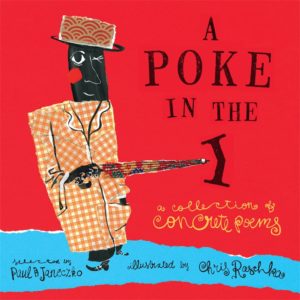
A Poke in the I: A Collection of Concrete Poems by Paul B. Janeczko (illustrated by Chris Raschka)

This award-​winning collection of 30 poems provides no end of fun thanks to a commitment to the playfulness of poetry.  A Booklist starred review explains that “these aren’t poems to read aloud, but to look at and laugh at together, with young children and especially older readers, who will enjoy the surprise of what words look like and what can be done with them.” A Publisher’s Weekly starred review adds that this book is “an uncluttered, meditative space for the picturesque language.”


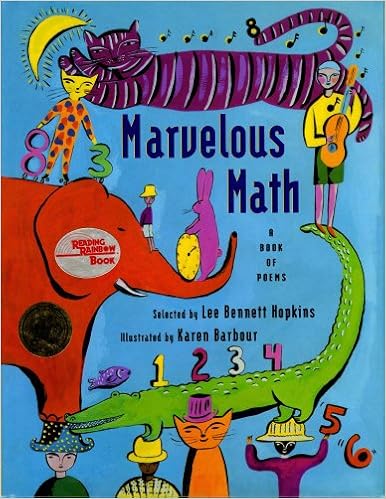
Marvelous Math: A Book of Poems by Lee Bennett Hopkins (illustrated by Karen Barbour)

It’s hard to imagine a list of good poetry picture books without including something by Lee Bennett Hopkins, the grand master of poetry and poetry anthologies for young readers. The 16 poems in this book–two written by Hopkins and the rest written by others–all include math or numbers as a thematic element. A few of my favorites? Lillian M. Fisher’s “To Build a House,” Janet S. Wong’s “One to Ten” and Felice Holman’s “Counting Birds.”


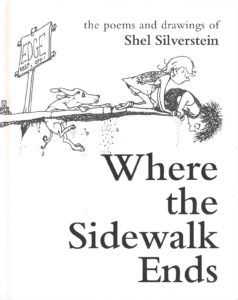
Where the Sidewalk Ends: Poems and Drawings by Shel Silverstein

What can be said about a poetry book from 1974 that nearly all adults recall with wonder, joy, and an enduring sense of nostalgia?

Sisters are auctioned off.

Sarah Cynthia Sylvia Stout will simply not take the garbage out!

A girl eats a whale.

Crocodiles go to the dentist.

Silverstein’s poetic mad-​but-​makes-​sense world is one where you wash your shadow and plant diamond gardens. Yes, his poems are loads of fun, but he’s a master wordsmith whose writing is far more profound than you might realize at first.