Reading Activities: A Walk in the Words by Hudson Talbott

A Walk in the Words
Author: Hudson Talbott
Illustrator: Hudson Talbott
14 September 2021
Nancy Paulsen Books
32 pages

Book description from Goodreads: “When Hudson Talbott was a little boy, he loved drawing, and it came naturally to him. But reading? No way! One at a time, words weren’t a problem, but long sentences were a struggle. As his friends moved on to thicker books, he kept his slow reading a secret. But that got harder every year. He felt alone, lost, and afraid in a world of too many words.

Fortunately, his love of stories wouldn’t let him give up. He started giving himself permission to read at his own pace, using the words he knew as stepping-​stones to help draw him into a story. And he found he wasn’t so alone–in fact, lots of brilliant people were slow readers, too. Learning to accept the fact that everyone does things in their own unique way, and that was okay, freed him up and ultimately helped Hudson thrive and become the fabulous storyteller he is today.”

Want some reviews of A Walk in the Words?

Reading Activities inspired by A Walk in the Words:

  • Before Reading–From looking at the front cover: 
    • What are you most curious about before opening the book?
    • Why do you think there are so many words on the tree branches?
    • What might it mean to “walk” in words instead of read them?
    • The character looks small compared to the words. How does that size difference make you feel?
    • This book is written and illustrated by the same person. What might that tell you about the story you’re about to hear?
  • After Reading–Now that you’ve read the story: 
    • At the beginning, what feels safe for the narrator, and what feels threatening?
    • When the narrator feels stuck, what specific choice helps him move forward?
    • The book uses pictures to show feelings like fear and feeling overwhelmed. Which image stayed with you the most, and why?
    • Where do you see the shift from fear to curiosity? What changes right before that moment?
    • What does this book suggest about reading slowly—or doing anything at your own pace?
    • Would you recommend this book to a friend? Why or why not?
  • Wall of Words Snapshot:
    In the story, a full page of text feels like a wall keeping him out. Draw your own “wall of words” on one side of a page. On the other side, draw what helps you get through a hard moment: a person, a tool, a habit, a thought. Add labels if you want!
  • Break a Big Word:
    The narrator takes “overwhelm” and makes it smaller by breaking it apart. Let’s do something similar! Choose one big feeling word and play with it. 
    • Write your word in BIG letters across the page.
    • Circle a part you know.
    • Underline the part that makes the word feel intimidating or too big.
    • Rewrite the word in a way that feels more your size.
    • Then write one sentence that begins: “I can handle this by…”
  • Stepping-​Stone Reading:
    Pick a short paragraph from any book. On a separate sheet of paper, write down the words you recognize instantly as you read. Those are your stepping stones. 
    • Read just those words in order to see what you can understand about the paragraph.
    • Then read the full paragraph at your own pace.
    • What felt different the second time? What helped you move forward?
  • Fear vs. Curiosity Tug-​of-​War:
    Draw a line down the middle of a page. Title one side Fear and the other Curiosity. 
    • On the Fear side, list what fear says about reading or learning.
    • On the Curiosity side, list what curiosity says.
    • Circle the one curiosity thought that feels strongest. Keep it as a “bookmark sentence” you can return to.
  • Paint with Words:
    The narrator says learning words is like finding new colors for art. Choose one scene you love (a storm, a birthday, a soccer game, a quiet night). Write two versions:
    Version 1 uses only simple words.
    Version 2 adds five “new colors,” more specific words, stronger verbs, sharper sensory details.
    Compare the two. Which version feels more alive to you, and why?
  • Books, Books, and More Books!: Check out these picture books about learning differences, self-​trust, and finding your way with words:

Aaron Slater, Illustrator by Andrea Beaty, illustrated by David Roberts
Aaron struggles with reading, but drawing is where his ideas come alive.


I Talk Like a River by Jordan Scott, illustrated by Sydney Smith
A boy describes what it feels like to stutter, using metaphor instead of explanation.


Just Ask! Be Different, Be Brave, Be You by Sonia Sotomayor, illustrated by Rafael López
Kids speak directly about their bodies, brains, and needs in a relatable way.


Thank You, Mr. Falker by Patricia Polacco
A girl carries deep shame about reading until one teacher finally sees what’s going on.
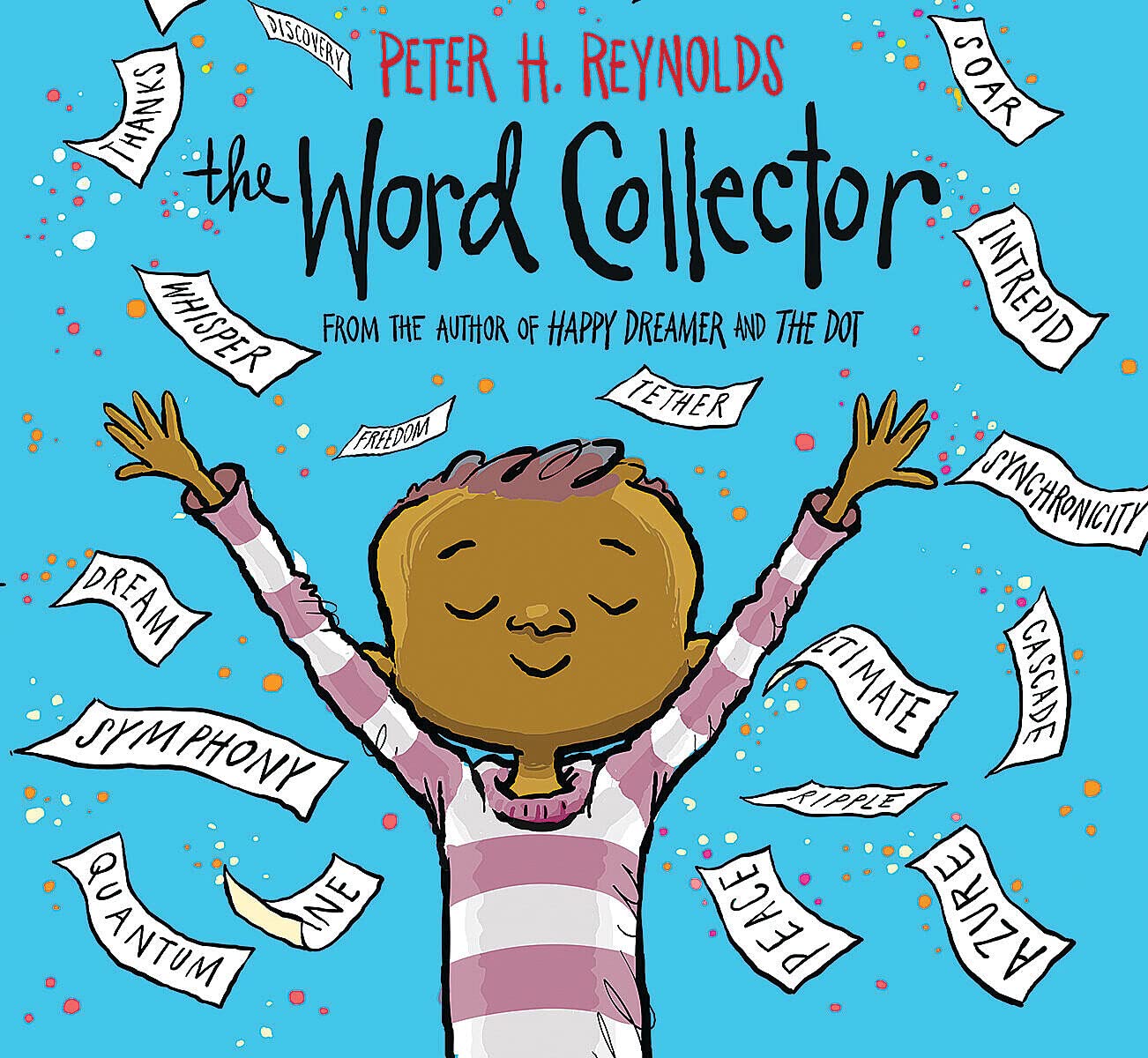

The Word Collector by Peter H. Reynolds
Jerome loves gathering words and noticing how they sound and feel.
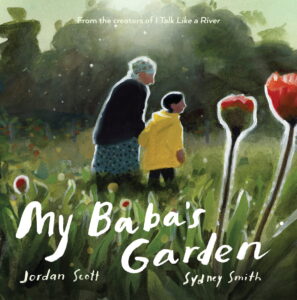
Picture Book Review: My Baba’s Garden by Jordan Scott

My Baba’s Garden
Author: Jordan Scott
Illustrator: Sydney Smith
Neal Porter Books
7 March 2023
32 pages

This month’s PB review is by Ryan G. Van Cleave (Owner/​Operator of Only Picture Books) and new OPB friend, Olga Herrera.

–Ryan’s Review of the Writing–

Jordan Scott’s My Baba’s Garden promises to be an unusual–perhaps magical–journey right from the start when the first-​person narrator states “My Baba lives in a chicken coop beside the highway” and that chicken coop is near a sulfur mill that’s “shaped like an Egyptian pyramid.” Pretty cool!

What we quickly realize is that the young boy narrator has an imagination that’s as wide as the ocean. By the second spread we see it in action again as he notices distant mountains that “look like whale bellies.” Of course, Sydney Smith obliged with terrific art that has the right undulations and curves that do suggest whale-ish-ness.

It’s interesting that Dad regularly drops off the child to spend the day with the child’s Baba who is “hiding in the steam of boiling potatoes.” I’ll bet plenty of young readers know life situations like this that are anything but the Leave It to Beaver family that just isn’t realistic any longer. Seeing this kind of alternative childcare situation should prove welcome to those readers.

While Baba lives in a tiny space that indeed might’ve once been a chicken coop, it’s “crammed with food from her garden,” and food becomes a way to connect grandparent and child. “We don’t talk very much,” the boy observes, and it seems clear that there’s a language barrier that’s easily overcome by food, tenderness, and familial love.

After feeding the boy breakfast, his Baba walks him to school. When it rains, however, she pauses and loads up a glass jar with all the worms she can find wriggling on the pavement and in the grass. Later, we find out that she releases the worms in her garden where they do their worm-​work that’s healthy and welcome for any vegetable garden. It’s one of many quiet but important lessons that Baba teaches the narrator (and readers).

But one day, Baba “leaves her chicken coop home and moves in with us.” The reason why isn’t explained, though it’s easy enough to infer that it’s for the health reasons. Leave it to this observant boy to notice that a new big building now stands where her house used to be, and her garden has turned into an uncared-​for jungle.

I won’t spoil the ending, but even though their situation has changed, the boy and his Baba continue to have a special, tender relationship that’s wondrous to witness. Coupled with Sydney Smith’s fine art, the ending of this book is delightful and full of heart.

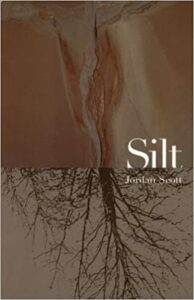
Even without knowing Jordan Scott’s background as a poet (I recommend his debut collection Silt), I’d recognize the careful, precise use of language one expects from a wordsmith. With sound repetition (“sees worms squirming” and “kneel next”) and vivid similes (“My Baba hums like a night full of bugs when she cooks”), this story is a pleasure to read.

It’s no surprise that an Author’s Note reveals that the narrator had a Baba in his life that did most of the things the book’s Baba does. We should all be so lucky as to have a loving Baba like that in our lives.

Well done, Jordan and Sydney.

4.5 out of 5 pencils


–Olga’s Review of the Illustrations–

Sydney Smith’s illustrations in My Baba’s Garden perfectly complement this beautiful and emotional story.

Sydney has painted memories!

Looking at the illustrations in My Baba’s Garden, I feel I’ve entered her home and should whisper as I read this book. Sydney’s loose watercolor helps us see these memories through sometimes teary eyes or when the sun comes through a window and causes you to squint a bit. His expert use of lighting is dramatic and impactful, and so beautiful. In every scene, the light is like a friend, welcoming.

The effect of this dramatic lighting is most pronounced when we meet Baba, the grandmother in the story. The spread where we first see this important character is filled with gorgeous pops of bright gouache color on a muted background and grounded by the strong shadow cast by the grandmother. This spread said everything you need to know about the character, her lifestyle, and her routine. It is breathtaking how much detail is available to us without the use of line.

The simplicity of the character design and the objects themselves balance the complexity of the illustration. Sydney provides just enough information to allow your eye to finish the rest of the story.

I found his use of color, predominantly yellow, very intentional in each panel. It is sparingly used and reserved for areas that are meant to call our attention. In a muted palette, the spots of vibrant yellow and a few reds are gorgeous and feel to float and be more solid than the rest of the painting. These pops of color are like the gestures of love the grandmother shows her grandson with no need for words. It’s no accident when you realize the color yellow is reserved for the boy’s raincoat.

In the spread where the boy explains what has happened to his grandmother’s unique home, we are invited to sit quietly with him in deep thought. It is such a powerful moment–expertly illustrated. The boy’s isolated eye draws us in while we slowly take in the information of what is happening outside of the room, all through reflections on the window. It is breathtaking.

Throughout the book, you will find patterns on cloth, or dishes, that give you a clear understanding of the rich tradition of the grandmother.

The gesture of kissing the food when it falls down is a tradition I am familiar with in my own family, and that moment when the boy kisses the apple slice made my heart ache. Sydney conveys emotion so well, and he does it quietly and elegantly. Speaking of quiet moments, the panel where the close-​up of Baba’s face with lighting from the window and the love in her eyes is gorgeous and wasn’t lost in me how juxtaposing it with the rain scene below ties the two characters in different worlds now. The noisy rain versus the quiet room. And both characters see each other.

In these two connecting scenes, the red of her smiling lips bounced on his boots and cheeks. Once again, a splosh of color balances the sadness of the scene with the love of the relationship.

Painting emotion is one of Sydney’s fortes, and My Baba’s Garden is the perfect harmony of nostalgia and love.

5 out of 5 crayons


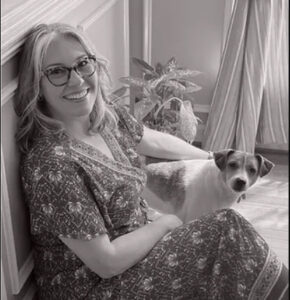
Olga Herrera (she/​her) is an author and illustrator of children’s books. She earned her bachelor’s of Fine Arts from the Ringling College of Art and Design with a major in Illustration.

Olga’s hilarious and endearing debut picture book, The Unwelcome Surprise, will be published in April 2023 by Feiwel & Friends, Macmillan.

One of her passion projects is the podcast she co-​founded, Illo Chat, a podcast about the journey into professional Illustration and the world of children’s book publishing.

As a long-​time member of the Society of Children’s Book Writers and Illustrators (SCBWI), she has served as a writing and illustration mentor for her regional chapter (MD/​DE/​WV) and has won several illustration competitions.

Olga is multicultural, Cuban and Ecuadorian, and is bilingual in Spanish and English. She was born in Miami, Florida, and grew up in Ecuador, a beautifully diverse country that remains close to her heart. As a teenager, she returned to the United States, where she began her interest in the arts. She is a visual storyteller, often looking for a napkin and pen to jot down some fantastic idea that is sure to disappear in the blink of an eye. When she is not creating her content, she teaches Illustration in traditional and digital techniques or creative writing for fiction picture books.

She lives in the picturesque state of Maryland with her husband, two children, and too many pets who patiently listen to her ideas.

You can find out what projects she is working on by following her on Instagram @olgachildrensillustrator, and on Twitter @OlgaIllustrator.

Her website is www.OlgaHerrera.me