Since it’s Back to School time pretty much everywhere, it just made sense to have this special Monday post about some of the best picture books about school. If I missed YOUR favorite picture book about school, drop me a note in the comments and I’ll try to include your fave in a future list or Bonus Goody post.
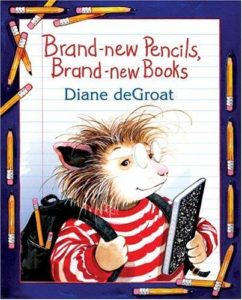 Brand-new Pencils, Brand-new Books by Diane deGroat (June 2007)
From Goodreads: “Gilbert, the popular star of deGroat’s New York Times bestseller Roses Are Pink, Your Feet Really Stink, returns in this humorous and reassuring back-to-school story, in which Gilbert experiences his first day in first grade.”
Pages: 32
Reading Age: 4–8
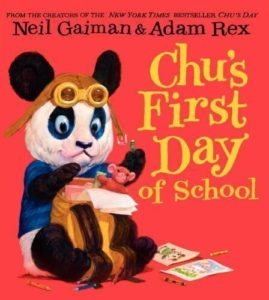 Chu’s First Day of School by Neil Gaiman, illustrated by Adam Rex (June 2015)
From Goodreads: “It is Chu’s first day of school. Chu is nervous. He hopes the other boys and girls will be nice. Will they like him? What will happen at school today? Will Chu do what Chu does best?”
Pages: 32
Reading Age: 1–5
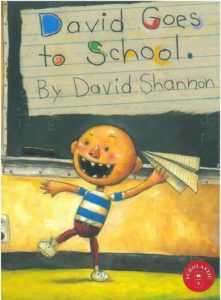 David Goes to School by David Shannon (May 2021)
From Goodreads: “David’s teacher has her hands full. From running in the halls to chewing gum in class, David’s high-energy antics fill each school day with trouble—and are sure to bring a smile to even the best-behaved reader.
In ‘David Goes to School’, young David shows up late to class, goes wacko at the blackboard, chews gum in class, yells answers out of turn, pulls pigtails, stares out the window, cuts in line, has a food fight (“I don’t care who started it!” says the teacher), lingers at recess, and more. Colorful, hilarious, childlike illustrations examine our strangely appealing demon-boy at eye level.”
Pages: 32
Reading Age: 3–6
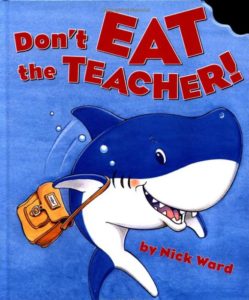 Don’t Eat the Teacher! by Nick Ward (January 1998)
From Goodreads: “Sammy has trouble controlling his enthusiasm on his first day of school.”
Pages: 32
Reading Age: 2–6
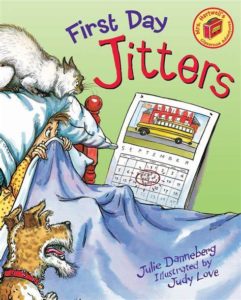 First Day Jitters by Julie Danneberg, illustrated by Judy Love (February 2000)
From Goodreads: “Everyone knows that sinking feeling in the pit of the stomach just before diving into a new situation. Sarah Jane Hartwell is scared and doesn’t want to start over at a new school. She doesn’t know anybody, and nobody knows her. It will be awful. She just knows it. With much prodding from Mr. Hartwell, Sarah Jane reluctantly pulls herself together and goes to school. She is quickly befriended by Mrs. Burton, who helps smooth her jittery transition. This charming and familiar story will delight readers with its surprise ending.”
Pages: 32
Reading Age: 5–8
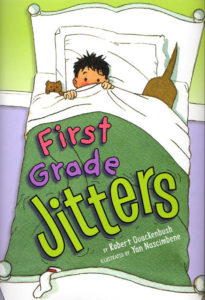 First Grade Jitters by Robert Quackenbush, illustrated by Yan Nascimbene (June 2010)
From Goodreads: “Perfect for nervous/excited kids about to go to school (and their parents!), this engaging story convinces parents and children alike that there is no place cooler than a first-grade classroom. Time to shake those jitters!
Here is the story of a young boy who is about to enter first grade and doesn’t know quite what to expect. Will his friends be there? Will he have to know how to read and spell? What if he can’t understand anything his teacher says?
Looks like a case of first grade jitters!”
Pages: 32
Reading Age: 5–6
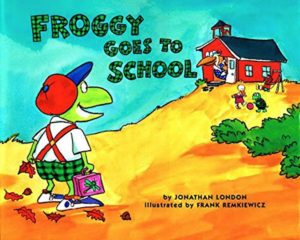 Froggy Goes to School by Jonathan London, illustrated by Frank Remkiewicz (September 1998)
From Goodreads: “Froggy’s mother knows that everyone’s nervous on the first day of school. “Not me!” says Froggy, and together they leapfrog to the bus stop — flop flop flop. Froggy’s exuberant antics, complete with sound effects, will delight his many fans and reassure them that school can be fun.“This is a great read-aloud with sounds and words that encourage active participation.…A charming story to calm those pre-school jitters.”
Pages: 32
Reading Age: 2–6
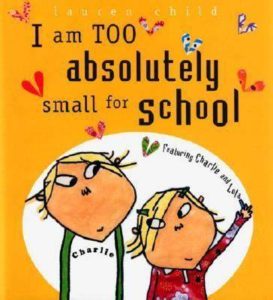 I Am Too Absolutely Small for School by Lauren Child (August 2005)
From Goodreads: “Lola is not so sure about school. After all, why would she need to count higher than ten when she never eats more than ten cookies at a time? Once again, it’s up to ever-patient big brother Charlie to persuade Lola that school is worthwhile — and that her invisible friend, Soren Lorensen, will be welcome, too.”
Pages: 32
Reading Age: 3–7
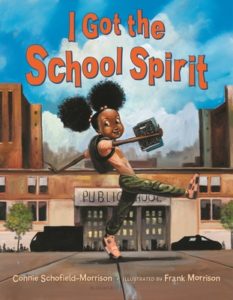 I Got the School Spirit by Connie Schofield-Morrison, illustrated by Frank Morrison (July 2020)
From Amazon: “This exuberant celebration of the first day of school illustrated by award-winning illustrator Frank Morrison will have every kid cheering for school to begin!
Summer is over, and this little girl has got the school spirit! She hears the school spirit in the bus driving up the street–VROOM, VROOM!–and in the bell sounding in the halls–RING-A-DING! She sings the school spirit in class with her friends–ABC, 123!”
Pages: 32
Reading Age: 3–6
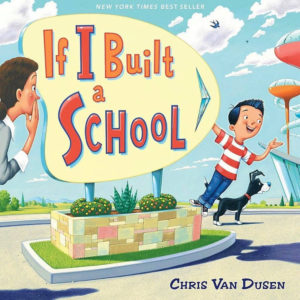
If I Built a School by Chris Van Dusen (June 2015)
From Goodreads: “In this exuberant companion to If I Built a Car, a boy fantasizes about his dream school–from classroom to cafeteria to library to playground.
My school will amaze you. My school will astound.
By far the most fabulous school to be found!
Perfectly planned and impeccably clean.
On a scale, 1 to 10, it’s more like 15!
And learning is fun in a place that’s fun, too.
If Jack built a school, there would be hover desks and pop-up textbooks, skydiving wind tunnels and a trampoline basketball court in the gym, a robo-chef to serve lunch in the cafeteria, field trips to Mars, and a whole lot more. The inventive boy who described his ideal car and house in previous books is dreaming even bigger this time.”
Pages: 32
Reading Age: 4–8
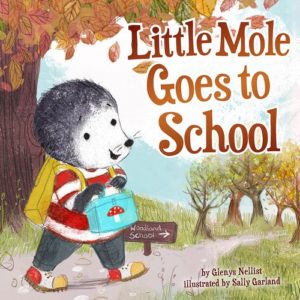 Little Mole Goes to School by Glenys Nellist, illustrated by Sally Garland (July 2022)
From Goodreads: “It’s Little Mole’s first day of school, and he’s nervous. What if he is the last to know his alphabet? What if he’s not good at anything? With a good bit of anxiety, Little Mole heads to class and begins to compare himself to his peers. How will he ever measure up? But soon a crisis on the playground reveals that he has everything he needs in his own two paws to save the day. In this third installment of the Little Mole series, author Glenys Nellist and illustrator Sally Garland spin another endearing tale of the beloved Little Mole, his encouraging mama, and his forest friends. Children will relate to Little Mole’s feelings of self-doubt, will cheer him on when he discovers his unique gifts and talents, and will be inspired to confront their own insecurities and celebrate what they have to offer, too.”
Pages: 36
Reading Age: 2–5
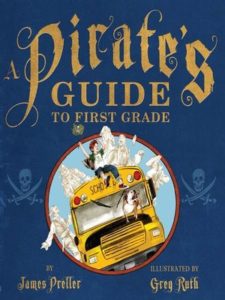 A Pirate’s Guide to First Grade by James Preller, illustrated by Greg Ruth (June 2013)
From Goodreads: “Arr! It’s the first day of first grade, and it’s all hands on deck for a young pirate and his crew. How much trouble can they get into? What will they do at recess? And, most important, what treasure awaits them at school?”
Pages: 48
Reading Age: 3–6
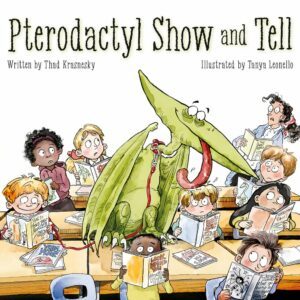 Pterodactyl Show and Tell by Thad Krasnesky, illustrated by Tanya Leonello (October 2018)
From Goodreads: “When a boy brings his pterodactyl to school for show-and-tell, hilarious havoc ensues. The creature’s delightfully demented antics, the kids’ expressions as they try to avoid the hungry pterodactyl, and the out-of-control imagination of the boy yield a wild and wacky romp. Kids who dig dinosaurs will devour this preposterous pterodactyl tale written in rhyming couplets and teeming with edgy school-age humor and giggle-inducing illustrations.”
Pages: 32
Reading Age: 5–7
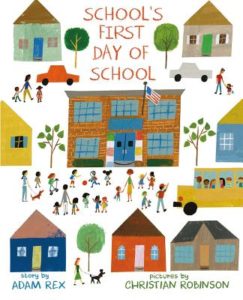 School’s First Day of School by Adam Rex, illustrated by Christian Robinson (June 2016)
From Goodreads: “It’s the first day of school at Frederick Douglass Elementary and everyone’s just a little bit nervous, especially … the school.”
Pages: 40
Reading Age: 5–6
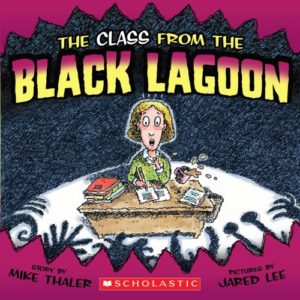 The Class from the Black Lagoon by Mike Thaler, illustrated by Jared Lee (June 2009)
From Goodreads: “Is it true that the new class REALLY is just a bunch of horrible ghouls? The new teacher has heard all sorts of weird stories about her students. What will she find when the students arrive?”
Pages: 32
Reading Age: 4–8
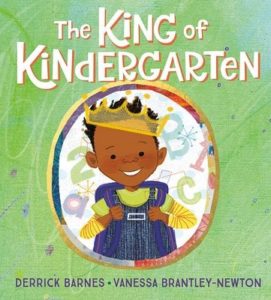 The King of Kindergarten by Derrick Barnes, illustrated by Vanessa Brantley-Newton (July 2019)
From Goodreads: “Starting kindergarten is a big milestone–and the hero of this story is ready to make his mark! He’s dressed himself, eaten a pile of pancakes, and can’t wait to be part of a whole new kingdom of kids. The day will be jam-packed, but he’s up to the challenge, taking new experiences in stride with his infectious enthusiasm! And afterward, he can’t wait to tell his proud parents all about his achievements–and then wake up to start another day.”
Pages: 32
Reading Age: 5–6
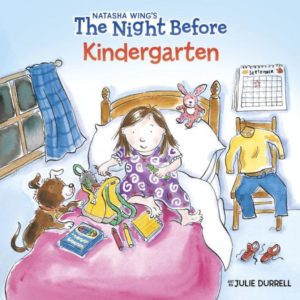 The Night Before Kindergarten by Natasha Wing, illustrated by Julie Durrell (July 2001)
From Goodreads: “It’s the first day of school! Join the kids as they prepare for kindergarten, packing school supplies, posing for pictures, and the hardest part of all—saying goodbye to Mom and Dad. But maybe it won’t be so hard once they discover just how much fun kindergarten really is! Colorful illustrations illuminate this uplifting takeoff on the classic Clement C. Moore Christmas poem.”
Pages: 32
Reading Age: 5–6 years
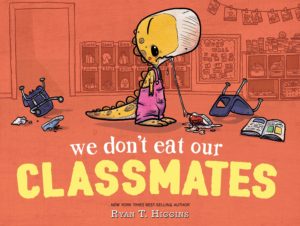 We Don’t Eat Our Classmates by Ryan T. Higgins (June 2018)
From Goodreads: “Penelope the dinosaur starts school, but it’s hard to make friends when her classmates are so delicious!
It’s the first day of school for Penelope Rex, and she can’t wait to meet her classmates. But it’s hard to make human friends when they’re so darn delicious! That is, until Penelope gets a taste of her own medicine and finds she may not be at the top of the food chain after all… Readers will gobble up this hilarious new story from award-winning author-illustrator Ryan T. Higgins.”
Pages: 48
Reading Age: 3–6
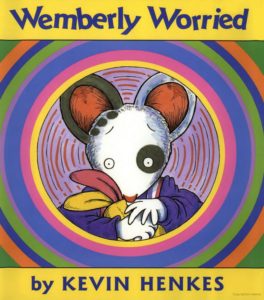 Wemberly Worried by Kevin Henkes (April 2010)
From Goodreads: “Wemberly worried about everything. Big things. Little things. And things in between. Then it was time for school to start. And Wemberly worried even more. If you ever worry (or know someone who does), this is the book for you.
Wemberly worried about spilling her juice, about shrinking in the bathtub, even about snakes in the radiator. She worried morning, noon, and night. “Worry, worry, worry,” her family said. “Too much worry.”
Pages: 32
Reading Age: 3–6
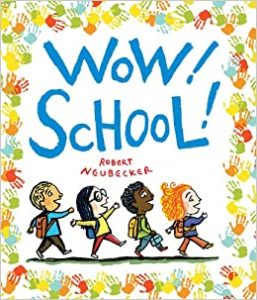 Wow! School! by Robert Neubecker (April 2011)
From Goodreads: “What could be more WOW! than the first day of school?
From science and storytime to music and math, Izzy’s classroom is full of new things to explore. Tag along with Izzy and experience the wonder and excitement of school from a child’s-eye view.”
Pages: 32
Reading Age: 3–7


 Flora and the Jazzers
 Before John Was a Jazz Giant by Carole Boston Weatherford, illustrated by Sean Qualls
 Jazz Day: The Making of a Famous Photograph by Roxane Orgill, illustrated by Francis Vallejo
 Rap a Tap Tap: Here’s Bojangles—Think of That! by Leo and Diane Dillon
 The Sound of All Things by Myron Uhlberg, illustrated by Connie Schofield-Morrison
 Trombone Shorty by Troy “Trombone Shorty” Andrews, illustrated by Bryan Collier


