Industry Insights: Decoding Editorial Feedback (with Real Picture Book Examples)

Hello, OPB friends!

This month, we’re doing something a little different for our Industry Insider post. Instead of featuring an interview, I wanted to dig into a question that comes up often during critique sessions, revision conversations, and email threads with clients, friends, and fellow kidlit writers:

What do editors really mean when they say things like “This feels quiet” or “I didn’t quite connect with the voice”?

As Editorial Director at Bushel & Peck Books—and a kidlit writer myself for the past ten years—I’ve heard these phrases from both sides of the table. I’ve also talked about them at length with my own agent, with critique partners, and with other editors across the industry. So, today’s post is a kind of translation guide: a short, honest look at some of the most common editorial phrases and what they often (but not always!) mean under the hood.


This feels quiet.”

This doesn’t mean “bad.” It usually means the concept doesn’t feel immediately marketable. Maybe the theme is lovely but soft, or the stakes feel internal rather than plot-​driven. Sometimes it means the story is tender or subtle, but doesn’t stand out in a crowded submission pile.

What might help:
Sharpen the hook. Raise the stakes. Consider whether the emotional arc or character journey could be more compelling or surprising.

Example: The Rabbit Listened by Cori Doerrfeld
This is a quiet book, yes, but it works because the emotional core is crystal-​clear and universally resonant. Note how the hook—how kids process big feelings—feels urgent and relatable, even though the plot is minimal.


It’s well-​written, but I didn’t fall in love.”

This is often code for “I admire this, but I don’t have a vision for how to sell it.” Editors have to advocate hard for every book they acquire, and that requires real enthusiasm. No one wants to take on a project they feel lukewarm about, even if the writing is strong.

What might help:
Nothing, necessarily. This one isn’t about a fixable flaw, but rather more about fit. Keep querying. The right person might fall hard.

Example: Julian Is a Mermaid by Jessica Love
This debut book is lyrical, quiet, and elegant—easily one an editor could have passed on for being “lovely, but maybe too subtle.” But its emotional depth and visual storytelling made the right editor fall in love, and champion it all the way to success.


There’s not quite enough here for a picture book.”

This might mean there’s not a full arc, or that the story leans more toward vignette or concept than narrative. It can also mean the emotional or plot payoff isn’t big enough to justify 32, 40, or 48 pages.

What might help:
Dig deeper into the character’s journey. Add tension, reversals, or a turning point. Picture books (even/​especially quiet ones!) need structure to shape the reader’s experience.

Example: A Sick Day for Amos McGee by Philip C. Stead and Erin E. Stead
This story is gentle, but it has a clear beginning, middle, and end. Amos takes care of animals at the zoo. One day he’s sick—and they return the favor. The role reversal adds narrative weight to what could’ve been a flat concept.


I wasn’t quite connecting with the voice.”

This is a gentle way of saying that something in the tone, language, or narrative feel simply didn’t land. The voice might feel too adult, too generic, or inconsistent. Or maybe it didn’t match the story’s intended mood or audience.

What might help:
Read it aloud. Is the rhythm strong? Does it sound like a real person? Could the narrator be more specific, distinctive, or emotionally resonant?

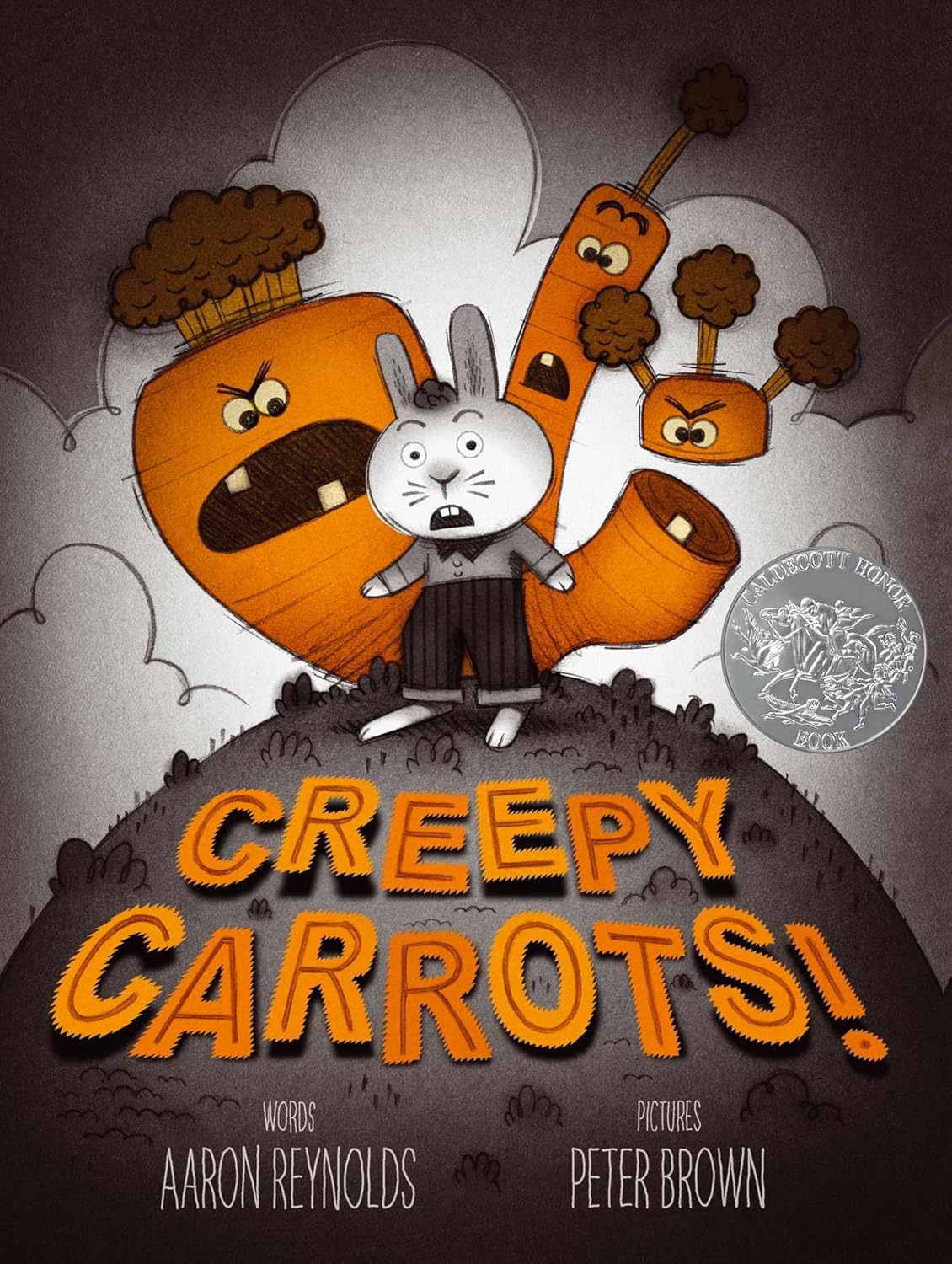
Example: Creepy Carrots! by Aaron Reynolds, illustrated by Peter Brown
The voice here is spot-​on: cinematic, dramatic, and a perfect match for the mock-​horror tone. The exaggerated seriousness is what sells the humor…and the book.

It’s too similar to something else on our list.”

This is rarely personal. More times than not, it’s strategic. Editors have to balance their list across themes, formats, tones, and audiences. If they just acquired a book about ballet-​loving dinosaurs, they’re probably not going to take another one. I run into this a lot at my press because we’re a small press with a small list. I can’t buy a second book about penguins if we’ve already got one in the pipeline, or just published one…even though I’d love to do an all-​penguin imprint!

What might help:
Check your comps. Make sure your book fills a different niche, or offers a fresh twist that feels essential, not adjacent.

Example: Don’t Let the Pigeon Drive the Bus! by Mo Willems
A story about a demanding character trying to get their way? Done a zillion times before. But the second-​person narration, meta structure, and pigeon personality made this feel wildly new, even though the premise is simple.


We’re being really selective right now.”

Always true. But also: sometimes it’s a way of softening a pass without going into detail. Budgets, list size, market trends, team bandwidth, and internal priorities all play a role.

What might help:
This is nothing you can control. It’s just not a reflection on you or your work. Keep going. The right project will hit the right desk at the right time.

Example: The Day the Crayons Quit by Drew Daywalt and Oliver Jeffers
A book like this may have felt risky at the wrong time: epistolary format, multiple voices, no central plot. But with the right champion at the right moment, it broke through—and became a bestseller.


Final Thoughts:
Rejections don’t always mean “no forever.” And editorial speak isn’t meant to be mysterious, though it can MOST DEFINITELY feel that way in the moment for a while. As writers, it helps to hear what’s often behind the phrases. As editors, it helps to be honest about what we mean. The more we can bridge that gap, the stronger the books (and the industry) become.

Got a phrase you’d like help decoding? Leave a comment or reach out! I’m happy to demystify where I can.
Picture Book List: 20 Great Books About Sharks

I’ve been watching a lot of SHARK WEEK reruns, and wow, sharks are pretty amazing. Clearly, kids agree because there are a lot of sharkcentric picture books out in the literary waters.

Here are a few that swim above the rest. See what you think! And if I missed any of your favorites, please tell me about them in the comments section.


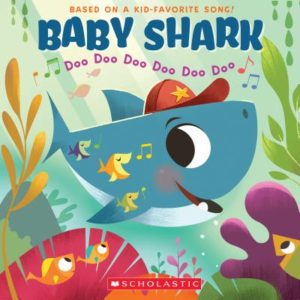
Baby Shark: Doo Doo Doo Doo Doo Doo (December 2018)

From Goodreads: “Baby Shark! Doo doo doo doo doo doo! Baby Shark! Doo doo doo doo doo doo! Baby Shark! Doo doo doo doo doo doo! Baby Shark! Baby Shark has become well-​known and well-​loved by teachers, parents, and children everywhere. And with hilarious and adorable under-​the-​sea art of Baby Shark, Mama Shark, Daddy Shark, Grandma Shark, and more ocean creatures, kids won’t be able to get enough of this silly illustrated story of a shark family! Children will delight in this silly sing-​along story with funny, eye-​popping illustrations and informative picture guides to help readers to mimic and act out the hand/​foot movements and develop their fine motor skills. By the end of the singalong story, little ones will be laughing, singing, and dancing their way to fun and reading success! Are you up for the Baby Shark reading challenge?”

Pages: 24

Reading Age: 1–3


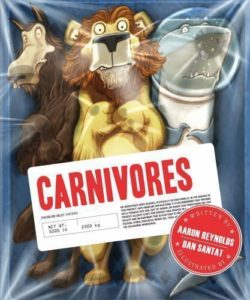
Carnivores by Aaron Reynolds, illustrated by Dan Santat (November 2013)

From Goodreads: “The lion is king of the jungle!
The great white shark is sovereign of the seas!
The timber wolf is emperor of the forests!

But…it’s lonely at the top of the food chain. It’s difficult to fit in when plant eaters can be so cruel–just because you ate a relative of theirs that one time! What’s a carnivore to do?

Aaron Reynolds’s roaringly funny text is perfectly paired with Dan Santat’s dynamic illustrations, creating a toothsome picture book that’s sure to stand out from the herd.”

Pages: 40

Reading Age: 4–8


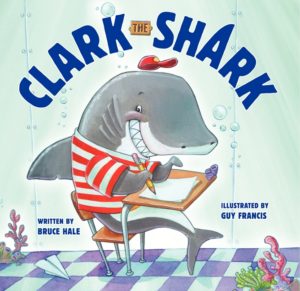
Clark the Shark by Bruce Hale, illustrated by Guy Francis (June 2013)

From Goodreads: “Clark the Shark is a great read-​aloud picture book, with fun rhythm and rhyme, from the ever-​popular Bruce Hale and Guy Francis.

Clark is a shark with zingbang, and BOOM. Clark zooms into school, crashes through the classroom, and is rowdy at recess. Clark loves life—but when his enthusiasm is too much for his friends, Clark’s teacher, Mrs. Inkydink, helps him figure out a way to tone it down.

Clark the Shark celebrates boisterous enthusiasm—and knowing when it’s time for indoor voices!”

Pages: 32

Reading Age: 4–8


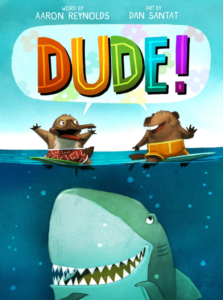
Dude! by Aaron Reynolds, illustrated by Dan Santat (April 2018)

From Goodreads: “Aaron Reynolds, the author of Nerdy Birdy and Creepy Carrots! teams up with Dan Santat, the Caldecott–winning illustrator behind The Adventures of Beekle: The Unimaginary Friend to create the hilarious, gnarly summer adventure picture book, Dude!

Dude! You have to read this book.

It’s totally about this platypus and this beaver who are friends. They want to go surfing but dude, there’s this shark who’s in the ocean, too.

But don’t worry. This shark approaches and you’ll never guess what happens.”

Pages: 40

Reading Age: 4–8


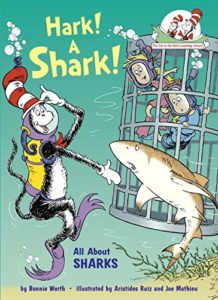
Hark! A Shark! by Bonnie Worth, illustrated by Aristides Ruiz and Joe Mathieu (January 2013)

From Goodreads: “In this latest installment of the Cat in the Hat’s Learning Library, the Cat introduces beginning readers to all kinds of sharks! From the smallest (the dwarf lantern) to the largest (the whale shark), the most notorius (the great white) to the most obscure (the goblin), the Cat explains why sharks have lots of teeth but no bones; how their tough skin helps them swim fast and stay clean (inspiring scientists–and bathing suit manufacturers!); how pores along the sides of their bodies help them sense prey; that they have more to fear from us than we do from them, and much, much more! Perfect for shark and Cat (in the Hat) fanciers, fans of the new PBS Kids preschool science show The Cat in the Hat Knows a Lot About That! will sink their teeth into this new addition to the series!”

Pages: 48

Reading Age: 3–6


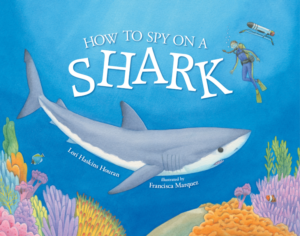
How to Spy on a Shark by Lori Haskins Houran, illustrated by Francisca Marquez (September 2019)

From Goodreads: “Spend a day at sea tracking sharks—with the help of a robot! Join a team of marine biologists as they head out in their boat to study mako sharks. Simple, entertaining text and bright, accurate illustrations bring science and technology to life, and additional pages of facts about sharks follow the story. This book is bound to make a splash with young minds!”

Pages: 24

Reading Age: 4–8


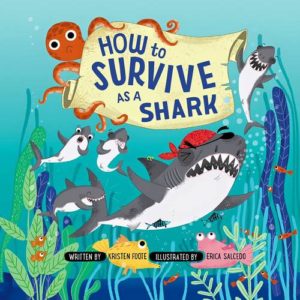
How to Survive as a Shark by Kristen Foote, illustrated by Eric Salcedo (September 2017)

From Goodreads: “Ahoy, me mateys! Upset your Mom swam away after you were born? Cry me an ocean. You’ve got ME to show you the ropes! Well, at least until I get a craving for baby shark. Swim along and I’ll teach you how to hunt using all six senses (a whole sense more than a human), why you can NEVER stop moving (blimey, no — not even to sleep!), and what your most dangerous threat is (here’s a hint: those sneaky landlubbers don’t even live in our waters!). Aye, me hearties, learning How to Survive as a Shark is not as easy as it sounds! How to Survive as a Shark provides a unique take on fish science that will entertain and educate in and out of the classroom. Full of opportunities for extended learning, this book includes fun facts hidden throughout the hilarious illustrated story — and after, a glossary of important terms and some real great white shark photos. If you’ve ever wondered how to think and swim like a shark–and you like to laugh while you learn–this book is for you!”

Pages: 44

Reading Age: 5–10


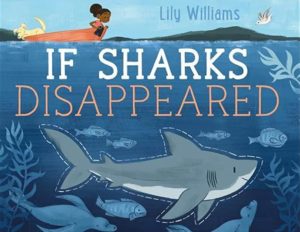
If Sharks Disappeared by Lily Williams (May 2017)

From Goodreads: “A healthy ocean is home to many different kinds of animals. They can be
big, like a whale,
tiny, like a shrimp,
and even scary, like a shark.

Even though sharks can be scary, we need them to keep the oceans healthy. Unfortunately, due to overfishing, many shark species are in danger of extinction, and that can cause big problems in the oceans and even on land.

What would happen if this continued and sharks disappeared completely?

Artist Lily Williams explores how the disappearance would affect other animals across the whole planet in this clever book about the importance of keeping sharks, and our oceans, healthy.”

Pages: 40

Reading Age:  4–8


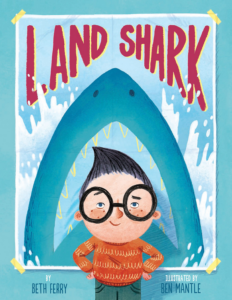
Land Shark by Beth Ferry, illustrated by Ben Mantle (August 2015)

From Goodreads: “The only thing Bobby wants for his birthday is a pet shark. So you can imagine his disappointment when his parents get him…a puppy. Everyone knows shark lovers can never become dog lovers. Or can they? Full of humor and heart, this book explores the idea that sometimes, getting exactly what you don’t want turns out to be exactly what you need.”

Pages: 36

Reading Age: 3–5


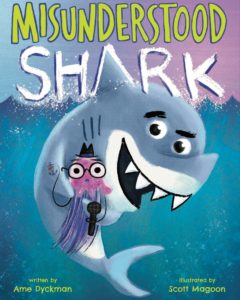
Misunderstood Shark by Ame Dyckman, illustrated by Scott Magoon (April 2018)

From Goodreads: “Every beachgoer knows that there’s nothing more terrifying than a… SHARRRK! But this shark is just misunderstood, or is he? In a wholly original, side-​splittingly funny story, New York Times bestselling author Ame Dyckman and illustrator Scott Magoon take this perennial theme and turn it on its (hammer)head with a brand-​new cheeky character.

The filming of an underwater TV show goes awry when the crew gets interrupted by a… SHARRRK! Poor Shark, he wasn’t trying to scare them, he’s just misunderstood! Then he’s accused of trying to eat a fish. Will Shark ever catch a break? After all, he wasn’t going to eat the fish, he was just showing it his new tooth! Or was he? Explosively funny, extraordinarily clever, and even full of fun shark facts, this surprisingly endearing story gets to the heart of what it feels like to be misunderstood by the people around you. With a surprise twist ending, our Misunderstood Shark will have kids rolling with laughter!”

Pages: 48

Reading Age: 3–5


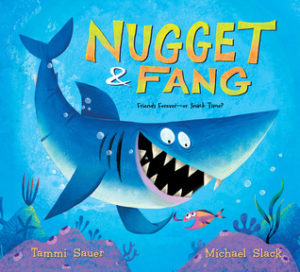
Nugget & Fang: Friends Forever–or Snack Time? by Tammi Sauer, illustrated by Michael Slack (March 2015)

From Goodreads: “In the deep ocean, tiny Nugget and big, toothy Fang get along swimmingly—until Nugget’s first day of minnow school. There Nugget learns that minnows are supposed to be afraid of sharks! To regain Nugget’s trust, Fang takes desperate (and hilarious) measures. But it’s not until his big sharp teeth save the entire school that minnows learn this shark is no foe. Fantastically stylized artwork adds even more humor to this undersea story of unlikely friendship.”

Pages: 40

Reading Age: 4–7


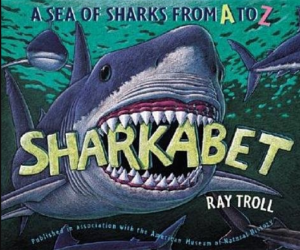
Sharkabet: A Sea of Sharks from A to Z by Ray Troll (February 2002)

From Goodreads: “Sharkabet: A Sea of Sharks from A to Z is a thrilling, chilling book for children of all ages. Featuring Ray Troll’s spectacular fishy art, this book portrays sharks both living and extinct.”

Pages: 40

Reading Age: 7–9


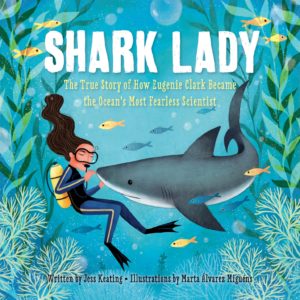
Shark Lady: The True Story of How Eugenie Clark Became the Ocean’s Most Fearless Scientist by Jess Keating, illustrated by Marta Álvarez Miguéns (June 2017)

From Goodreads: “At 9 years old, Eugenie Clark developed an unexpected passion for sharks after a visit to the Battery Park Aquarium in New York City. At the time, sharks were seen as mindless killing machines, but Eugenie knew better and set out to prove it. Despite many obstacles in her path, Eugenie was able to study the creatures she loved so much. From her many discoveries to the shark-​related myths she dispelled, Eugenie’s wide scientific contributions led to the well-​earned nickname ‘Shark Lady.’ ”

Pages: 40

Reading Age: 4–8


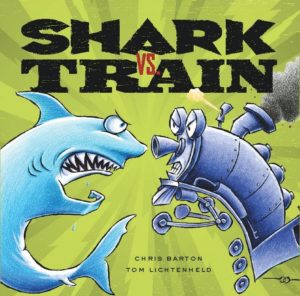
Shark vs. Train by Chris Barton, illustrated by Tom Lichtenheld (April 2010)

From Goodreads: “Shark VS. Train!
WHO WILL WIN?!

If you think Superman vs. Batman would be an exciting matchup, wait until you see Shark vs. Train. In this hilarious and wacky picture book, Shark and Train egg each other on for one competition after another, including burping, bowling, Ping Pong, piano playing, pie eating, and many more! Who do YOU think will win, Shark or Train?”

Pages: 40

Reading Age: 4–8


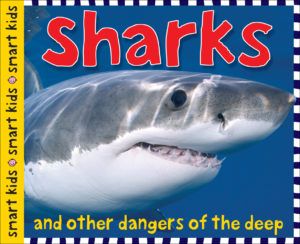
Sharks: And Other Dangers of the Deep by Roger Priddy (October 2005)

From Goodreads: “Close-​up photographs of sharks and other fascinating creatures. Large format book Great for school projects.”

Pages: 32

Reading Age: 4–7


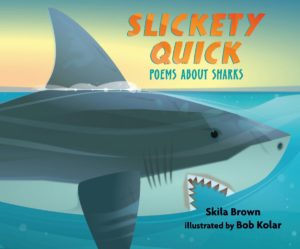
Slickety Quick: Poems About Sharks by Skila Brown, illustrated by Bob Kolar (March 2016)

From Goodreads: “Fourteen shark species, from the utterly terrifying to the surprisingly docile, glide through the pages of this vibrantly illustrated, poetic picture book.

From the enormous whale shark to the legendary great white to the enigmatic goblin shark to the small cookie-​cutter shark, Slickety Quick is a delightful frenzy of shark mayhem. Mysterious species such as the camouflaged wobbegong and the elusive frilled shark share the waters with better-​known blue and nurse sharks, each commemorated in a poem by Skila Brown and illustrated by Bob Kolar. Sneaky shark facts ripple through each spread to further inform the brave and curious young reader intrigued by the power — and danger — of these amazing creatures.”

Pages: 32

Reading Age: 6–9


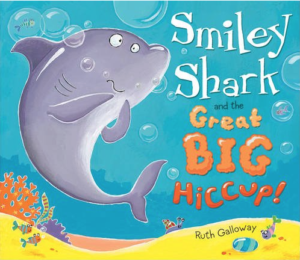
Smiley Shark and the Great Big Hiccup! by Ruth Galloway (May 2013)

From Goodreads: “Oh no! Smiley Shark has the biggest hiccups ever! Hic, Hic, Hicuuuuuup! Soon he is doing roly-​polies with Starfish, being tickled by Octopus, and holding his breath with Pufferfish. But nothing’s working! Will his friends ever put a stop to his big and bothersome hiccups? This hilarious sequel to the best-​selling Smiley Shark by Ruth Galloway will soon have you in fits too! The perfect picture book for any three to six year-​old who loves sea-​creatures, sharks and silliness!”

Pages: 32

Reading Age: 2–6


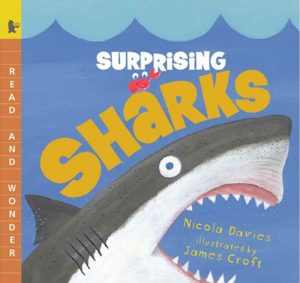
Surprising Sharks by Nicola Davies, illustrated by James Croft (April 2005)

From Goodreads: “Why does a swell shark blow up like a party balloon? What does a lantern shark use its built-​in lights for? Full of fun facts, here’s a surprising book about sharks that kids can really get their teeth into.

SHAAAARRRKK!” That’s probably the last word anyone wants to hear while swimming in the warm blue sea. But most sharks aren’t at all what people expect. In fact, those who think all sharks are giant, man-​eating killers are in for a surprise! The compelling narrative, colorful illustrations, and captivating facts in SURPRISING SHARKS reveal that sharks come in all shapes and sizes — and probably should be more afraid of humans than we are of them.”

Pages: 32

Reading Age: AGES 3–7


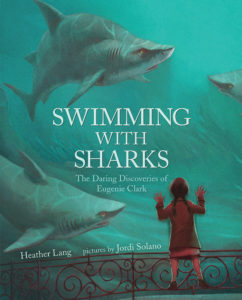
Swimming with Sharks: The Daring Discoveries of Eugenie Clark by Heather Lang, illustrated by Jordi Solano (December 2016)

From Goodreads: “Before Eugenie Clark’s groundbreaking research, most people thought sharks were vicious, blood-​thirsty killers. From the first time she saw a shark in an aquarium, Japanese-​American Eugenie was enthralled. Instead of frightening and ferocious eating machines, she saw sleek, graceful fish gliding through the water. After she became a scientist an unexpected career path for a woman in the 1940s she began taking research dives and training sharks, earning her the nickname “The Shark Lady.”

Pages: 32

Reading Age: 4–8


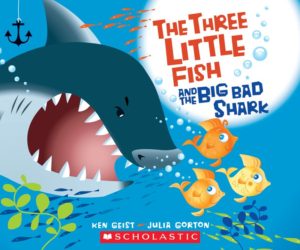
The Three Little Fish and the Big Bad Shark by Ken Geist, illustrated by Julia Gorton (May 2007)

From Goodreads: “A hilarious retelling of THE THREE LITTLE PIGS, with foil on the cover!

Little fish, little fish, let me come in.” “Not by the skin of my finny fin fin!” “Then I’ll munch, and I’ll crunch, and I’ll smash your house in!” Mama tells her three little fish that it’s time to make their own homes. Jim builds his house of seaweed, but the big bad shark munches it up. Tim builds his house of sand, but the shark crunches it up. It’s smart Kim who sets up house in an old sunken ship! Children will delight in this silly story with funny, eye-​popping illustrations. And there’s foil on the cover!”

Pages: 32

Reading Age: 3–6