
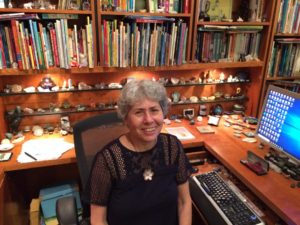
Author Interview: Marilyn Singer

This month’s Author Interview at Only Picture Books is with Marilyn Singer, the author of 90+ books for children and young adults. In addition to being an incredibly prolific author, she’s the host of the former AOL Children’s Writers Chat and currently co-​hosts the Poetry Blast at various conferences.

Need more Marilyn bio nuggets? Try these five facts:

  1. She LOVES swing dancing.
  2. She auditioned for Jeopardy but didn’t get selected–yet.
  3. She got to sing with a chorus for a track on the recording of the revival of the Broadway musical, Pippin.
  4. She’s lives with a cat named Benito and a poodle named Bizzy.
  5. She writes in so many different styles and genres—picture books, realistic novels, fantasy, mysteries, fairy tales, nonfiction, poetry, etc.—because it “keeps her from getting bored.”

Feel like you’ve got enough of a sense of things now to move straight to interview time? Let’s go!

Website: https://marilynsinger.net/
Facebook: https://www.facebook.com/WriterBabe


RVC: It’s my understanding that your love for language emerged at a very early age thanks to the efforts of your family. What specifically did they do?

MS: My Romanian grandmother, who lived with us, told me marvelous stories every night. My parents read to me a lot, especially fairy tales and poetry. They also sang to me popular songs of the day. I grew up appreciating great lyricists such as Cole Porter, Ira Gershwin, Lorenz Hart, and Johnny Mercer. So, my family really did teach me to love language.

RVC: Rumor has it that you were writing your own poems in elementary school. What did you like most about poetry back then?

MS: I think I liked the rhythm and musicality, particularly because I loved songs and singing. I also liked the emotion behind poetry and the fact that it could move me and other people and also make us laugh.

RVC: Despite all that, you didn’t consider writing as a career until a few years after college, right? Why not? What helped you make the move into the world of words? 

MS: Oh, I thought about writing as a career way back in elementary school—that, and having a dog kennel. 😉

But as I got older, my mom said that teaching was a stable career for a woman, and I decided she was probably right. So, I did become a high school English teacher, but I didn’t stay long in that career. I was rather rebellious and didn’t get along with the administration. When I quit teaching, I wasn’t sure what I wanted to do. My husband, Steve Aronson–head of the film department of the American Federation of Arts–got me jobs writing teaching guides and catalog copy about films and also filmstrips (remember those?). Then one day to my surprise, when I was sitting in the Brooklyn Botanic Garden, I started writing stories about insect characters I’d made up when I was eight. I read the stories to Steve, who was encouraging, and I joined the Bank Street Writers Lab, and the members were also positive. I submitted those and other stories and I was very lucky. I got a manuscript accepted after about six months.

Would that it were that easy since!

RVC: Tell us a bit more about that first book and what it meant to you.
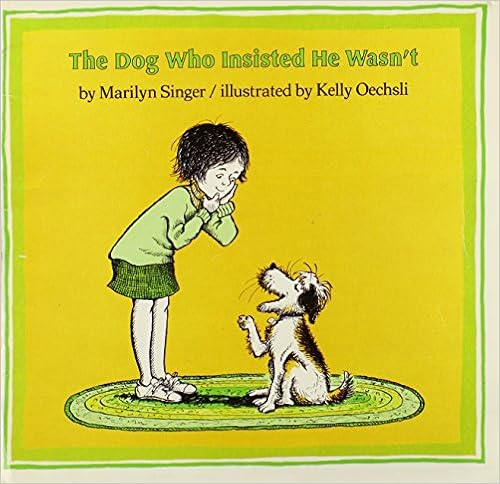
MS: Well, as I said, I was most fortunate. My first book was The Dog Who Insisted He Wasn’t. Ann Durell at Dutton accepted it and my next two books as well. I imagined my own dogs talking and having particular ideas and traits about personhood, and I think the book grew out of that. Once it and my next books were published, I decided that maybe I WAS a writer. It’s not an easy profession, though. It has serious ups and downs—from acceptances and rejections to good sales and low ones to books still in print for decades to those going out of print after a year. Still, I get to make my own hours and work in my pjs if I want to, and that’s not bad!

RVC: What’s one thing that non-​poets don’t fully appreciate about poetry?

MS:  Hmm, I don’t know if they realize that good poetry is hard to write and that it doesn’t always have to rhyme. A lot of folks who dislike poetry think it’s abstruse, which may be true of some poems, but certainly not all. Some also think that there’s just one type of poetry, which isn’t true in the least. I believe that there’s a poem or a type of poetry for all readers to enjoy. But they may need help finding it, which is where teachers, parents, other relatives, and friends come in.
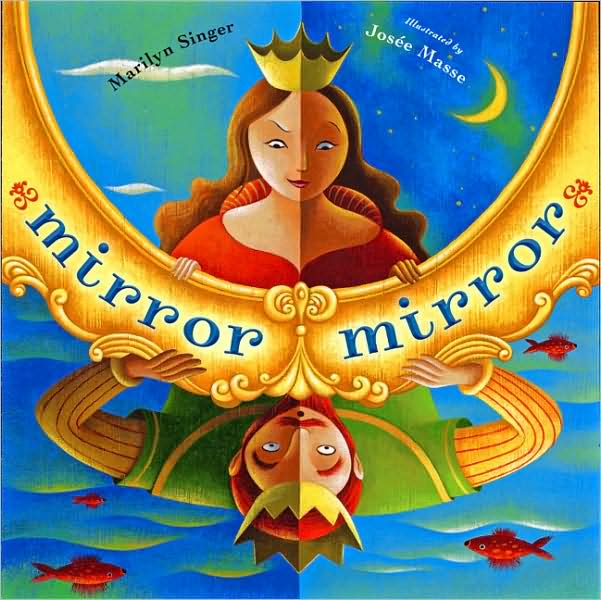
See the source imageRVC: Just the other day, I picked up Mirror Mirror: A Book of Reverso Poems in my weekly grab-​whatever-​catches-​my-​eye run at the public library. What made you think of creating a book like that?

MS: One day I was watching my cat sitting in an easy chair and a poem came into my head:

A cat                                       Incomplete:

without                                    A chair

a chair:                                    without

Incomplete.                             a cat.

I began to wonder if I could come up with more poems like that. I wrote a number of them on a variety of subjects, but quite a few were based on fairy tales. I showed them to an editor who suggested I do an entire collection based on fairy tales, and that’s how Mirror Mirror (Dial, 2010), with divine illustrations by Josée Masse, came about.

I originally called them up-​and-​down poems. It was my husband who came up with the word “reverso.” To write a reverso, I follow strict rules—when the lines are reversed, there are changes in just punctuation and capitalization, and the second half of the poem has to say something different from the first half. These poems are tricky to write. I have to be in a games-​playing head. Also, I have to write them on a computer, as opposed to a legal pad (which is how I write many of my poems) so that I can shift around the lines and see if they make sense.

RVC: You’ve got a host of animal-​related books out in 2019 and 2020—one on presidential pets, one on insects and spiders, one on animals that live in cities, and one on how animals eat. Did you write a lot of animal poems and they sort of fell into these categories, or do you come up with the title/​idea first and then create the poems?

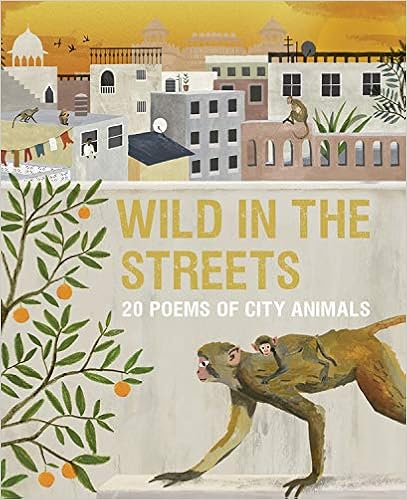
MS: The theme came up first for each of those books. Then I started to write the poems. Two of those books, Bug Dipping, Bug Sipping (S&S, 2020) and Gulp, Gobble (S&S, 2019) are each really a single poem. Who Named Their Pony Macaroni? (Disney-​Hyperion, 2019) and Wild in the Streets (Quarto, 2019) are collections. I never feel that I have a collection in the works until I write a minimum of five to seven poems. And then I have to write a lot more to finish the collection.

RVC: When do the titles happen?

MS: The title almost always comes last, sometimes after much discussion with editors, marketing people, and friends.

RVC: So, you’re essentially a lifelong New Yorker. And what’s something most people don’t appreciate or understand about being a New Yorker?

MS: That’s an interesting question. I think a lot of people believe that New Yorkers are cold or hard when in fact people here are generally friendly and helpful. I’m a native New Yorker and I find I start conversations with folks anywhere and anytime. People here love to give directions and advice on things to see and do.  And they will help you if you are in trouble. I once tripped on the street and a stranger picked me up and held me until I said I was fine. We do tend to be in a hurry a lot of the time, though, and I know that when I’m trying to get to a Broadway theater, I get impatient with tourists taking selfies. 😉

RVC: How does your New York-​ness play into your writing?

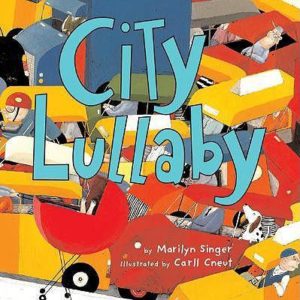
MS: I think the energy here gives me energy to write, and I also think some of my work is inspired by the city—books such as City Lullaby and poems in Nine O’Clock Lullaby, On the Same Day in March, A Full Moon Is Rising, Every Month Is a New Year, and Wild in the Streets, just to name a few.

RVC: Of the many awards and honors you’ve received, which meant the most to you?

MS: I was thrilled to receive the 2015 National Council of Teachers of English (NCTE) Excellence in Poetry for Children Award because it was for the body of my work. I found out I’d won it at a birthday brunch for my husband, so we both got to celebrate that day.

RVC: Now it’s time to close things out with the Awesome Sauce, Mesmerizing, Life-​or-​Death-​Stakes* SPEED ROUND! (*life or death stakes not included!) Ready?

MS: As Neil deGrasse Tyson would say, “Let’s do this!”

RVC: Cake, cupcakes, or pie?

MS: Pie—or maybe tres leches cake.

RVC: Three careers you might’ve had if you never got into kidlit?

MS: Casting director. Zoo keeper. Cabaret singer.

RVC: So, you’re having a dinner party with three guests from the world of books. Living or dead, real or imaginary, what three characters would you invite?

MS: I’d invite Shakespeare, Lin-​Manuel Miranda, and Irene Pepperberg, who studies parrots. They’ve all written books/​plays, so do they count?

RVC: Of course! It’s your party, after all. Next question–which of your books is your secret favorite?
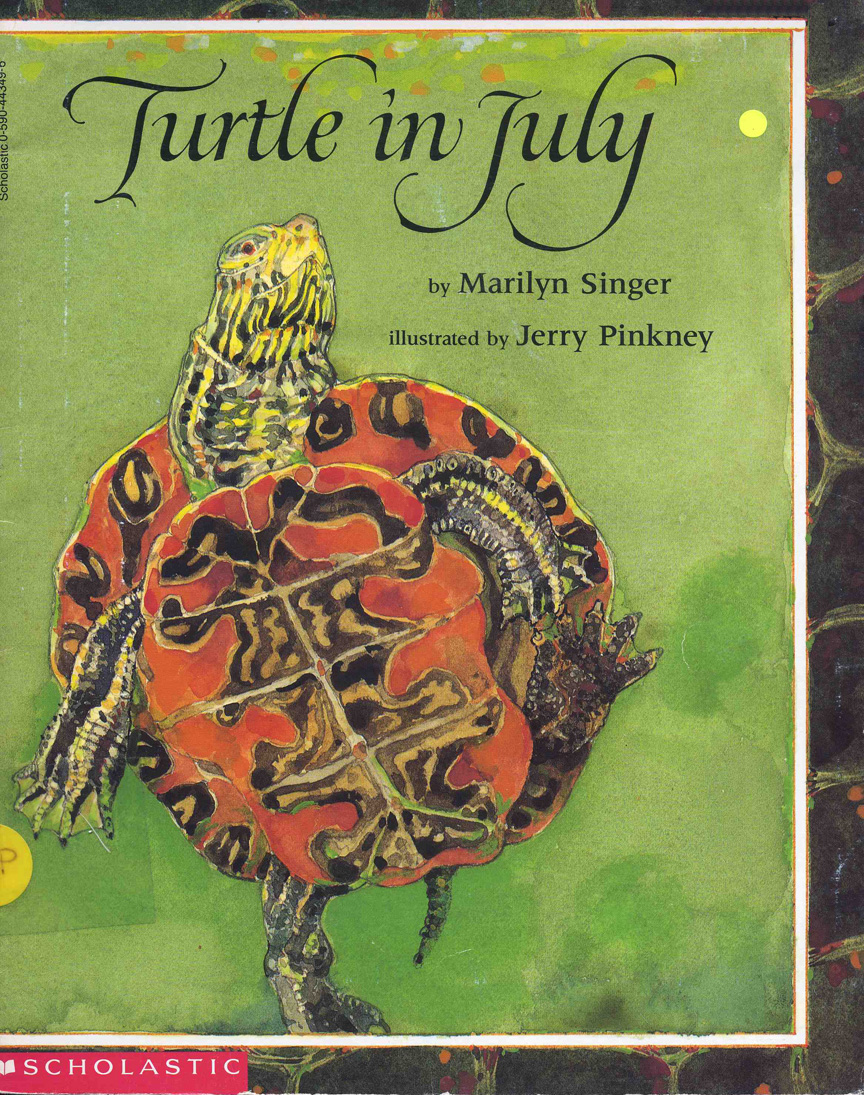
See the source imageMS: That’s a really hard question to answer. I’m fond of my first poetry collection, Turtle in July, and Mirror Mirror, too, since it was a surprise even to me! I also really like The First Few Friends, a YA novel set in the late 60s that bombed at the box office, as it were. I think it might’ve done better if it had been published today.

RVC: Most underappreciated yet awesome kidlit poet working today?

MS: All kidlit poets are underappreciated! Poetry is underappreciated! You’re not going to get me to name names. 😉

RVC: What would you like your literary epitaph to be?

MS: I came, I saw, I wrote about it.

RVC: Thanks so much, Marilyn!


Picture Book Review: We Are (Not) Friends by Anna Kang


We Are (Not) Friends
Author: Anna Kang
Illustrator: Christopher Weyant
Two Lions
1 April 2019
40 pages

This month’s PB review is by Ryan G. Van Cleave (#1 Friend at Only Picture Books) and Ringling College of Art and Design Illustration Professor (and OPB superfriend) John Herzog.

–Ryan’s Review of the Writing–

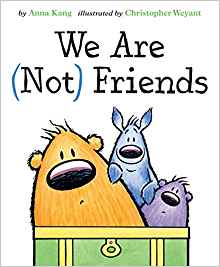
We Are (Not) Friends is the fourth book in the You Are (Not) Small series, and the same fuzzy pals we’ve come to know from the other titles are here again with a new problem. The two of them are engaged in a terrific playdate with a cool trunk of fun stuff, and suddenly a new (blue) pal arrives, asking: “Can I play with you?”

Big brown fuzzy pal: “Yes!”

Little purple fuzzy pal: “Well…”

See where this is going? Welcome to the world of playdate–and friendship–politics. So many of the fun things this new trio of “friends” wants to try are best suited for two, such as a dancing duet. What’s the left-​out fellow to do when the other two are having fun without them? Whether it’s playing at being dinosaur hunters or pretending to build a car, someone is on the outs each time.

The sparse text doesn’t get in the way of telling an important, vital story that showcases how friends–old and new–can get along if the idea of what friendship means is re-​examined and re-​imagined. Part of the fun, as well, is the delightful sound effects such as WHUMP, ERGG, OOPH, and BONK that dovetail with Weyant’s comedic visuals.

While I’m still a bit more taken by You Are (Not) Small, this latest book is a worthy addition to the series and will likely please many readers, big AND small alike. Adult readers, in particular, will appreciate the lesson on friendship and inclusion.

4.25 out of 5 pencils


–John’s Review of the Illustrations–

Friendship and empathy are at the heart of Anna Kang and Christopher Weyant’s endearing We Are (Not) Friends, which tells the story of three friends who each feel left out at some point or another during their playdate.

The story is simple, and the illustrations complement that simplicity well. Like the previous books in the series, this is very much a character study with minimal backgrounds and as-​needed props. Instead of showing the characters against grand vistas and views, the illustrations are hyper-​focused on these “fuzzy friends” trying to navigate the perils that can come with new friends.

An aspect of the characters that really stands out to me is their expressions. As an illustrator who admires and strives for simplicity, Weyant has achieved moments of humor, sadness, and depth with a mere handful of brush strokes. For me, looking at the effectiveness of these expressions is like watching Usain Bolt run the 100-​meter dash or watching Gene Kelly dance while wearing roller skates. Weyant makes it look so darn easy when, in reality, nothing could be further from the truth. Simple is hard, and anyone who says differently is selling something.

My one nit-​pick with the illustrations might be viewed as charming to others, but not to me. It doesn’t detract from the overall experience of the book, but I have to say… It drives me nuts that I don’t exactly know the species of these “fuzzy friends.” One looks like a bear, another looks like a kangaroo, and another looks like a gopher. But it’s never exactly clear WHAT these animals are supposed to be. That’s something I appreciate about the Elephant and Piggie books by Mo Willems. He’s very clear about the characters’ species. I’m willing to admit that I might be wrong on this, though. Maybe it actually is cute and charming that it’s left up to us what exactly the characters are in We Are (Not) Friends. Right now, however, I find myself craving some clarity.

I’ve gotta be honest here: I have a deep admiration for the talents of Anna Kang and Christopher Weyant. From a superficial standpoint, their books are fairly simple and straightforward–great for children. But, if you dig deeper (or you’re a parent who ends up reading these books three or four million times to your children at night), you can find an incredible amount of subtext that speaks volumes about the human condition–which is both amazing and amusing since their books have yet to feature a human character.

4 out of 5 crayons


John Herzog is an illustrator and educator. His clients include Hasbro, Dreamworks TV, Houghton Mifflin Harcourt, and Highlights for Children. He also teaches illustration classes at Ringling College of Art and Design. John is a member of the Society of Illustrators and SCBWI, and received the 2018 SCBWI Magazine Merit Award for his Highlights High Five cover illustration. He lives in Florida with his wife, two kids, a tarantula, a bearded dragon, and a fish.

He is represented by Shannon Associates.

Editor Interview: Karen Nagel (Aladdin Books/​Simon & Schuster)

Meet Karen Nagel, Executive Editor at Aladdin Books/​Simon & Schuster. Prior to joining their team in 2011, she was a Senior Editor at Blue Apple Books (2008–2011) and Senior Editor at HarperCollins (2005–2008). But that’s the sort of bio stuff you hear about when you’re in a job interview, right? At OPB, we do more. We go deeper. We come at things from a different angle.

With that in mind, let’s uncover the REAL 411 about Karen via Six Awesome Karen Facts:

  1. Has had the same best friends since age 7.
  2. Did follow spots for an off-​off-​off Broadway production of Sam Shepard’s ‘Tooth of Crime.’
  3. Bicycled through Europe at 16 with American Youth Hostel.
  4. Has no appendix or tonsils.
  5. Loves laughing.
  6. Enjoys yoga.

And for those who DO yearn for traditional bios, let’s share that too.

Karen Nagel has had the great good fortune of a career in children’s book publishing. From #1 New York Times, USA Today, and Publishers Weekly bestselling books to Coretta Scott King and Society of Illustrator award winners, she has worked with many of industry’s most noteworthy authors and artists.

Today she is the Executive Editor at Simon & Schuster’s Aladdin Books, where she not only has continued to work on bestselling books, but perhaps more significantly has conceived and created new formats for emerging–and reluctant–young readers, planting the seeds for a lifelong love of books. A graduate of New York University, she’s a true believer in the transformative and transcendent power of the arts, the ocean, friendship, family, peace, and love.”

BOOM! Now that we’ve laid the groundwork here for a beautiful, well-​informed relationship, let’s plunge into the interview.

Here we go!

Aladdin Books website: http://simonandschusterpublishing.com/aladdin/

LinkedIn: https://www.linkedin.com/in/karen-nagel-7a5aa115/


See the source imageRVC: Let’s start with a question I’ve never asked an editor before. In 2017, you acquired world rights for Fox & Friends co-​host Ainsley Earhardt’s debut picture book, Take Heart, My Child: A Mother’s Dream. How are things different when working with a celebrity author?

KN: It might be easier for a celebrity author to promote and sell books as they have, for the most part, a built-​in audience and platform. But celebrity or not, it’s the personal connection I want to establish from the get-​go and the relationship we develop along the book-​creating process that is most important and impactful to me and to the story itself. The notable personalities I have the pleasure of working with have been terrific, as I think we at Aladdin do a wonderful job of reflecting what’s in their heart(s).

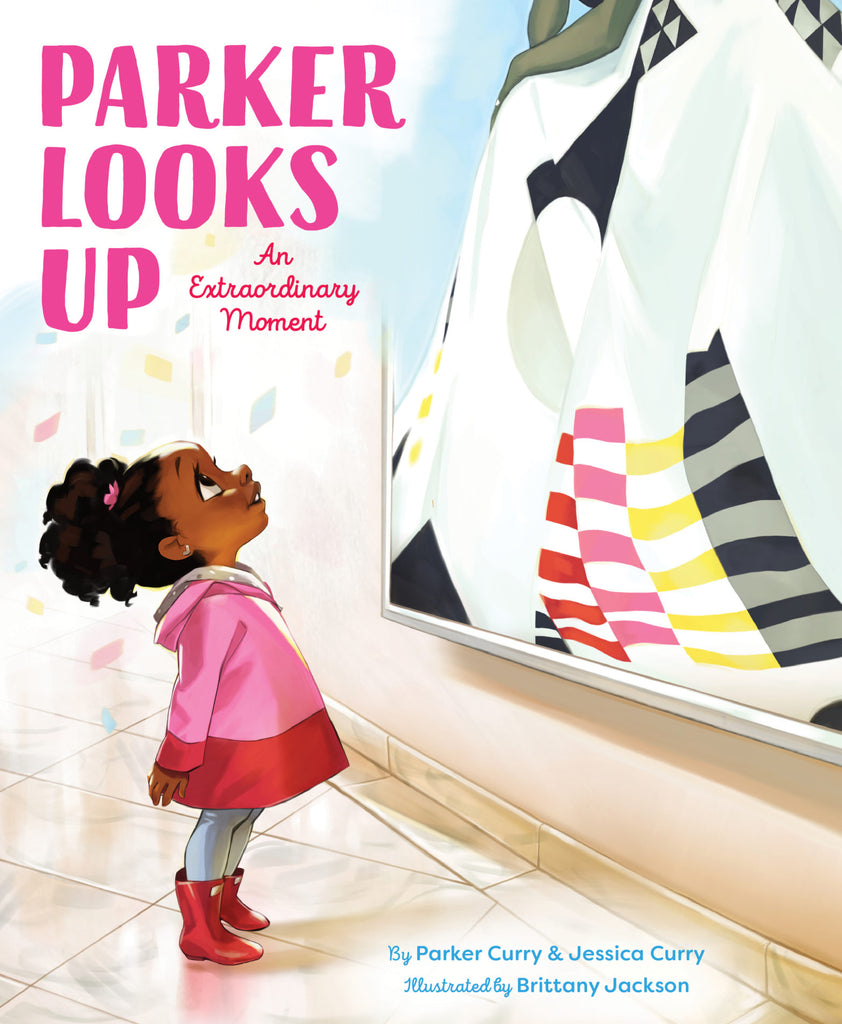
See the source imageRVC: What about the other celebrity book you’ve recently acquired, Parker Looks Up: An Extraordinary Moment, written by four-​year-​old Parker Curry and her mother, Jessica ?

KN: This has been a dream come true for Jessica and Parker, and to capture their experience on that historical and unforgettable day, has been a labor of love on our part.

I sure wouldn’t want to disappoint a four-​year-​old, would you?

RVC: Great point! In a Forbes.com article about Parker Looks Up, you said, “Does anyone ever know the moment that will forever change their lives?” Got a moment like that in your own life you’d like to share? Maybe the one that sent you down the path of kidlit publishing?

KN: Books from my aunt: Charlotte’s Web; Hello, Mrs. Piggle-​Wiggle; The Little Prince.

RVC: What’s the best non-​traditional training you’ve had that helped prepare you for your career as an editor?

KN: Summer sleep-​away camp. I’m not kidding.

RVC: Makes sense to me (I learned all too much at sleep-​away camps!). Now some might not know this, but you’re an author, too. How did your own book, Two Crazy Pigs, come about?

KN: My older son came home from camp (see, it’s camp again) one day, singing a silly made-​up song: We are two crazy pigs…and I was inspired! What would happen on a farm with two out-​of-​control piggys?

RVC: Do you have a sequel or another book in the works?

KN: I have a TCP sequel, and am just looking for the time to finish it…

RVC: I totally understand that–so many projects, so little time. Now let’s tackle a writer-​pleasing question. What’s “out” in the world of picture books? What’s yesterday’s news? What’s the equivalent of parachute pants, which we all love via the nostalgia sheen of memory, but we honestly don’t need to see again in real-​life anytime soon?

KN: Everything is cyclical, to my mind. And it seems short-​sighted to me to pigeonhole an idea as yesterday’s news…

RVC: Fair enough. One a scale of 1 to 11,000, how important is it that an aspiring author have a platform and/​or a viable, robust marketing plan?

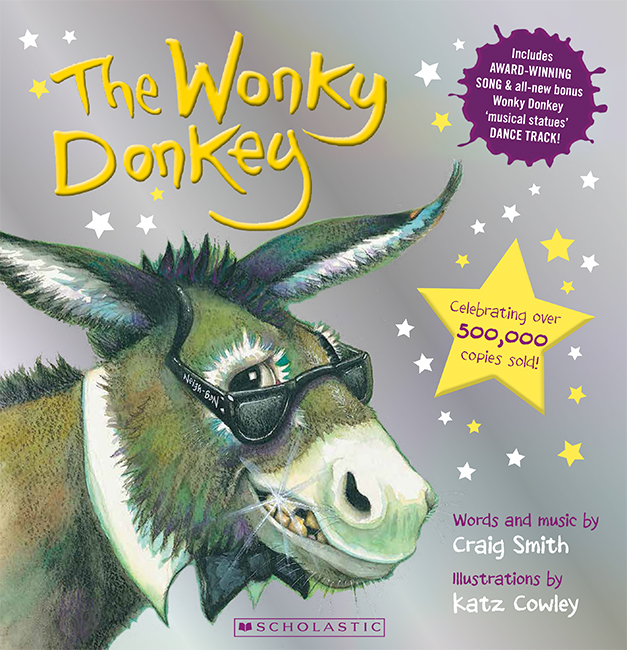
See the source imageKN: These days, 9,000. But then there’s the Scottish Grandma reading The Wonky Donkey, and I doubt she was officially part of any type of platform or robust marketing plan.

RVC: If I could give you a bullhorn powerful enough to reach the ears of every single picture book author on the planet, but it only had enough juice to work for one sentence, what’s the one thing you’d tell them all?

KN: Revise, revise, revise, and remember to listen to and then speak from your real heart.

RVC: Without further ado, hubbub, or hullabaloo, it’s time for … THE SPEED ROUND! Shockingly fast Qs followed by lickety-​split As. Ready?

KN: Ready!

RVC: HERE WE GO! Game of Thrones—great TV series or the greatest TV series? 

KN: Great TV series.

RVC: Which cryptid would make the coolest pet—Sasquatch, Loch Ness Monster, or Chupacabra?

KN: Sasquatch.

RVC: “If I were still in book editing but NOT in the world of kidlit, I’d be editing ________.”

See the source imageKN: Biographies of musicians.

RVC: Favorite non-​Aladdin picture book from 2018?

KN: All Are Welcome by Alexandra Penfold and Suzanne Kaufman.

RVC: What Aladdin picture books coming out later this year are you most excited about?

See the source imageKN: Superbuns! By Diane Kredensor. The Presidents: Portraits of History by Leah Tinari. Parker Looks Up by Parker Curry and Jessica Curry.  Amy Wu and the Perfect Bao by Kat Zhang.

RVC: What’s the three-​item checklist for your dream picture book manuscript?

KN: Well-​written; funny; out-of-the-box.

RVC: Thanks a bunch, Karen. It’s been a pleasure helping the Only Picture Book family get to know you better. 


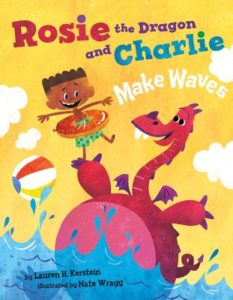
Educational Activities: Rosie the Dragon and Charlie Make Waves by Lauren H. Kerstein

Rosie the Dragon and Charlie Make Waves
Author: Lauren H. Kerstein
Illustrator: Nate Wragg
Two Lions
1 May 2019
40 pages

It’s summertime, and you’re invited for a rollicking day at the pool with Charlie and his pet dragon (and best friend!), Rosie. But be careful—swimming with a dragon can be, um, challenging.


Need some reviews of Rosie the Dragon and Charlie Make Waves?

Booking Mama

Mom Read It

The Children’s Book Review


Educational Activities inspired by Lauren H. Kerstein’s Rosie the Dragon and Charlie Make Waves:

  • Before Reading–From looking at the front cover: 
    • Where do you think Rosie and Charlie are making waves?
    • What type of relationship do they seem to have?
    • Does the story look like it’s about today or a long time ago?
  • After Reading
    • Among other things, this book is about safety at public pools. What do you now know about pool safety?
    • What do you think Rosie likes most about Charlie’s gummy snacks?
    • Which character do you think is most like you? Charlie or Rosie? Why?
  • Writing–This book ends with Rosie wanting to learn to read. Write the story of what happens the next day when Charlie tries to teach her to read. What kind of trouble does Rosie get into (we KNOW she gets into trouble)?
  • Crafts–With an adult’s help, try some of the following dragon-​themed crafts: 
  • Further Reading–Who doesn’t like dragons, right? While the dragons in the following books aren’t swimming in a pool, they are doing some fun things. Which of these looks most dragon-​tastic to you? (Click on the book cover for more information on any of these titles!)

See the source image

See the source image

See the source image

See the source image


Author/​Illustrator Interview: Fred Koehler

See the source image

This month’s Author/​Illustrator Interview is with Fred Koehler, who first got on my radar at the 2017 SCBWI regional conference in Miami. I was sitting in the back row for the Heidi Stemple and Jane Yolen Picture Book Intensive, and this quiet, red-​haired dude slipped into the chair behind me as the event started, and he ended up doodling/​drawing/​sketching the entire time. During one of the breaks, I finally asked him who he was and what kind of work he’d done, if any.

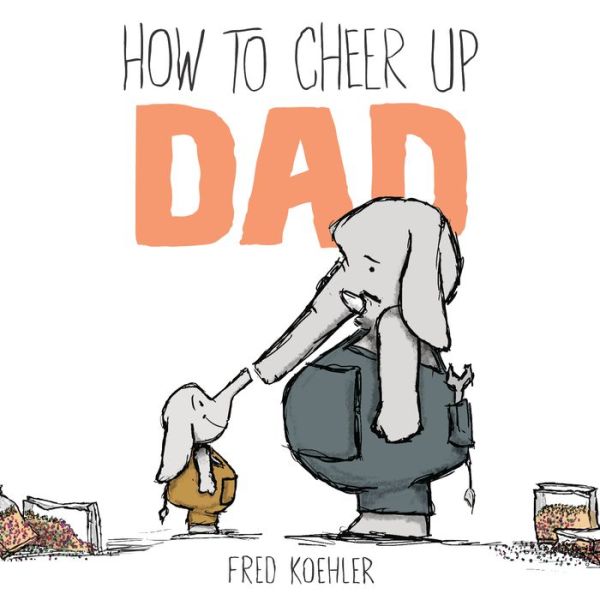
Fred kind of shrugged and said he’d done “a few things” and “had another thing coming out,” but didn’t give any indication that he was talking about his illustration work on “things” like One Day, the End and This Book Is Not About Dragons, as well as his own author/​illustrated books How to Cheer Up Dad and Super Jumbo.

Way to slow play it, Fred.

Just in case you don’t yet have the full 411 on the fun coolness that is Fred, here are Five Fredtastically Freddifying Facts to help you out. Only one fact is an “alternate fact,” meaning 100% completely fakeroo-​false. (If you can’t tell which one’s the fabricated falsehood, I’ll dish that answer in the finale of this interview.)

See the source image1—He’s got a dog named Cheerio Mutt-​face McChubbybutt.
2—There’s an official Penguin Kids promo video for How to Cheer Up Dad where Fred gets hit in the face with Silly String and then a whipped cream pie.
3—Fred broke the Guinness World Record for having the largest traveling children’s book.
4—Fred bet me I couldn’t work 13+ words that begin with F in a single short bio-​style paragraph.
5— Fred’s real-​life misadventures include sunken boats, shark encounters, and a hurricane.

Need a bit more to REALLY feel like you know Fred? Here’s a KidLit TV video where he shows you how to draw a puppy!

With that, we’re ready. We’re set. It’s time to Fred it on!

Website: https://www.ilikefred.com/
Facebook: https://www.facebook.com/superfredd
Twitter: https://mobile.twitter.com/superfredd
Instagram: https://www.instagram.com/fred_koehler_/
Goodreads: https://www.goodreads.com/author/show/7135838.Fred_Koehler


RVC: Let’s begin with the place where so much begins for you—Mitchell’s Coffee House. What’s the dealio?

FK: For me, every work space has a vibe and a specific energy. That energy might be emotional, psychic, kinetic (or it might all be in my head). Since I started going to Mitchell’s in college, it’s always been “home turf,” where good vibes flow and I can even go back behind the counter and refill my coffee if it’s busy.

RVC: You’re also pretty darn active in social media in a way that people seem to dig. What’s your seems-​to-​be-​working philosophy?

FK: My formula is simple: Be open about my failures. Joke about them and learn from them in real time. I don’t go for perfect because my life is generally a mess. Perfect isn’t authentic or believable.

RVC: One of the constants in your path to success seems to have been SCBWI (Society of Children’s Book Writers and Illustrators). Share how that organization played a part in your own journey. 

FK: I prefer to be a lone wolf, but I’m slowly realizing that you have to have community. For the publishing world, there’s no better community than SCBWI. Loads of like-​minded people, great instruction, and specific opportunities to connect with publishing dealmakers.

RVC: Any tips on how SCBWI can help launch the careers for other authors, illustrators, and author/​illustrators?

FK: I recommend showing up to make friends, not deals. Then you start to see it as a lifelong journey, not some prize you’re racing to win. You can find peace with where you’re at, and still keep the fire lit to get where you want to be.

RVC: Let’s pin this down. You’ve done illustrating. You’ve done author-​illustrating. So, do you consider yourself to be a words-​first or pictures-​first story creator? 

FK: I sold my first two books as author/​illustrator. But before that, I wrote some really terrible stuff including a novel-​that-​must-​not-​be-​named-​and-​will-​never-​be-​published. Most stories play out in my head like a movie, complete with narrative voiceover and camera direction. I can choose to write down what the narrator is saying, sketch out what the camera is seeing, or even dive into the head of one of the characters and describe the story through their perspectives and biases.

All of that, in a nutshell, is my superpower.

See the source imageRVC: One of the benefits of being an illustrator is that you can justify a lot of trips for photographic/​visual reference. (Okay, writers do this too!) When you illustrated Matt Forrest Esenwine’s picture book, Flashlight Night, you went a bit overboard with the research. What did you do to prepare you to illustrate that book?

FK: Well, the manuscript called for castles and waterfalls, old ships and foreign shores. So, I did what any illustrator would do and hopped a flight to Manchester so I could bum up and down the UK for a few weeks and find photographic reference for all of these illustrations. I did it all the cheap–youth hostels and public transit.

I had just about every adventure that the characters had in the book. Made friends. Got lost. Even bled a bit. I’d do it again in a heartbeat.

RVC: You’re fortunate enough to call kidlit queen Jane Yolen a friend and a mentor. What are some of the most important lessons that she’s given you, explicitly or implicitly?

FK: Jane is famous for all sorts of great advice for writers. My favorite is about luck. She figures that luck makes its own path through the ether, wandering where it will to bless the heads and hearts (and wallets) of mortals at its own whimsy. But she also figures that there are things we can do as creatives to invite luck in, to nudge ourselves toward its path. Hard work is at the top of that list. If you’ve got a house in order and a bag packed when luck knocks on your door, you’ll be ready to join it on an adventure.

See the source imageRVC: Since we’re talking about relationships with writers—what’s the best part about being married to another writer? (For those who don’t know, his wife is YA novelist Sarah McGuire, author of the terrific books Valiant and The Flight of Swans.)

FK: This is kind of deep, but one amazing thing about Sarah is being able to know her through the books she reads and writes. When she tells me how the Chronicles of Narnia sent her racing through her home, opening cabinets and closets trying to find an entrance, I know that we share a sense of the numinous. Or if I read a scene she wrote about, let’s say, betrayal, I could feel how deeply that knife cuts for her. An honest writer lays bare their soul on the page, warts and all. Who else gets to read and fall in love with another person’s soul? We’re a lucky pair.

See the source imageRVC: Speaking of novels—talk a bit about how you moved your kidlit career from purely picture books to including a middle grade novel like Garbage Island (The Nearly Always Perilous Adventures of Archibald Shrew).

FK: Story came to me most naturally through words, so novels were my first love. I was just awful at writing them. But the format of a picture books honed my ability to tell a story succinctly and to add depth and meaning in the negative space. So, when I sat down to pen a novel after working on numerous picture books, I had a new sense of vision for what it could be.

Writing coach Joyce Sweeney taught me a lot about novel craft. And I’d be remiss if I didn’t mention the Writer360 Breakout Novel Intensive as the training that filled in additional gaps in my novelist toolkit. And to bring everything full circle, that proactive work nudged me into the path of luck in the form of a publisher excited about whatever I came up with next. And when luck came knocking, I was ready.

RVC: Let’s look forward. You’re under contract to write The Sailing City (Boyds Mills Press, 2020), which is the sequel to Garbage Island. Can you share a little bit about that new book?

FK: The second novel was harder than the debut, and it’s still in first pass editorial so it’s hard to really even say. I half expect to get a letter saying, “Dear Fred, This sequel is an exceptional way to waste months of everyone’s time and 60,000 words.” But I’ll let you know.

RVC: You’ve been warned. I’ve been warned. All the elephants in Fred’s picture books have been warned. But here we all are—it’s time for THE SPEED ROUND! Fast Qs and equally fast As, please!

FK: Bring it!

RVC: Tater tots or French fries?

FK: Tots.

RVC: Best Saturday afternoon activity: fishing, writing, or drawing?

FK: I’m a fisherman first, artist second.

RVC: Coolest Harry Potter spell that doesn’t yet exist?

FK: Abra-​ka-​dinner.

RVC: The #1 picture book writer you’d LOVE to illustrate for?

FK: I don’t care who wrote it. Just send me a manuscript that’s equally brilliant, unusual, and impossible.

RVC: Best compliment by a child reader?

FK: I got a letter recently from a reader who loved Garbage Island, and subsequently started picking up trash in his neighborhood so it wouldn’t end up in the ocean. Does it get any better than that?

RVC: Three words that sum up your relationship with kidlit.

FK: Let’s stick with “brilliant, unusual, and impossible.”

RVC: Thanks so much, Fred! Much appreciated!


**For those of you who needed to cheat to figure out which of the Fred Facts is false, it’s #4. The over-​the-​top F business is all me. Blame OPB.


Picture Book Review: The Panda Problem by Deborah Underwood

See the source image

The Panda Problem
Author: Deborah Underwood
Illustrator: Hannah Marks
Dial Books
2 April 2019
48 pages

This month’s PB review is by Ryan G. Van Cleave (Biggest Panda Fan at Only Picture Books) and OPB review newcomer, Florida author-​illustrator Loreen Leedy.

–Ryan’s Review of the Writing–

One thing that we’ve come to expect from Underwood’s books is how stories themselves are often part of the story. In her latest picture book, The Panda Problem, that’s exactly what’s happening. A Narrator (yes, that’s with a capital N since this one’s quite the active character here) is trying to set up a story about Panda in a “beautiful bamboo grove,” but despite the Narrator’s insistence that a main character has to have a problem, Panda claims to not have one. “Looks like you’re the one with a problem, buddy,” Panda explains to the Narrator.

The story gets fairly chaotic from there in a fun way that will delight readers, especially once the setting moves far from the bamboo grove. Thankfully, the art clearly showcases the two distinct voices. Panda’s words are always in cartoon-​style speech bubbles, and those by the Narrator look like regular text on the page, which gives the words an adult, authorial seriousness to them. Together, they create a fast-​paced dialogue that roars along as Panda tries to help make the story, well, a story. Sort of.

A bonus is that Underwood includes plenty of kid-​pleasing sound effects, as well (witness a spider who says “BRAAAAP!” and the GLUG GLUG SLOSH of Panda’s paper boat wipeout).

While other picture book authors have had characters who wrest control of the story from a narrator/​author, Underwood’s adorable Panda does it in a fun, memorable way that doesn’t get overly meta and also introduces readers to storytelling techniques (such as dialogue and the escalation of stakes).

Even though I’m an admitted panda bear fan, this is a highly entertaining, witty read regardless.

4.25 out of 5 pencils

– Loreen’s Review of the Illustrations–

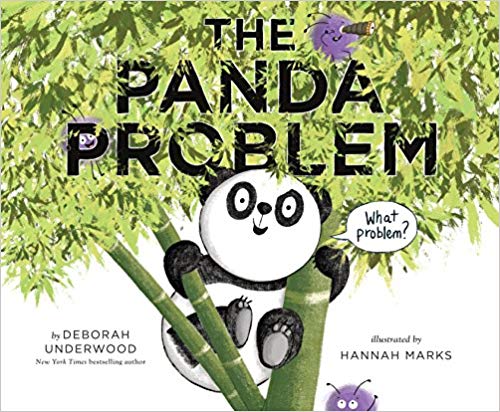
The premise of this cheeky picture book can be found on the book jacket as Panda disputes the title The Panda Problem right on the front cover by asking, “What problem?” Mysterious round purple characters hint at mysteries to unfold. On the back cover, Panda is smirking after drawing a line through the floating headline NO PROBLEM, NO STORY and rewriting it as NO STORY, NO PROBLEM!

Continuing the theme, the front flap copy originally stated that the author “…puts readers in control of this story.” However, our main character has revised it to read “…puts readers PANDA in control of this story.” The back flap copy has likewise been extensively revised by the irrepressible bear.

The color scheme is at first limited to black, white, olive greens, and purple only. The digitally painted illustrations include bamboo stalks with a subtle cloth texture and energetic dry brushed leaves, while Panda has loosely drawn line work enclosing the white parts of the body. Backgrounds are primarily white space in the beginning of the book, keeping the focus on Panda and the argument with the Narrator about whether or not Panda needs a story problem to be solved. The empty white space can also be an indication of the (seemingly) unfinished state the story is in.

As the debate continues, one spread is filled with possible problems proposed by the Narrator such as “Are you afraid of spiders?” or “Is your paw sore?” and Panda’s repeated answers, “Nope.” Once they’re mentioned, comical spiders appear in the artwork. The Narrator’s words are in a clean sans serif font while Panda speaks with lively handwritten words inside expressive speech balloons with oval, undulating, or spiky shapes. When the Narrator gets especially frustrated, her words are set in ALL CAPS.

Rich photographic textures add interest and additional colors to the illustrations, such as woven fibers in a hammock, wood grain in a banjo, and crumpled paper in a sailboat. As Panda induces a multi-​hued torrent of jelly beans by merely mentioning the possibility, the Narrator loses control of events. At this point the aliens arrive, portrayed as happy purple fuzzballs who accompany Panda to Antarctica.

The scenes become increasingly chaotic as spiders, penguins, aliens, and (suddenly) twin pandas sail across the icy waters then are shipwrecked. Panda’s worried face is seen in extreme close-​up while finally giving in and admitting there’s a problem. After wailing about their hunger and the complete lack of bamboo in Antarctica, the two pandas make a deal for the Narrator to take over again, sort of. The last page is blank except for the Narrator’s final, satisfying word.

Self-​taught illustrator and designer Hannah Marks lives and works in England; The Panda Problem is her first picture book released in the United States. The design of the type and illustrations perfectly complement and extend the concepts within about the power of words, creativity, writing, characters, illustration, and of course, story problems.

4 out of 5 crayons


See the source image

Loreen Leedy is the author-​illustrator of more than 40 popular picture books that have received many rave reviews and honors. Her titles such as Measuring Penny, Amazing Plant Powers, and Crazy Like a Fox: A Simile Story often include math, science, and language arts content. Her most recent book, Step by Step, features footprints made by baby animals including a puppy, duckling, and fawn in a page-​turning question and answer format. It makes an appealing nonfiction choice for preschool, kindergarten, and first grade age levels.

To see Loreen’s work and download free book activity printables, please visit www.LoreenLeedy.com.