
Illustrator Interview: Duncan Beedie

This month’s interview is with author/​illustrator Duncan Beedie, the first UK-​based interview subject we’ve ever had at OPB! Don’t worry, though—I’ve installed a UK-​to-​American-​English translator plugin, so we don’t run into any linguistic snafus!
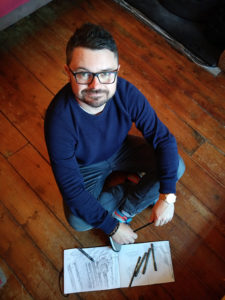
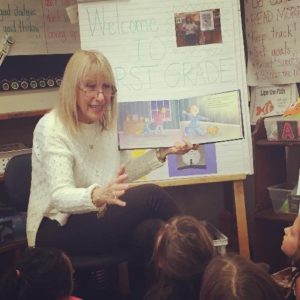
Let’s borrow some bio stuff from Duncan himself: “I have been doodling and drawing since way back in the early 1980s, lying on my parents’ living room floor, grasping a felt tip in my clammy little fist, through to my current profession, grasping a Wacom stylus in my clammy little fist. So, not much has changed, although I no longer lie on the floor to draw.”

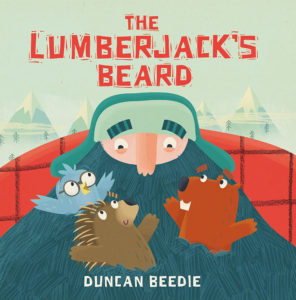
I first learned about Duncan via his picture book, The Lumberjack’s Beard, which I read to my kids and they said, “That beard is bonkers good.” With an endorsement like that, I knew I had to bring Duncan into the OPB fold one way or another.

So, let’s get this interview underway and learn about all things Duncan! With a little luck, we might learn something about that wondrous across-​the-​pond place called the UK, as well.


RVC: Let’s start right where my kids did—that lumberjack’s beard. With a picture book where you’re both author and illustrator, where does the story begin? With a title, an image, a phrase? (It’s the beard, right? You can tell us.) 

DB: I always start with a character design. I consider myself more of an illustrator than a writer, so doodling in a sketchbook always comes first. Then, if there’s a character I particularly like, I start to develop a world for him/​her. I think about that character’s routine, what they might wear or eat, and hopefully a story idea emerges. That was certainly the case with “Big” Jim Hickory in The Lumberjack’s Beard.

RVC: One of the things I’ve noticed in looking at picture books by UK publishers (like Templar Books, which published many of your titles) is that there’s a stylistic difference from picture books from US publishers. What do you think? Do you see it, too? What’s this about?

DB: I’m afraid to say I haven’t looked closely enough at enough US picture books to be able to comment on the stylistic differences (my apologies!) I do, however, notice differences between UK books and their European counterparts. Particularly in terms of the illustration. I also think artists and writers vary incredibly within the UK. I haven’t a clue what accounts for this stylistic difference, but it’s great to see so much variety on bookshop shelves.

RVC: I completely agree. Variety is the life of spice, right? Something like that?

Moving ahead! I always like to know the origin story of a creative. You gave us a wonderful bio nugget in the intro, so let’s jump to another key point in your creative past—your first book. What’s the story behind it? How did it come about?

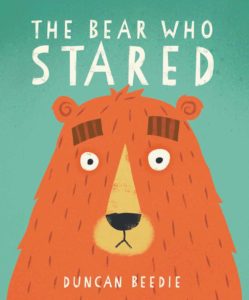
DB: The Bear Who Stared came about from an illustration as well. One day I drew a gormless-​looking bear [UK translator in action here! Gormless: an informal British word, meaning “lacking in vitality or intelligence; stupid; clumsy”] as if he were posing for a passport photo. I had a printout of it in my studio and would occasionally stare at it–the gormless bear stared back.

Eventually a story about a socially awkward bear formed in my mind. I sketched out a storyboard and sent it to a couple of publishers, and Templar Books replied stating they were interested in developing it. The rest is history, as they say.

RVC: I love the answer, but I confess–that bear’s staring is getting to me now, too! ARGH! Let’s move on as if that bear isn’t still giving me The Look…

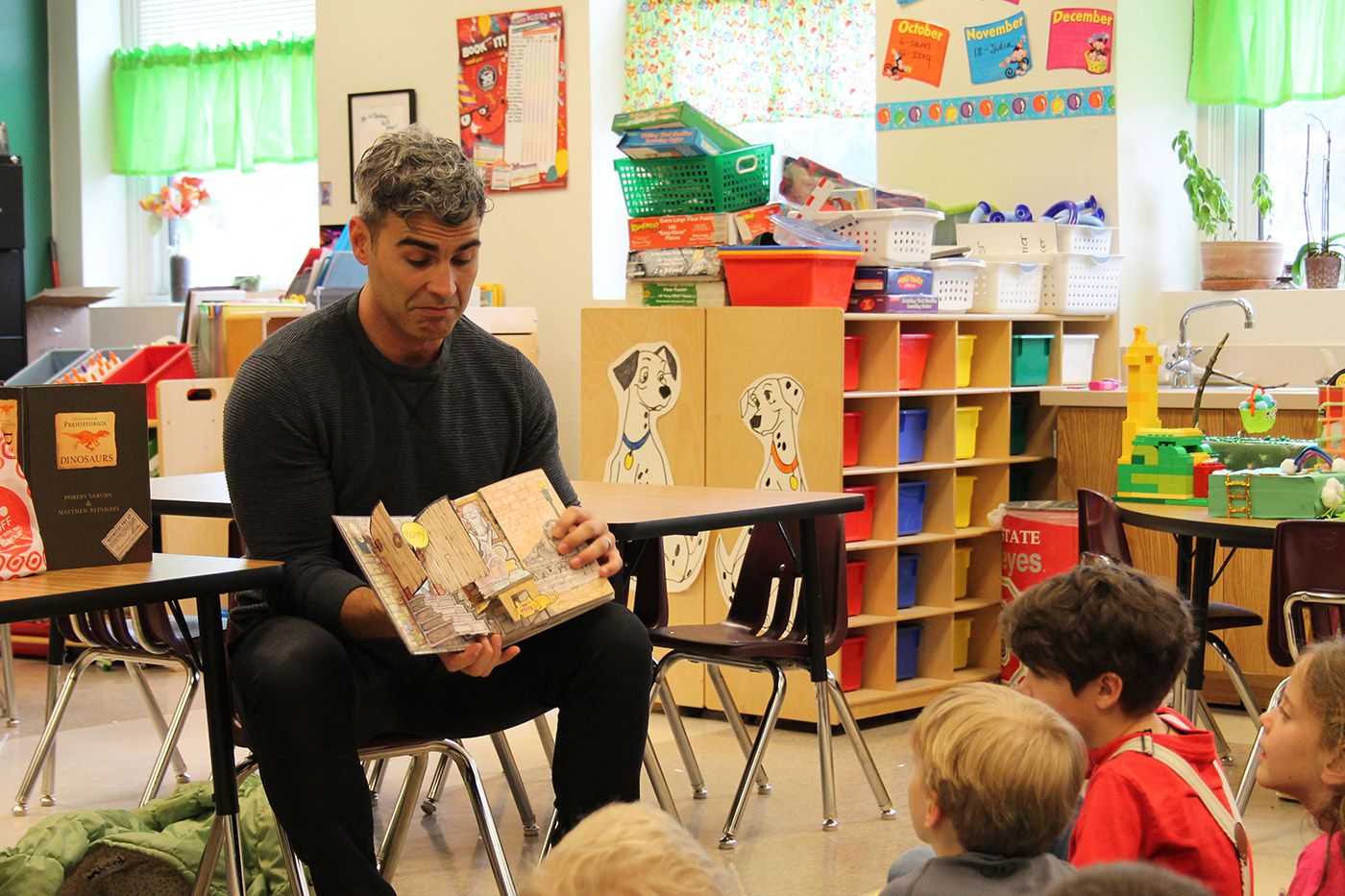
Prior to getting into illustrating picture books, you worked in animation for 14 years. How did the skills you learned in that environment inform your work as a picture book illustrator?

DB: Quite simply, animation is a great form of storytelling. In terms of my artwork, it taught me a great deal about the storytelling process. Storyboarding in particularly made me think about pacing a narrative and how to construct a visual composition in terms of using the space available. I still use animation software (Adobe Animate CC) to draw the colour artwork for my picture books. I know there are plenty of other programs out there, but I find it so intuitive and easy to use. 

RVC: In all your experience with picture books, what has surprised you the most?

DB: This might sound weird, but I’m constantly amazed by how bloody nice everyone is in the world of children’s books. Maybe I’ve just been lucky, but there’s a real community spirit among authors, illustrators, and even competing publishers. I say “competing,” but there seems to be a genuine camaraderie across the board. I came into the industry from having worked in TV and commercials, so it was a bit like moving from LexCorp to a puppy sanctuary.

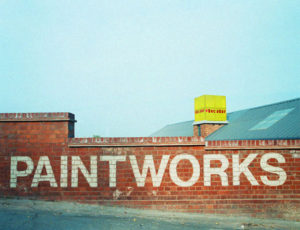
RVC: I understand that you “have a desk” at Paintworks, which seems like an artsy, hipster place with studio/​offices, residential spaces, and an exhibition venue. How much work do you do there? And how does it affect your creative process, having a clear view of the city, as you do?

DB: Well, I see you have done your research!

I rent a desk in an animation studio called Sun & Moon Studios. I’ve known the directors for a long time and they are good friends of mine. We have recently moved to a much bigger studio that is even “hipper,” with a foosball table and “industrial-​chic vibe.” However, I have lost my window view of the city, so have to make do with a photo of it as my desktop wallpaper.

I tried working from home, but it was such a solitary experience that it genuinely impacted my mental health. It’s nice to be able to socialize with fellow creative types.

RVC: What do you think is the most common misconception about freelance illustrating?

DB: That we sit around in cafés with MacBooks, eating artisan poppy seed bagels, whilst wearing gaudy knitwear and big hooped earrings, and stroking cats. Although, like most clichés, there must be enough truth in this scenario to warrant the cliché status.

RVC: Though your description there is a 100% match with every single artist I know, I take your point. It could just be me and my select group here. Who can say?

Let’s talk agents. You’re repped by Jodie Hodges at United Agents. At what point in your career did you secure representation, and how vital is it for young artists to do the same?

DB: I was initially repped by Illustration Ltd (from 2011) and it was great to have a team with their expertise fighting in my corner, as it were. If I do conform to an artist stereotype, it is that I have about the same level of business acumen as a goldfish. A lot of clients (outside of publishing) seem to think of illustration as a hobby and therefore don’t value it for what it’s worth. An agent will fight to get you a fair price and have the gumption to stand up to the cheapskates.

RVC: If I asked Jodie to describe your work, what would she say?

DB: What I love about Jodie is that she has this brilliant ability to communicate what she looks for in authors and illustrators in such a clear yet personable manner–that’s a hugely important asset for an agent to have. As such, I couldn’t begin to put words into her mouth–I’d just ruin it.

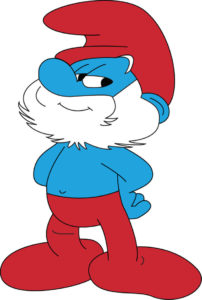
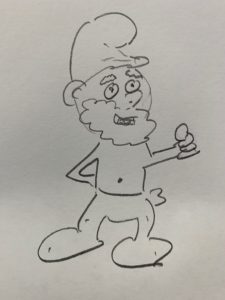
RVC: Sometimes I hear people say that you can’t teach people to write. Do you think people can be taught to draw? (Note that this comes from a person who, despite working at Ringling College of Art and Design for a decade, can only draw three things—a bunny, Papa Smurf, and a vaguely three-​dimensional box. Then again, I’m not on the art side of things. Maybe that has something to do with it …)

DB: I’m self taught when it comes to illustration, and I’m always learning. Some people have more of a natural talent that comes through without tuition, while others hone their skills at art college. There’s no right or wrong way, but you should never stop learning new things.

Don’t discount your Papa Smurf drawing skills. They may save your life one day.

RVC: Well, if drawing smurfs can save a life, then thank goodness I’m so good at it, right? I mean, just consider the two images below.

You can barely tell which is drawn by a fancy professional artist and which is done by yours truly, right? I KNOW! It’s amazing what I’ve been able to do without a single art class ever! Can you believe it?

In any case, let’s have one last “serious” question before we move on. And let’s be clear—this might be the most important question anyone has ever been asked in an interview EVER. What in the blazes are “sherbet dib-​dabs”? My much-​ballyhooed WordPress UK-​to-​American-​English translator plugin is stumped at that phrase, which appears in your website bio.

Color/​colour me intrigued!

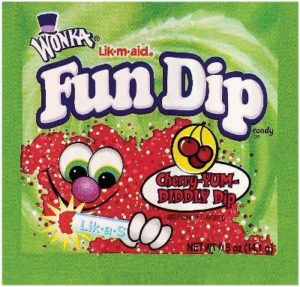
DB: So, a “Sherbet Dib Dab” is a piece of candy from the UK in the 1980s, which constitutes a pouch of sherbet powder into which one dips a lolly (boiled sweet on a stick). You then lick said sherbet from the lolly and repeat this process until the sherbet is all gone and the lolly has been licked into non-existence.

At school, we used to pour the entire sherbet contents into our mouths so that they frothed up with foam. We then thrashed about on the ground to emulate a rabid fit. There was a genuine rabies scare in the early 80s so this behavior was frowned upon by teachers and parents alike.

RVC: Oh my goodness, I’m SO glad I asked. From your delicious description, the candy sounds a bit like Fun Dip. But without the rabies fakeroo, I think, which I bet made it an extra tasty experience for all involved!

Now … no matter which side of the pond you’re on, this is what you’ve been waiting for. THE LIGHTNING ROUND! Zappy fast Qs and zippy-​skippy As, please. Are YOU READY!?!

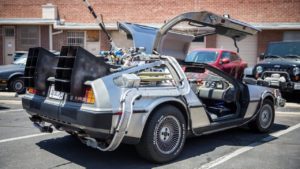
DB: Hit me up with those gigawatts! I’m revving the DeLorean in anticipation.

RVC: Best place for fish and chips in Bristol?

DB: Easy! Prince’s in Fishponds. Next…

RVC: Coolest ships–Battlestar Galactica or Buck Rogers?

DB: Presuming you mean the original BG, then that one. Cylon Raiders trounce anything else in the galaxy.

RVC: What secret talent do you have that no one would suspect?

DB: It’s nerdy, but as my dad is a retired air force officer, I was obsessed with planes as a kid. I can identify pretty much any military aircraft at a glance.

RVC: What’s going to keep you up tonight after this interview?

DB: Oooooh, that’s a toughie. I may have to come back to that.

RVC: Best illustrated picture book you’ve recently encountered (by any artist not named Duncan)?

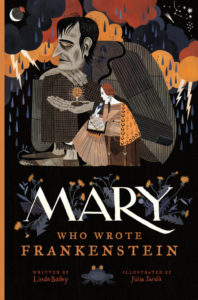
DB: I love Mary Who Wrote Frankenstein written by Linda Bailey and illustrated by Júlia Sardà. It’s a delicious slice of Gothic brilliance.

RVC: Best compliment a kid’s given your art?

DB: It’s not specifically about my art, but I remember after a book reading at a school, one kid ran up to me, hugged me round the legs, then told me he loved me and wanted me to come home with him to be his daddy. You can’t really top that. In fact, that’s probably going to be the thing that keeps me up tonight.

RVC: Thanks so much, Duncan. It was a hoot getting to know you and your work better. (For Duncan and his UK pals, I’ll offer a possible UK equivalent for the American expression “a hoot.” I’d go with “gobsmackingly bloody scrummy,” “tickety-​boo,” or perhaps just the simple but tried-​and-​true “sick.”)

Illustrator Interview: Matthew Reinhart

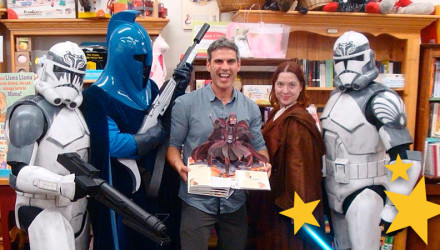
This month’s interview is with author/​illustrator Matthew Reinhart, an artist whose life feels parallel to mine in all kinds of nifty ways. For example:
Matt’s folks are from Iowa (Cedar Rapids).

My folks are from Iowa (Des Moines)!


Matt’s dad was the son of a farmer.

My mom was the daughter of a farmer!


Matt’s dad served in the Navy.

My dad served in the Air Force!


Matt has a sister named Erin.

I have a brother named Aron!


Matt’s an avid fantasy and science fiction fan.

I’m an avid fantasy and science fiction fan!


Matt was a student at Clemson University.

I was a professor at Clemson University (alas, not one of Matt’s)!


Matt has lived “all over,” including South Carolina, Illinois, and Florida.

I’ve lived “all over,” including South Carolina, Illinois, and Florida!


Matt’s bio says he’s “married and busy with work.”

My bio says I’m “married and busy with work”!


Are you starting to see why I’m so intrigued by Matt, my artistic and—let’s be honest here—all-around-general-life doppelgänger?

Let me just add one more parallel, which is perhaps the most awesome pairing of all.

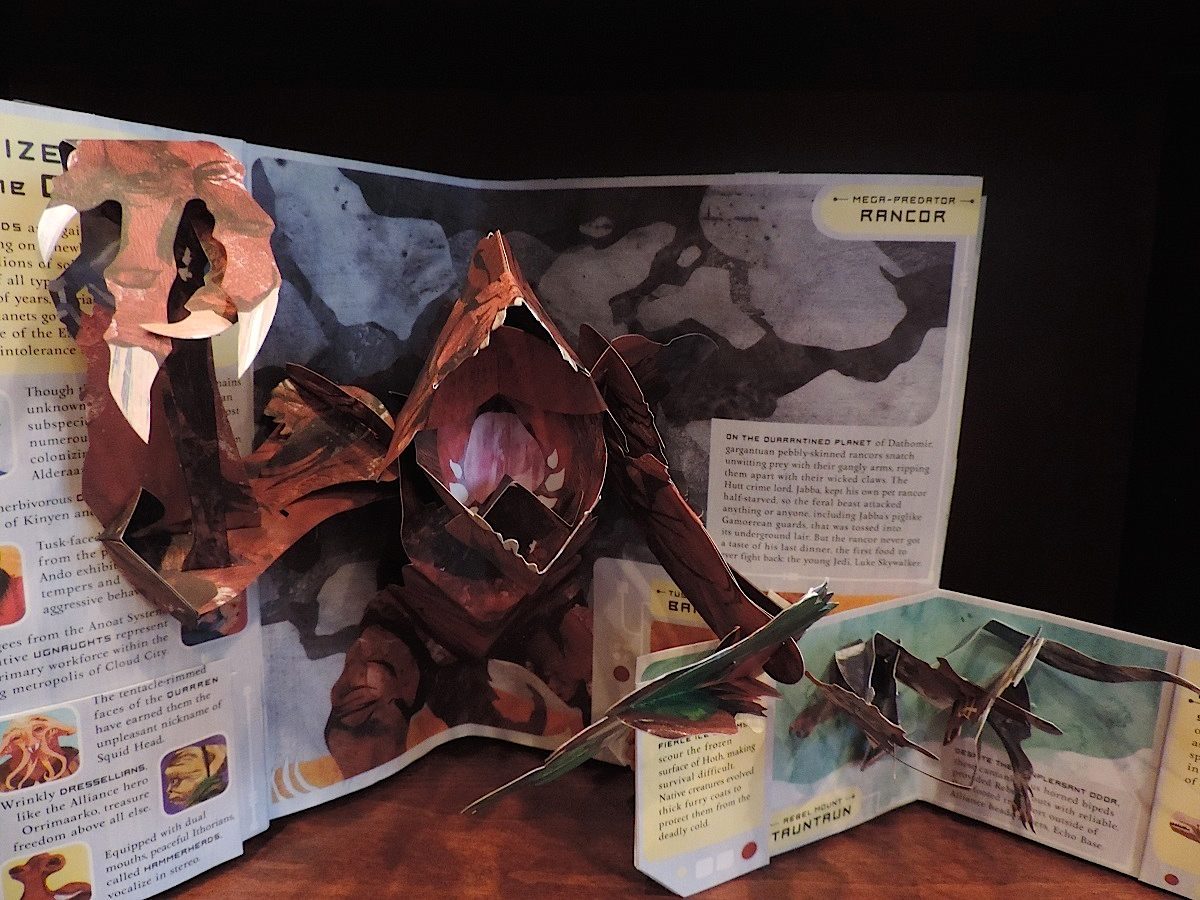
  • Matt makes awesome pop-​up books.
  • I love to read awesome pop-​up books!

Do you see why we’re practically best friends, despite only meeting (virtually, at that!) a few weeks back?
Let’s jump right ahead to the interview and see what YOU might have in common with my good pal, Matt. (My guess is “A lot!”)


website: www.matthrewreinhart.com

YouTube: https://www.youtube.com/channel/UCxbY5VDdSrdvcMBvZBqvChA

Twitter: https://twitter.com/MatthewReinhar1

Facebook: https://www.facebook.com/Pop-Up-Books-by-Matthew-Reinhart-263860686940/

Instagram: https://www.instagram.com/matthewcreinhart/


RVC: Your website’s ABOUT section says that “from before Matthew could remember, art always took center stage.” At what point did you pick up writing, and how did that addition to your creative arsenal change things for you? 

MR: Words were not my medium when I was young–pictures were my primary language. Back when I began making children’s books, I needed to learn quickly how to write despite the fact that there’s often very little room left on the page after the pop-​ups go in! I guess research and writing was something I was always pretty good at and, over the years, I think I’ve gotten better thanks to the help of talented editors.

I’d love to go back to school for creative writing–I’ll put that on my “to do” list!

RVC: If you ever do decide to go back to college to study creative writing, keep our program at Ringling College in mind. We especially cater to visually-​oriented writers in a host of ways.

**Okay, the horn-​tooting PR moment is now over.**

Back to the interview–like me in my teen years, you were concerned that an artistic future maybe wasn’t the best option. I wanted to play guitar (at first) and (later) become a writer. You wanted to be an artist, but you attended Clemson to study biology in preparation for attending med school. What type of doctor did you think you’d be? And how did studying the human body help with your art?

MR: Honestly, I’m not sure how much I actually thought about much back then, let alone what type of doctor I wanted to be. I just sort of did what was expected of me. I think there was a time when I wanted to be a plastic surgeon, mainly because I thought I could have a profitable medical career. Pretty altruistic goals, huh?  It was ridiculous idea, actually, because all of my sketchbooks were filled with monsters, mutants, space aliens, and robots. I mean, if I had been a plastic surgeon I might’ve grafted on extra eyes, antennae, and cyborg implants!

I will say that studying anatomy, biology, botany, and zoology helped immensely with art. It’s important when either drawing, painting or paper engineering a living thing that I understand its structure, how it moves and its placement in nature.

RVC: What changed in terms of your plans? What gave you courage to go from Clemson to New York City and NOT start medical school right away?

MR: What changed was that I actually got into medical school right after Clemson and I didn’t want to go! So, I told my parents I needed a year away from any schooling, moved to New York City for a year, and worked at an organ procurement organization taking corneal tissue from donor cadavers. Yes, you heard that right–I took out dead peoples’ eyeballs! Gruesome, eh?

That job gave me a lot of perspective about life and a future career. Life is short, and work takes up a LOT of time. I wanted a career that really made me happy, to be fulfilled. So, I made the plunge and never looked back.

RVC: Let’s talk about the Pratt Institute. After a year of eyeball procurement (now that’s a phrase I never thought I’d write!), you applied there and got accepted into the industrial design track with an eye (no pun intended!) toward making toys. What are some of the most valuable lessons you took away from those classes?

MR: My time at Pratt was just two years long–a quick graduate degree in industrial design was all I could afford. I had the talent and ability, but my Pratt classes really honed them into something viable for a career. My color theory professor, in particular, made a big impression on me–I learned to use color more intelligently, to manipulate palettes that could help tell stories.

My work after Pratt, however, was my real education–just getting thrown into pop-​up design headfirst. That, in my opinion, is the very best way to learn and grow creatively.

RVC: Say a few words about your friend and mentor, children’s book author Robert Sabuda. What type of influence did he have on your career?

MR: I wouldn’t have the career I have without him. I’m very thankful for our time together and the classic books we created together.

RVC: I can’t go any further without asking you directly about pop-​up books, because, well, I LOVE pop-​up books. When did you first learn that you had the knack for making these clever, tricky, amazing, wonderful things? 

MR: I think I had it many years before I even started working as a pop-​up book apprentice but I didn’t even realize it. In high school and college, I made elaborate mix-​tapes (long before smartphones carried all our favorite tunes) for my friends which often included illustrated comics. A few of them even had very simple pops, but I only have one to show for it today.

Aside from that, I was always making things out of paper and cardboard–that was all we had around the house that I could build with as a kid. You make do with what you’re given–I was always scavenging up any box, Styrofoam, cardboard, anything to make what was in my head!

See the source imageRVC: What’s the story of your first published pop-​up book, The Pop-​Up Book of Phobias? How did it come about, and what surprises did you encounter along the way?

MR: Robert Sabuda was offered the book, but he couldn’t do it, so I got offered the job by the publisher Melcher Media. I thought the book was an odd concept initially, to be honest, and didn’t even think it would end up being produced. We were rushed, too, so I don’t really remember much, other than having to build that damn toilet pop-​up 20 times over!

My biggest surprise was that the book was a moderate hit. I’ve since developed a fondness for the book and am proud to have been a part of making it memorable.

See the source image

RVC: You’ve gone on to create pop-​up books for some of the biggest pop culture franchises, such as Star Wars, Game of Thrones, Frozen, Transformers, My Little Pony, DC superheroes, LEGO, and more. Which one were you most stoked to work with/​for purely on a personal fanboy level? 

MR: Star Wars is my number one, with Transformers a very, very close second.  Both franchises very much inspire me to this day.

See the source image

RVC: Those are two of my favs, as well. Speaking of things that inspire us, tell us–what was it like working with picture-​book legend Maurice Sendak?

MR: It was an incredible experience for me. Here I was, this young inexperienced artist collaborating with this legend, Maurice Sendak! I was sort of blown away at his openness to listen to my opinion and vent his own insecurity with his work. Many artists are insecure about their work, no matter the level of success.

Maurice had an irreverent sense of humor and he always tried to shock me with what he could say. I’d seen and done pretty much everything, though, so I was rarely fazed. I miss him and will always be thankful for our friendship.

RVC: And what about working with Tomie DePaola?

MR: Tomie was wonderful to work with and really a fast learner. Once we gave him the specifics, he ran with it and made his artwork at lightning pace. He’s continued to be a friend and inspiration.

RVC: In one of your YouTube Pop-​Up Master Class videos, you mention how some of your best work emerges from playing around with paper. When you’re deep in the throes of paper experimenting, how much paper might you go through in a single workday?

MR: Eek! I don’t want to think about that!

Most of the time, the paper I use and toss is in messy pieces so it’s unusable when I need to toss it. I try NOT to throw paper away if I can do anything about it, but if I had to guess? Hmmm … 3–4 letter-​sized sheets during those times of unbridled paper experimentation.

RVC: What’s the most common misconception about pop-​up books?

MR: The common misconception is that pop-​up books are silly little books for kids. No book is ever silly, unless of course, they’re meant to be! Often folks tell me they’re shocked by how complicated, impressive, and sophisticated some of the titles I’ve worked on are. They want to keep the books all for themselves and not share them with their kids, which I think is hilarious. I just try to make a book that’s interesting for everyone, including myself.

RVC: What have you not yet done in a pop-​up book that you’d like to try?

MR: Scented elements! I’ve always wanted to make a food pop with scratch-​n-​sniff pop-ups.

You heard it first–Stinky Pops by Matthew Reinhart, coming sometime soon!

RVC: In all your experience with the world of picture books (of which pop-​up books are a part), what has surprised you the most?

MR: I’m surprised that despite all the advances of entertainment technology, digital media, and online story content, kids still like to curl up with a book. Reading a book is a personal one-​on-​one thing. There’s something about turning each page, holding the book, and taking it wherever.

School book fairs are as popular and important as ever. Books still matter–and I’m happy for that, as are all book-​makers, without a doubt.

RVC: It’s time now for the much-​ballyhooed, always-​interesting, and rarely-​equaled SPEED ROUND! High-​octane questions and potent-​pithy answers, please. Are you ready? 

MR: Yup!

RVC: Favorite type of cheesecake?

MR: Dulce De Leche Cheesecake or Oreo Cheesecake–pretty much any sort of candy or sweet (aside from fruit, which should never invade dessert, in my opinion) you can add to cheesecake is fine by me.

See the source imageRVC: Craziest “paper” you’ve ever worked with?

MR: Tyvek–that untearable, waterproof “paper” used to make FedEx envelopes/​packs and homewrap.

RVC: Crayola color that doesn’t yet exist, but you wish it did!

MR: Phosphorescent lime green.

RVC: Most unexpected source of inspiration for your paper art?

MR: Anything, to me, can be inspiration–so I wouldn’t characterize something that inspires me like that at all.

RVC: Favorite pop-​up book created by someone not named Matthew Reinhart?

MR: Hmmm… that’s tough. There are a lot! I’d say number one is Haunted House by Jan Pienkowski.

See the source image

RVC: Three words that describe what being an artist means to you?

MR: MAKE FANTASIES REAL.

RVC: Thanks so very much, Matthew!

Author Interview: John Coy

This month’s author interview is with Minneapolis author John Coy. I first learned about him from reading his middle grade novel Crackback. It turns out that in addition to YA and middle grade work, he’s authored a number of picture books, too, on a variety of topics. Along the way, John received numerous awards for his writing including a Marion Vannett Ridgway Award for best first picture book, a Charlotte Zolotow Honor, a Bank Street College Best Book of the Year, and the Burr/​Warzalla Award for Distinguished Achievement in Children’s Literature.

Yeah, OPB is pretty excited to hear what he’s got to share. With that, let’s all find out together!

Website: https://johncoy.com/pages/about/index.html
Facebook: https://www.facebook.com/John-Coy-Author-106528552773090/
Twitter: https://twitter.com/johncoy23
Instagram: https://www.instagram.com/johncoy23/


See the source imageRVC: Let’s start with a can’t‑miss question. Clearly you love sports, having written the 4 for 4 middle-​grade series and picture books such as Hoop Genius: How a Desperate Teacher and a Rowdy Class Invented Basketball  and Strong to the Hoop. Why do sports topics/​issues translate so well into stories for kids?

JC: The drama. I played lots of sports as a kid and I’m amazed how the details of particular games stick with me all these years later. Sports provide a heightened atmosphere and that translates into good tension for stories.

RVC: When did you first realize you wanted to write picture books?

JC: At the Roseville Library in Minnesota when I was thirty-​two years old. I was looking at books with my five-​year-​old daughter and I had mine and she was still looking. I’d been reading tons of picture books with her and was fascinated by how much was possible with the form. I went over to the computer and typed in my own name to see if anybody named John Coy had written a book. The result came back  “Zero books by this author.” I realized if I wanted something to come up I needed to actually write a story.

RVC: In your bio at the Scholastic books site, it says that you’ve worked “as a dishwasher, mattress maker, tour guide, and group home worker before taking up writing.” Which of those proved most useful in terms of helping you become a successful writer?

JC: I love this question. All of them helped, but the tour guide job was the one most directly connected since giving a good tour is all about having great stories. And great stories come from reading, listening to people, conducting research, and then distilling that information to a memorable story. In terms of school visits, though, the group homework continues to be the most valuable as I learned how to connect and work with many different people.

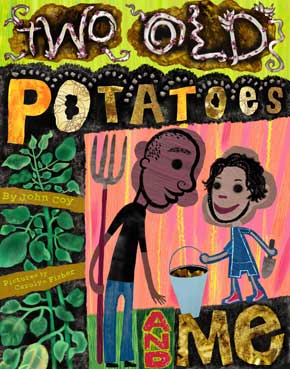
See the source imageRVC: Describe the process of how a picture book emerges for you, from the kernel of an idea to the final product that you send on to an acquisition editor (who surely has their own requested tweaks, revisions, and adjustments). By way of example, how about we examine the genesis story of Two Old Potatoes and Me? What’s the seed-​to-​plant process there?

JC: This one has an interesting origin. In 1999, I was getting married in England and going to be in Europe for five weeks. I needed something to plant in my plot at the community garden that was hardy and could survive while I was gone, so I planted the entire area in potatoes. When I came back, the plot was full of weeds but the potatoes were doing fine. In the fall, I had so many potatoes so I gave some away to friends. One of them–Norton Stillman–called me and told me how good they were. “You should write a book about growing potatoes,” he said.

The next day I started writing about potatoes and then revised and revised it. I sent it to one editor who liked it but rejected it on the grounds that they already had a book about green beans, a vegetable quota I was unaware of. The second editor, Andrea Cascardi at Crown, said yes. Three illustrators turned down the chance to illustrate it, which turned out to be fortunate because we got Carolyn Fisher who created stunning art, including a copyright page with text in the shape of a potato with one sprout thanking Norton Stillman for the idea.

RVC: Two Old Potatoes and Me uses a memorable rhythmic text throughout. What are your feelings on rhyme? And how important is the sound of a picture book to you?

JC: Rhyme is tricky and I’m in awe of folks who do it well. Sound is key to picture book text since the book is designed to be read by an adult to a child. I read stories aloud over and over as I’m working on them. I also record them and hear new things when I listen to the recordings that help make changes.

RVC: What type of rituals or routines are part of your writing process?

JC: Yoga to start the day, breakfast, then some newspapers online. and NBA highlights for procrastination. I try to stay away from email until the afternoon in order to keep space for writing.

RVC: Writing advice is fairly easy to find, and it often consists of the same basic things—write more, read more, revise more, etc. What’s the most unexpected bit of useful advice you have for aspiring authors? 

JC: I don’t know if it’s unexpected, but the best advice for me came from the poet Diego Vazquez, Jr.: writers write. For me, that’s important to repeat regularly. Writers write.

I see many aspiring writers spending huge amounts of time trying to understand the business of publishing. Writers write. I think the most important aspect of writing is to write compelling stories.

Writers write.

RVC: Since we mentioned the submission process, let’s get your take on this question that many aspiring writers have. How vital is it for picture book writers to be represented by a literary agent?

JC: I did not have an agent for my first four picture books. Then my editor Andrea Cascardi decided to be an agent after her son was born. He just turned twenty-​one and Andrea is still my agent. She knows more about this than I do, so here’s her answer:

Speaking as an agent, I would have to say it’s about getting access. Most of the large houses don’t accept unsolicited manuscripts. That said, if a writer attends conferences where editors agree to read submissions from attendees or if they do online workshops where editors speak and also agree to read submissions, there are ways to get in the door.”

RVC: Knowing all you now know, what’s one thing you’d have done differently in terms of your writing career way back when?

JC: I would’ve started earlier. The worst piece of advice I heard was that if you don’t have to write every day, then you aren’t a writer. I didn’t feel I had to write every day. so I thought I wasn’t a writer. That and fear of rejection kept me from starting sooner.

RVC: What’s next for you, picture-book-wise?

See the source imageJC: Two picture books I started over twenty years ago. On Your Way, beautifully illustrated by Talitha Shipman, comes out August 13. It’s a celebration of first steps and the various ways we learn to move.

In October, My Mighty Journey: A Waterfall’s Story will be published. It’s the story of the only major waterfall on the Mississippi River and what it has witnessed over the past twelve thousand years. It’s first-​person waterfall, a type of story we don’t have enough of. Gaylord Schanilec and a team of artists collected material from the riverbank and made striking art with it.

In spring of 2020, two new books will be published. If We Were Gone will be released on the fiftieth anniversary of Earth Day and imagines a world without people. Natalie Capannelli, in her picture book debut, created great pictures for that and it will have a different dust jacket and cover. Then for Father’s Day, Dads, my second collaboration with the award-​winning photographer Wing Young Huie, will be released.

RVC: Congrats on so much success! We’ll keep an eye out for those titles here at OBP

Now–just one last question for this part of the interview. There’s an audio recording at Teaching Books.net where you explain exactly how to pronounce your name. How common of an issue is this for your readers and/​or during school visits? I ask because I’ve got a potentially tricky name to get right, too, for a variety of reasons. Inquiring minds want to know!

JC: This is a great service from Teaching Books. I’m surprised how many schools check it out in advance of visits even with my simple name.

RVC: Alright, it’s time for … THE SPEED ROUND! Cheetah-​fast questions followed by Ferrari-​fast answers, please. Ready?

JC: Ready!

RVC: If I never became a writer, I’d have been a ___________.

JC: frustrated writer.

RVC: Most likely to appear in a future John Coy book—dinosaurs, ninjas, or pirates?

JC: Dinosaurs right now.

RVC: The Princess Bride. Great 80s movie or the greatest 80s movie?

JC: Great 80s movie.

RVC: Which is more satisfying—a book’s birthday or an idea for a new book?

JC: Idea. That’s when the fun begins.

See the source imageRVC: Favorite picture book by an author not named John Coy?

JC: Kao Kalia Yang’s A Map into the World, which comes out in October. I love it.

RVC: Coolest thing a kid said to you during a school visit?

JC: “Thank you for coming to our school.” That never gets old and goes straight to my heart.

RVC: Thanks so much, John!

Author Interview: Marilyn Singer

This month’s Author Interview at Only Picture Books is with Marilyn Singer, the author of 90+ books for children and young adults. In addition to being an incredibly prolific author, she’s the host of the former AOL Children’s Writers Chat and currently co-​hosts the Poetry Blast at various conferences.
Need more Marilyn bio nuggets? Try these five facts:

  1. She LOVES swing dancing.
  2. She auditioned for Jeopardy but didn’t get selected–yet.
  3. She got to sing with a chorus for a track on the recording of the revival of the Broadway musical, Pippin.
  4. She’s lives with a cat named Benito and a poodle named Bizzy.
  5. She writes in so many different styles and genres—picture books, realistic novels, fantasy, mysteries, fairy tales, nonfiction, poetry, etc.—because it “keeps her from getting bored.”

Feel like you’ve got enough of a sense of things now to move straight to interview time? Let’s go!

Website: https://marilynsinger.net/
Facebook: https://www.facebook.com/WriterBabe


RVC: It’s my understanding that your love for language emerged at a very early age thanks to the efforts of your family. What specifically did they do?

MS: My Romanian grandmother, who lived with us, told me marvelous stories every night. My parents read to me a lot, especially fairy tales and poetry. They also sang to me popular songs of the day. I grew up appreciating great lyricists such as Cole Porter, Ira Gershwin, Lorenz Hart, and Johnny Mercer. So, my family really did teach me to love language.

RVC: Rumor has it that you were writing your own poems in elementary school. What did you like most about poetry back then?

MS: I think I liked the rhythm and musicality, particularly because I loved songs and singing. I also liked the emotion behind poetry and the fact that it could move me and other people and also make us laugh.

RVC: Despite all that, you didn’t consider writing as a career until a few years after college, right? Why not? What helped you make the move into the world of words? 

MS: Oh, I thought about writing as a career way back in elementary school—that, and having a dog kennel. 😉

But as I got older, my mom said that teaching was a stable career for a woman, and I decided she was probably right. So, I did become a high school English teacher, but I didn’t stay long in that career. I was rather rebellious and didn’t get along with the administration. When I quit teaching, I wasn’t sure what I wanted to do. My husband, Steve Aronson–head of the film department of the American Federation of Arts–got me jobs writing teaching guides and catalog copy about films and also filmstrips (remember those?). Then one day to my surprise, when I was sitting in the Brooklyn Botanic Garden, I started writing stories about insect characters I’d made up when I was eight. I read the stories to Steve, who was encouraging, and I joined the Bank Street Writers Lab, and the members were also positive. I submitted those and other stories and I was very lucky. I got a manuscript accepted after about six months.

Would that it were that easy since!

RVC: Tell us a bit more about that first book and what it meant to you.

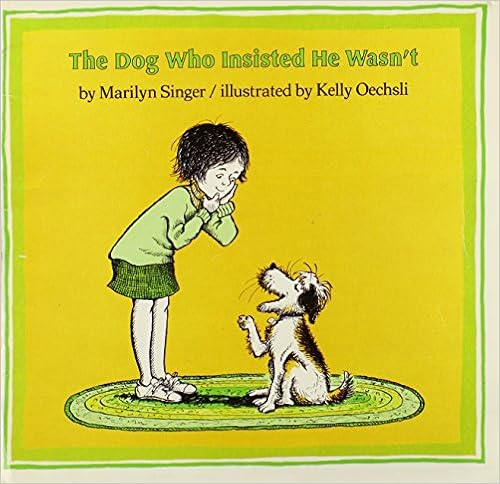
MS: Well, as I said, I was most fortunate. My first book was The Dog Who Insisted He Wasn’t. Ann Durell at Dutton accepted it and my next two books as well. I imagined my own dogs talking and having particular ideas and traits about personhood, and I think the book grew out of that. Once it and my next books were published, I decided that maybe I WAS a writer. It’s not an easy profession, though. It has serious ups and downs—from acceptances and rejections to good sales and low ones to books still in print for decades to those going out of print after a year. Still, I get to make my own hours and work in my pjs if I want to, and that’s not bad!

RVC: What’s one thing that non-​poets don’t fully appreciate about poetry?

MS:  Hmm, I don’t know if they realize that good poetry is hard to write and that it doesn’t always have to rhyme. A lot of folks who dislike poetry think it’s abstruse, which may be true of some poems, but certainly not all. Some also think that there’s just one type of poetry, which isn’t true in the least. I believe that there’s a poem or a type of poetry for all readers to enjoy. But they may need help finding it, which is where teachers, parents, other relatives, and friends come in.

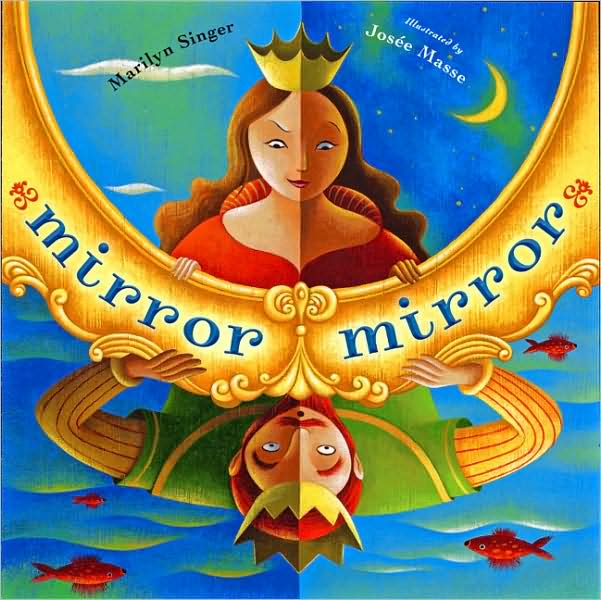
See the source imageRVC: Just the other day, I picked up Mirror Mirror: A Book of Reverso Poems in my weekly grab-​whatever-​catches-​my-​eye run at the public library. What made you think of creating a book like that?

MS: One day I was watching my cat sitting in an easy chair and a poem came into my head:

A cat                                       Incomplete:

without                                    A chair

a chair:                                    without

Incomplete.                             a cat.

I began to wonder if I could come up with more poems like that. I wrote a number of them on a variety of subjects, but quite a few were based on fairy tales. I showed them to an editor who suggested I do an entire collection based on fairy tales, and that’s how Mirror Mirror (Dial, 2010), with divine illustrations by Josée Masse, came about.

I originally called them up-​and-​down poems. It was my husband who came up with the word “reverso.” To write a reverso, I follow strict rules—when the lines are reversed, there are changes in just punctuation and capitalization, and the second half of the poem has to say something different from the first half. These poems are tricky to write. I have to be in a games-​playing head. Also, I have to write them on a computer, as opposed to a legal pad (which is how I write many of my poems) so that I can shift around the lines and see if they make sense.

RVC: You’ve got a host of animal-​related books out in 2019 and 2020—one on presidential pets, one on insects and spiders, one on animals that live in cities, and one on how animals eat. Did you write a lot of animal poems and they sort of fell into these categories, or do you come up with the title/​idea first and then create the poems?

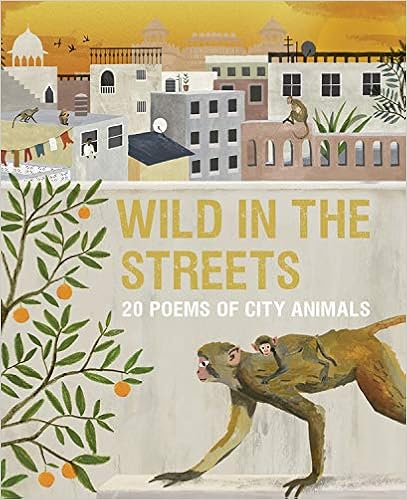
MS: The theme came up first for each of those books. Then I started to write the poems. Two of those books, Bug Dipping, Bug Sipping (S&S, 2020) and Gulp, Gobble (S&S, 2019) are each really a single poem. Who Named Their Pony Macaroni? (Disney-​Hyperion, 2019) and Wild in the Streets (Quarto, 2019) are collections. I never feel that I have a collection in the works until I write a minimum of five to seven poems. And then I have to write a lot more to finish the collection.

RVC: When do the titles happen?

MS: The title almost always comes last, sometimes after much discussion with editors, marketing people, and friends.

RVC: So, you’re essentially a lifelong New Yorker. And what’s something most people don’t appreciate or understand about being a New Yorker?

MS: That’s an interesting question. I think a lot of people believe that New Yorkers are cold or hard when in fact people here are generally friendly and helpful. I’m a native New Yorker and I find I start conversations with folks anywhere and anytime. People here love to give directions and advice on things to see and do.  And they will help you if you are in trouble. I once tripped on the street and a stranger picked me up and held me until I said I was fine. We do tend to be in a hurry a lot of the time, though, and I know that when I’m trying to get to a Broadway theater, I get impatient with tourists taking selfies. 😉

RVC: How does your New York-​ness play into your writing?

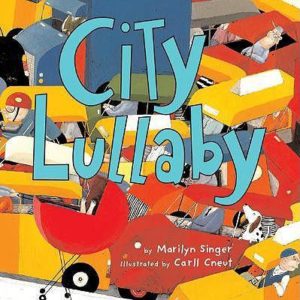
MS: I think the energy here gives me energy to write, and I also think some of my work is inspired by the city—books such as City Lullaby and poems in Nine O’Clock Lullaby, On the Same Day in March, A Full Moon Is Rising, Every Month Is a New Year, and Wild in the Streets, just to name a few.

RVC: Of the many awards and honors you’ve received, which meant the most to you?

MS: I was thrilled to receive the 2015 National Council of Teachers of English (NCTE) Excellence in Poetry for Children Award because it was for the body of my work. I found out I’d won it at a birthday brunch for my husband, so we both got to celebrate that day.

RVC: Now it’s time to close things out with the Awesome Sauce, Mesmerizing, Life-​or-​Death-​Stakes* SPEED ROUND! (*life or death stakes not included!) Ready?

MS: As Neil deGrasse Tyson would say, “Let’s do this!”

RVC: Cake, cupcakes, or pie?

MS: Pie—or maybe tres leches cake.

RVC: Three careers you might’ve had if you never got into kidlit?

MS: Casting director. Zoo keeper. Cabaret singer.

RVC: So, you’re having a dinner party with three guests from the world of books. Living or dead, real or imaginary, what three characters would you invite?

MS: I’d invite Shakespeare, Lin-​Manuel Miranda, and Irene Pepperberg, who studies parrots. They’ve all written books/​plays, so do they count?

RVC: Of course! It’s your party, after all. Next question–which of your books is your secret favorite?

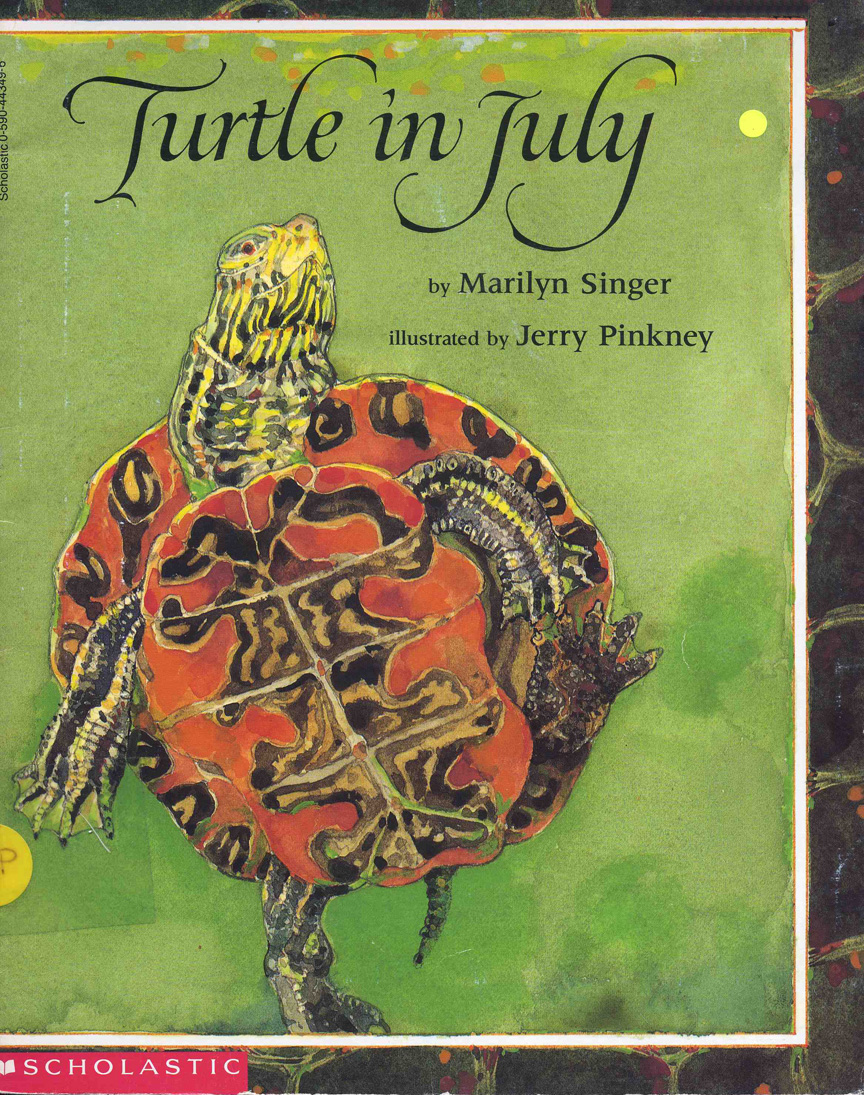
See the source imageMS: That’s a really hard question to answer. I’m fond of my first poetry collection, Turtle in July, and Mirror Mirror, too, since it was a surprise even to me! I also really like The First Few Friends, a YA novel set in the late 60s that bombed at the box office, as it were. I think it might’ve done better if it had been published today.

RVC: Most underappreciated yet awesome kidlit poet working today?

MS: All kidlit poets are underappreciated! Poetry is underappreciated! You’re not going to get me to name names. 😉

RVC: What would you like your literary epitaph to be?

MS: I came, I saw, I wrote about it.

RVC: Thanks so much, Marilyn!


Author/​Illustrator Interview: Fred Koehler

See the source image

This month’s Author/​Illustrator Interview is with Fred Koehler, who first got on my radar at the 2017 SCBWI regional conference in Miami. I was sitting in the back row for the Heidi Stemple and Jane Yolen Picture Book Intensive, and this quiet, red-​haired dude slipped into the chair behind me as the event started, and he ended up doodling/​drawing/​sketching the entire time. During one of the breaks, I finally asked him who he was and what kind of work he’d done, if any.

Fred kind of shrugged and said he’d done “a few things” and “had another thing coming out,” but didn’t give any indication that he was talking about his illustration work on “things” like One Day, the End and This Book Is Not About Dragons, as well as his own author/​illustrated books How to Cheer Up Dad and Super Jumbo.

Way to slow play it, Fred.

Just in case you don’t yet have the full 411 on the fun coolness that is Fred, here are Five Fredtastically Freddifying Facts to help you out. Only one fact is an “alternate fact,” meaning 100% completely fakeroo-​false. (If you can’t tell which one’s the fabricated falsehood, I’ll dish that answer in the finale of this interview.)

See the source image1—He’s got a dog named Cheerio Mutt-​face McChubbybutt.
2—There’s an official Penguin Kids promo video for How to Cheer Up Dad where Fred gets hit in the face with Silly String and then a whipped cream pie.
3—Fred broke the Guinness World Record for having the largest traveling children’s book.
4—Fred bet me I couldn’t work 13+ words that begin with F in a single short bio-​style paragraph.
5— Fred’s real-​life misadventures include sunken boats, shark encounters, and a hurricane.

Need a bit more to REALLY feel like you know Fred? Here’s a KidLit TV video where he shows you how to draw a puppy!

With that, we’re ready. We’re set. It’s time to Fred it on!

Website: https://www.ilikefred.com/
Facebook: https://www.facebook.com/superfredd
Twitter: https://mobile.twitter.com/superfredd
Instagram: https://www.instagram.com/fred_koehler_/
Goodreads: https://www.goodreads.com/author/show/7135838.Fred_Koehler


RVC: Let’s begin with the place where so much begins for you—Mitchell’s Coffee House. What’s the dealio?

FK: For me, every work space has a vibe and a specific energy. That energy might be emotional, psychic, kinetic (or it might all be in my head). Since I started going to Mitchell’s in college, it’s always been “home turf,” where good vibes flow and I can even go back behind the counter and refill my coffee if it’s busy.

RVC: You’re also pretty darn active in social media in a way that people seem to dig. What’s your seems-​to-​be-​working philosophy?

FK: My formula is simple: Be open about my failures. Joke about them and learn from them in real time. I don’t go for perfect because my life is generally a mess. Perfect isn’t authentic or believable.

RVC: One of the constants in your path to success seems to have been SCBWI (Society of Children’s Book Writers and Illustrators). Share how that organization played a part in your own journey. 

FK: I prefer to be a lone wolf, but I’m slowly realizing that you have to have community. For the publishing world, there’s no better community than SCBWI. Loads of like-​minded people, great instruction, and specific opportunities to connect with publishing dealmakers.

RVC: Any tips on how SCBWI can help launch the careers for other authors, illustrators, and author/​illustrators?

FK: I recommend showing up to make friends, not deals. Then you start to see it as a lifelong journey, not some prize you’re racing to win. You can find peace with where you’re at, and still keep the fire lit to get where you want to be.

RVC: Let’s pin this down. You’ve done illustrating. You’ve done author-​illustrating. So, do you consider yourself to be a words-​first or pictures-​first story creator? 

FK: I sold my first two books as author/​illustrator. But before that, I wrote some really terrible stuff including a novel-​that-​must-​not-​be-​named-​and-​will-​never-​be-​published. Most stories play out in my head like a movie, complete with narrative voiceover and camera direction. I can choose to write down what the narrator is saying, sketch out what the camera is seeing, or even dive into the head of one of the characters and describe the story through their perspectives and biases.

All of that, in a nutshell, is my superpower.

See the source imageRVC: One of the benefits of being an illustrator is that you can justify a lot of trips for photographic/​visual reference. (Okay, writers do this too!) When you illustrated Matt Forrest Esenwine’s picture book, Flashlight Night, you went a bit overboard with the research. What did you do to prepare you to illustrate that book?

FK: Well, the manuscript called for castles and waterfalls, old ships and foreign shores. So, I did what any illustrator would do and hopped a flight to Manchester so I could bum up and down the UK for a few weeks and find photographic reference for all of these illustrations. I did it all the cheap–youth hostels and public transit.

I had just about every adventure that the characters had in the book. Made friends. Got lost. Even bled a bit. I’d do it again in a heartbeat.

RVC: You’re fortunate enough to call kidlit queen Jane Yolen a friend and a mentor. What are some of the most important lessons that she’s given you, explicitly or implicitly?

FK: Jane is famous for all sorts of great advice for writers. My favorite is about luck. She figures that luck makes its own path through the ether, wandering where it will to bless the heads and hearts (and wallets) of mortals at its own whimsy. But she also figures that there are things we can do as creatives to invite luck in, to nudge ourselves toward its path. Hard work is at the top of that list. If you’ve got a house in order and a bag packed when luck knocks on your door, you’ll be ready to join it on an adventure.

See the source imageRVC: Since we’re talking about relationships with writers—what’s the best part about being married to another writer? (For those who don’t know, his wife is YA novelist Sarah McGuire, author of the terrific books Valiant and The Flight of Swans.)

FK: This is kind of deep, but one amazing thing about Sarah is being able to know her through the books she reads and writes. When she tells me how the Chronicles of Narnia sent her racing through her home, opening cabinets and closets trying to find an entrance, I know that we share a sense of the numinous. Or if I read a scene she wrote about, let’s say, betrayal, I could feel how deeply that knife cuts for her. An honest writer lays bare their soul on the page, warts and all. Who else gets to read and fall in love with another person’s soul? We’re a lucky pair.

See the source imageRVC: Speaking of novels—talk a bit about how you moved your kidlit career from purely picture books to including a middle grade novel like Garbage Island (The Nearly Always Perilous Adventures of Archibald Shrew).

FK: Story came to me most naturally through words, so novels were my first love. I was just awful at writing them. But the format of a picture books honed my ability to tell a story succinctly and to add depth and meaning in the negative space. So, when I sat down to pen a novel after working on numerous picture books, I had a new sense of vision for what it could be.

Writing coach Joyce Sweeney taught me a lot about novel craft. And I’d be remiss if I didn’t mention the Writer360 Breakout Novel Intensive as the training that filled in additional gaps in my novelist toolkit. And to bring everything full circle, that proactive work nudged me into the path of luck in the form of a publisher excited about whatever I came up with next. And when luck came knocking, I was ready.

RVC: Let’s look forward. You’re under contract to write The Sailing City (Boyds Mills Press, 2020), which is the sequel to Garbage Island. Can you share a little bit about that new book?

FK: The second novel was harder than the debut, and it’s still in first pass editorial so it’s hard to really even say. I half expect to get a letter saying, “Dear Fred, This sequel is an exceptional way to waste months of everyone’s time and 60,000 words.” But I’ll let you know.

RVC: You’ve been warned. I’ve been warned. All the elephants in Fred’s picture books have been warned. But here we all are—it’s time for THE SPEED ROUND! Fast Qs and equally fast As, please!

FK: Bring it!

RVC: Tater tots or French fries?

FK: Tots.

RVC: Best Saturday afternoon activity: fishing, writing, or drawing?

FK: I’m a fisherman first, artist second.

RVC: Coolest Harry Potter spell that doesn’t yet exist?

FK: Abra-​ka-​dinner.

RVC: The #1 picture book writer you’d LOVE to illustrate for?

FK: I don’t care who wrote it. Just send me a manuscript that’s equally brilliant, unusual, and impossible.

RVC: Best compliment by a child reader?

FK: I got a letter recently from a reader who loved Garbage Island, and subsequently started picking up trash in his neighborhood so it wouldn’t end up in the ocean. Does it get any better than that?

RVC: Three words that sum up your relationship with kidlit.

FK: Let’s stick with “brilliant, unusual, and impossible.”

RVC: Thanks so much, Fred! Much appreciated!


**For those of you who needed to cheat to figure out which of the Fred Facts is false, it’s #4. The over-​the-​top F business is all me. Blame OPB.


Author Interview: Carole Boston Weatherford

This month’s Author Interview is with NC-​based writer Carole Boston Weatherford. She’s been on my short list for some time, and when I saw that she and OPB pal Rob Sanders were co-​teaching a workshop on nonfiction at a regional SCBWI conference, I signed up. The day after that workshop, I moved her to the top of the Must-​Have list.

Here’s a quickie bio that’ll give you a sense of why that happened.

Born in Baltimore, Maryland, Carole went on to earn a BA from American University, an MA from the University of Baltimore, and an MFA from the University of North Carolina at Greensboro. Her 50+ books have won two NAACP Image Awards, a Coretta Scott King Award, three Caldecott Honors, an SCBWI Golden Kite Award, the Lee Bennett Hopkins Poetry Award, and many, many more. Somehow, she still finds the time to also serve as Professor of English at Fayetteville State University in North Carolina as well as be a frequent participant at writing conferences.

Are you starting to see why she’s an OPB must-have?

Let’s dive right in!

website: www.cbweatherford.com
GoodReads: www.goodreads.com/author/show/57825.Carole_Boston_Weatherford
Twitter: www.twitter.com/poetweatherford


RVC: You’ve said that books have been a part of your life for as long as you can remember. What were some of the early biggest influences?

See the source imageCBW: I loved the folktale, How the Camel Got Its Hump. I also had a copy of the Caldecott award-​winner Chanticleer and the Fox, and I had Robert Louis Stevenson’s A Child’s Garden of Verses. My favorite poem was “The Land of Counterpane.” My fourth grade teacher introduced me to the poetry of Langston Hughes. To this day, I consider him my literary mentor in absentia.

RVC: Some people come later in life to poetry, but not you. You heard its lyric call in first grade, right?

CBW: A poem came to me out of the blue and I recited it for my mother on the drive home from school. She parked the car and wrote it down. A couple years later, she asked my father, a high school printing teacher, to have his students print my poems on the letterpress in his classroom. So, at an early age before the computer age, I saw my work in print. That gave me the audacity years later to think that I could become a published author.

RVC: What poetic technique should more prospective picture book writers work on to make their text more effective?

CBW: Picture book writers can employ poetic techniques such as aural qualities, distilled emotions, concrete imagery, economy of language, and rhythm to make their manuscripts sing.

RVC: How do you decide which poetic style/​approach will work for a piece? Perhaps you might offer a book example or two by way of explanation?

See the source imageCBW: The style and approach need to feel right for the project. Will the manuscript be free verse or rhymed couplets; from first, second, or third person point of view; a book length poem or a narrative sequence? For You Can Fly: The Tuskegee Airmen, I chose second person to put readers in the cockpit with the pioneering World War II aviators. For Voice of Freedom: Fannie Lou Hamer, Spirit of the Civil Rights Movement, I chose first person so young readers could hear the voice of Ms. Hamer, a powerful orator and singer. For Before John Was a Jazz Giant: A Song of John Coltrane, I used repetition to riff about the saxophonist’s childhood. Jazz Baby and The Sound that Jazz Makes were both inspired by nursery rhymes.

RVC: So you’re a prolific writer. How do you balance your writing life with your non-​writing life? What goes into your process of choosing which projects to take on?

CBW: Balancing literary, academic, and family duties is a juggling act. Balls sometimes drop. My literary mission is to mine the past for family stories, fading traditions, and forgotten struggles. The projects I take on advance that mission. Often, I am rescuing a subject from obscurity or am setting the record straight. Time is precious and finite. Thus, I need to be keenly interested in a subject because I never know how much research will be involved or how long the writing process will take. Likewise, I never know how long it will take to sell a manuscript.

RVC: Talk a bit about the CBW/​JBW mother/​son author/​illustrator duo.

CBW: My son, Jeffery Weatherford, showed artistic ability at an early age so I put him in studio art classes outside of school. He went on to get a degree in digital design and an MFA in painting. You Can Fly: The Tuskegee Airmen gave me a chance to work with him as an illustrator.

I did some picture research for him and suggested that he create scratchboard drawings. But he did not show me every drawing upon completion. When I saw the illustrations, I was so proud. We’re working on a few collaborations now.

Jeffery is also a performance poet, and we’re working together on a hip hop novel.

RVC: How important is a critique group for a prospective picture book author?

CBW: A critique group can be crucial to an emerging writer. My critique group midwifed some of my early manuscripts, including The Sound that Jazz Makes, my first book to win a national award.

RVC: One of my favorite books of yours is Freedom in Congo Square. As a lifelong musician, I’m really drawn to that book’s connection to the musical communities of New Orleans, but I’m equally taken by the chant-​like rhymes that feel so rooted in the structure of music. And who doesn’t love the folk-​art style used by R. Gregory Christie, too, right?

CBW: Freedom in Congo Square was our third collaboration. When I first saw Greg’s illustrations for the book, I emailed him and said: “This is it for you. I don’t know what ‘it’ is, but remember that you heard it here first.” The book went on to win a Caldecott Honor.

RVC: So many of your books come hand-​in-​hand with an amazing origin story. What’s your favorite, and why?

CBW: Billie Holiday has been my muse since before I even realized I had one. But I almost didn’t write Becoming Billie Holiday for fear that young readers wouldn’t be familiar with her. Then, I was touring the Great Blacks in Wax Museum in my hometown of Baltimore. I was admiring the wax figures of musicians when a girl walked up and said, “Oooo, Billie Holiday.” I asked the girl what grade she was in and she indicated, “Eighth grade.” Then, I asked, “You’ve heard of Billie Holiday?” She replied, “Yeah, she could sing!”

When the girl moved on, I looked Billie’s wax figure in the eyes. She gazed back at me. It was almost as if she said, “I told you to write my book.” So, I got busy on what would become my YA debut.

RVC: Please say a few words about the state of multicultural literature in the kidlit world. And if you’d like to include a Call to Action, that’d be most welcome!

CBW: The first wave—actually ripple–of multiculturalism was in the 1960s and 1970s after the publication of Ezra Jack Keats’ A Snowy Day. In the early 90s, I was a new mother. Trips to bookstores and libraries with my children introduced me to a new crop of multicultural books. At the time, I was in an MFA program and was writing poetry for adults. I did some research about writing for children and realized that the industry was undergoing a multicultural boom. So, I entered the children’s book industry in 1995 during the second wave of multiculturalism. We are now experiencing the third wave. The term “multicultural” has been replaced by the word “diverse.” And in some cases, writers of color are being replaced by white writers who take on subject matter outside of their culture.

While We Need Diverse Books has raised awareness and created opportunities, the Own Voices movement has raised cultural sensitivity issues too complex to discuss here. For the sake of future generations, we must continue to grow the body of books by and about people from marginalized cultures and the opportunities for non-​whites inside the industry.

RVC: We’re to the final questions now, which means we’ve reached the SPEED ROUND! Zoomy-​fast answers, please. Ready?

CBW: Ready!

RVC: Most underappreciated living rap artist?

CBW: Noname. (Really! Love her.)

RVC: If you had to choose a career outside of the literary world, what would it be?

CBW: Fashion designer, filmmaker, or rapper.

RVC: What’s the most writerly type of pizza?

CBW: A pizza of my mind. Seriously though, I don’t eat pizza because my diet is primarily plant-​based. Pizza without cheese doesn’t interest me.

RVC: Since you co-​taught that SCBWI workshop together… what’s your favorite Rob Sanders picture book?

See the source imageCBW: Peaceful Fights for Equal Rights.

RVC: Three words you hope every reader says/​uses when they read one of your books?

CBW: That really happened?!

RVC: We started this interview by talking about books that influenced you, so let’s end with the names of three of your writing heroes.

CBW: Toni Morrison. Langston Hughes. Marilyn Nelson.

RVC: Thanks so very much, Carole!